CONTENTS
L’Unique labo About
Concept
Set along the riverside in Haruyoshi, Fukuoka, “L’Unique labo” is a fully reservation-only counter restaurant with just eight seats, serving French cuisine.
The name “L’Unique” means “one of a kind,” while “labo” means “laboratory” — true to its name, this is an experimental space that continually explores new expressions within the framework of French cuisine.
The interior, designed like a stage, occupies a renovated former chapel. Within a white-toned space with ceilings over 6 meters high, curved lighting fixtures by the Swiss design collective atelier oï meet the natural texture of wood, creating a quiet, otherworldly stillness.
The restaurant serves only a single course, the “Menu L’Unique,” made up of eleven dishes. The menu changes roughly every two months, and every single dish incorporates fruit, herbs, and edible flowers, creating a composition that lets guests savor shifting notes of fragrance and color throughout the meal.
The style is built around seasonal ingredients from across Kyushu, fused with classical technique honed in France.
Every element — not just the food, but the sound of cooking, the fragrance in the air, the temperature of the wine, even the angle of the light — is meticulously considered, coming together as a single, complete “production.”
“Less a meal than a stage performance to watch unfold” — it’s that sense of total immersion that has made this restaurant such a talked-about presence in Fukuoka.
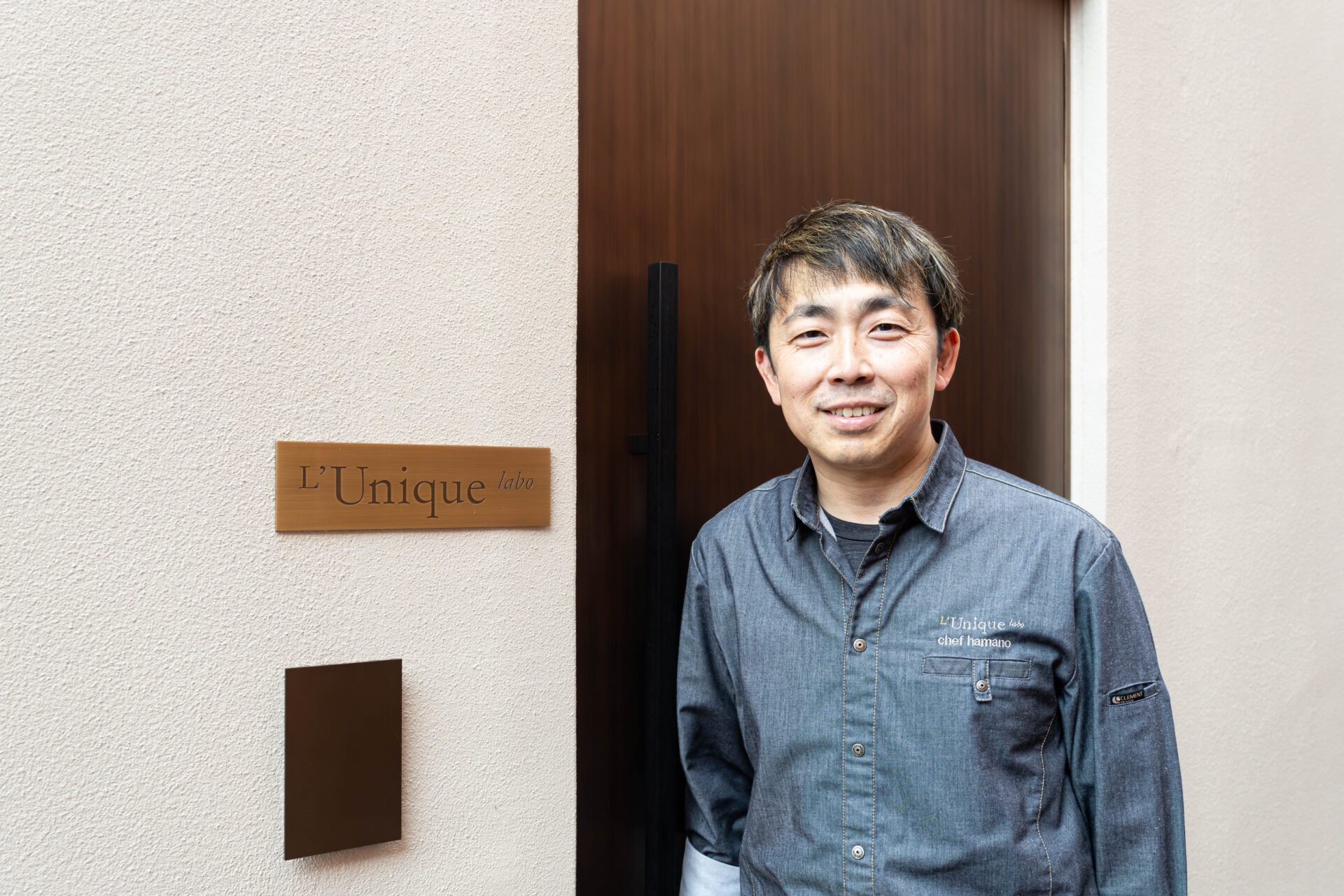
【Chef: Masafumi Hamano】
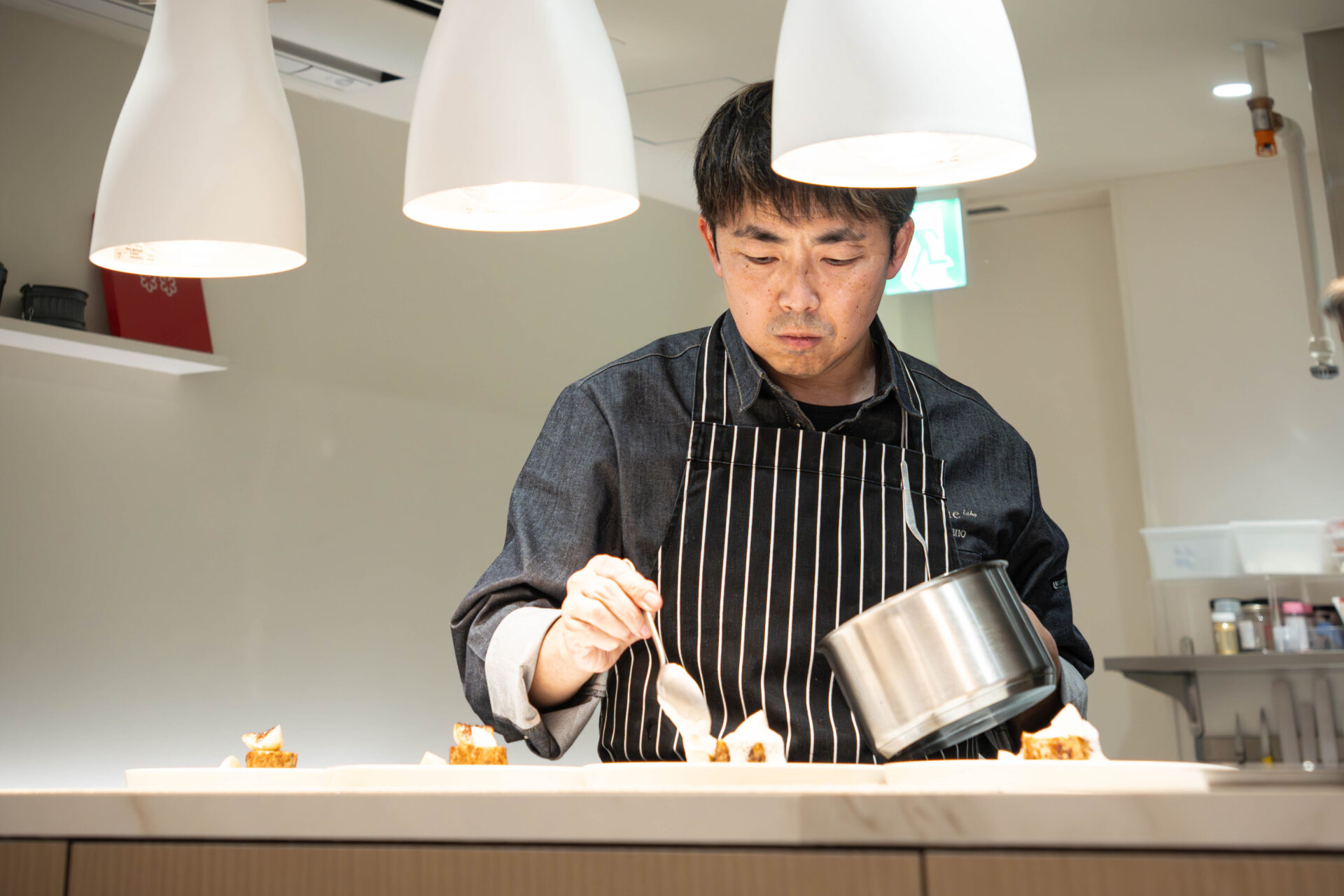
Chef Masafumi Hamano was born to a tomato-farming family in Itoshima, Fukuoka Prefecture.
Growing up in a life closely tied to nature, he developed an instinct for bringing seasonal bounty to the table from an early age.
After graduating from Nakamura Culinary and Confectionery Institute, he spent eight and a half years honing his craft at “La Rochelle” in Tokyo, thoroughly mastering the fundamentals and structural discipline of French cuisine.
In 2004, he moved to France alone, training across Lyon, the Loire Valley, and Burgundy, before opening his own restaurant, “Au 14 Février Saint-Amour-Bellevue,” in Saint-Amour-Bellevue, Burgundy.
That restaurant earned a Michelin star in 2014 and a second star in 2018, drawing significant attention within France itself.
His approach — honoring classic technique while pursuing modern expression through the fragrance of ingredients and structural composition — earned widespread acclaim.
After 20 years in France, he returned to Japan in 2023 and opened “L’Unique labo” along the riverside in Haruyoshi, Fukuoka.
Here, as owner-chef, he directs everything from menu development to kitchen management, spatial design, and ingredient selection.
The restaurant is located within “HOTEL IL PALAZZO,” occupying a renovated former chapel — an otherworldly, stage-like space.
Chef Hamano’s cuisine combines the structural plating discipline he built in France with a genuine appreciation for the natural bounty of Kyushu.
Working from the philosophy of “designing the course backward from the main dish,” he builds the meal’s arc around a balance of fragrance, acidity, and heat control, using fruit, herbs, and edible flowers to draw harmony with the wine.
Rooted in deep respect for Itoshima’s producers and Kyushu’s ingredients, he offers an experience built around “savoring time itself” — this is both the reason he returned to this region, and the very aesthetic that L’Unique labo stands for.
Restaurant Reviews
L’Unique labo was featured in the latest Japanese edition of the globally renowned French restaurant guide “Gault&Millau” — Gault&Millau 2026 (published March 17, 2026, the guide’s 10th Japanese edition) — earning a score of 16/20 and three toques (“an outstanding restaurant” rating). Among the 581 restaurants listed across all 47 prefectures of Japan, this is an unusually swift recognition given the restaurant only opened in September 2025.
As noted above, owner-chef Masafumi Hamano held two Michelin stars for six consecutive years, from 2018 through 2023, at his own restaurant “Au 14 Février Saint-Amour-Bellevue” in Burgundy, France, prior to returning to Japan — a track record that likely contributed significantly to this latest recognition.
Dining Prelude
Exterior & Entrance
Standing along the riverside in Haruyoshi is HOTEL IL PALAZZO.
At one corner of the property, at the end of an approach leading to what was once used as a chapel, L’Unique labo sits quietly.
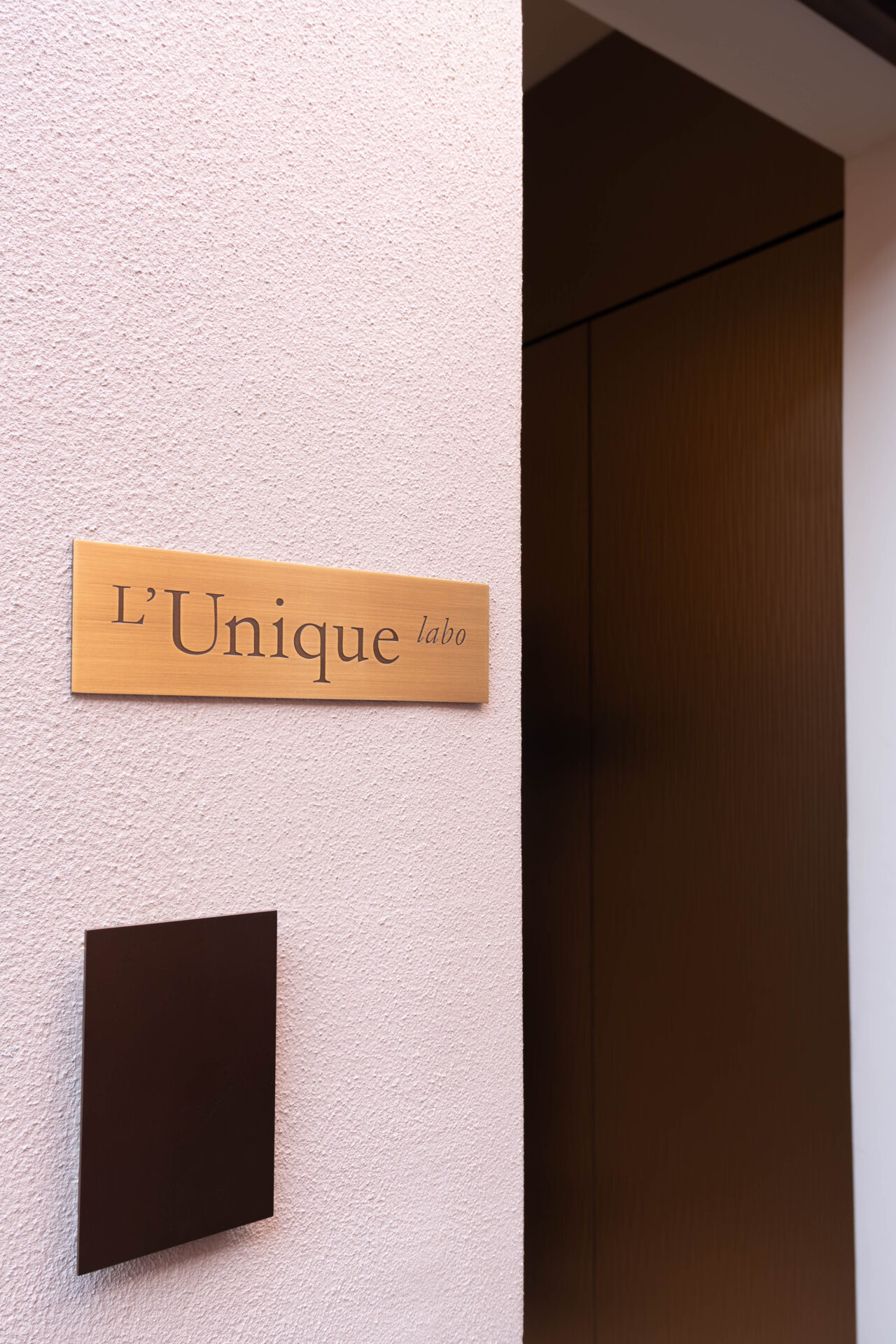
The exterior blends naturally into the hotel’s refined architecture, its presence as a restaurant deliberately understated.
There’s no large signage at the entrance — the atmosphere shifts simply through the play of light and the building’s architectural lines.
As you approach the door, the hotel’s ambient bustle gradually fades away, and a quiet air unique to the restaurant begins to rise.
Soft light filters through the glass, offering only a hazy glimpse of the white and wood tones within.
It carries the impression of “an entrance leading toward a single stage” — with no excessive flourish, yet a sense of tension and anticipation builds naturally even before stepping inside.
Despite its convenient location, the quiet stillness of the entrance hints at the beginning of something special.
Rather than feeling like just another room within the hotel, the atmosphere just outside the door naturally conveys that this is “a place prepared for this space alone.”
The Waiting & Dining Space
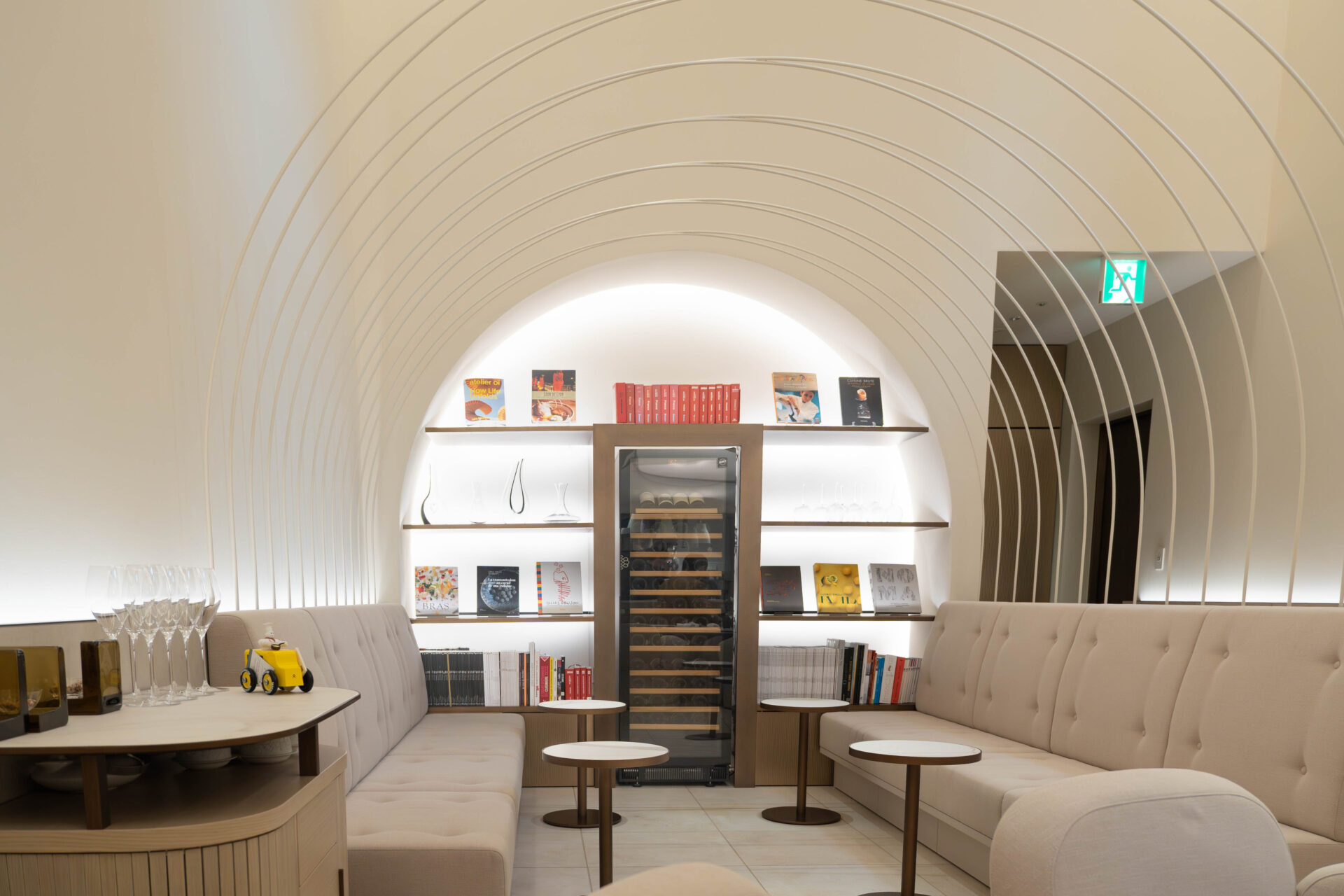
The first thing to greet guests upon opening the door is a waiting space designed with soft, enveloping curves.
Set within a white-toned space, layered archways create the sensation of stepping into a quiet tunnel.
Beyond it, a wine cellar and shelves of culinary books line the space, giving it the feel less of a restaurant and more of “a small study filled with art books.”
Even the time spent waiting for a table to be ready feels deliberately designed here, functioning as a genuine prologue to the course ahead.
【A Bite While Waiting】
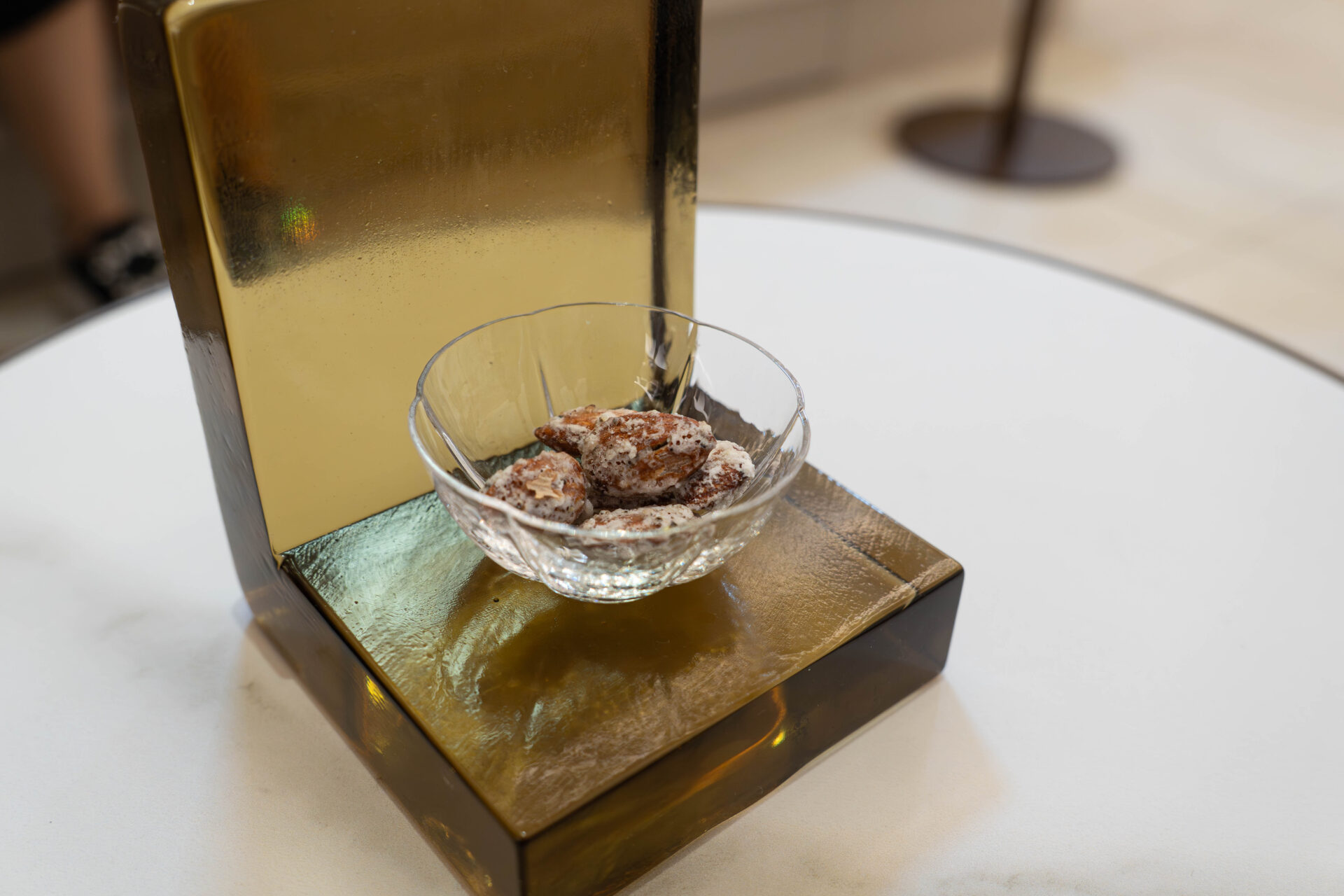
Before being shown to the table, a small almond confection is quietly served in the waiting space.
Just a small portion in a glass vessel — its modest quantity feels exactly right, a gentle “overture” that doesn’t distract from the focus that follows in the course ahead.
Coated in a light sugar shell, the almonds carry a subtle sweetness that gently resets the palate.
At this moment, staff quietly ask, “Would you care for something to drink?”
There’s no sense of pushing the suggestion — it simply follows the guest’s own rhythm.
It’s clear the waiting time isn’t treated as mere “waiting,” but as a brief runway to help guests settle into the restaurant’s atmosphere.
This small exchange and single bite of confection quietly settle whatever air guests carried in from outside,
naturally preparing the mind for the course about to begin.
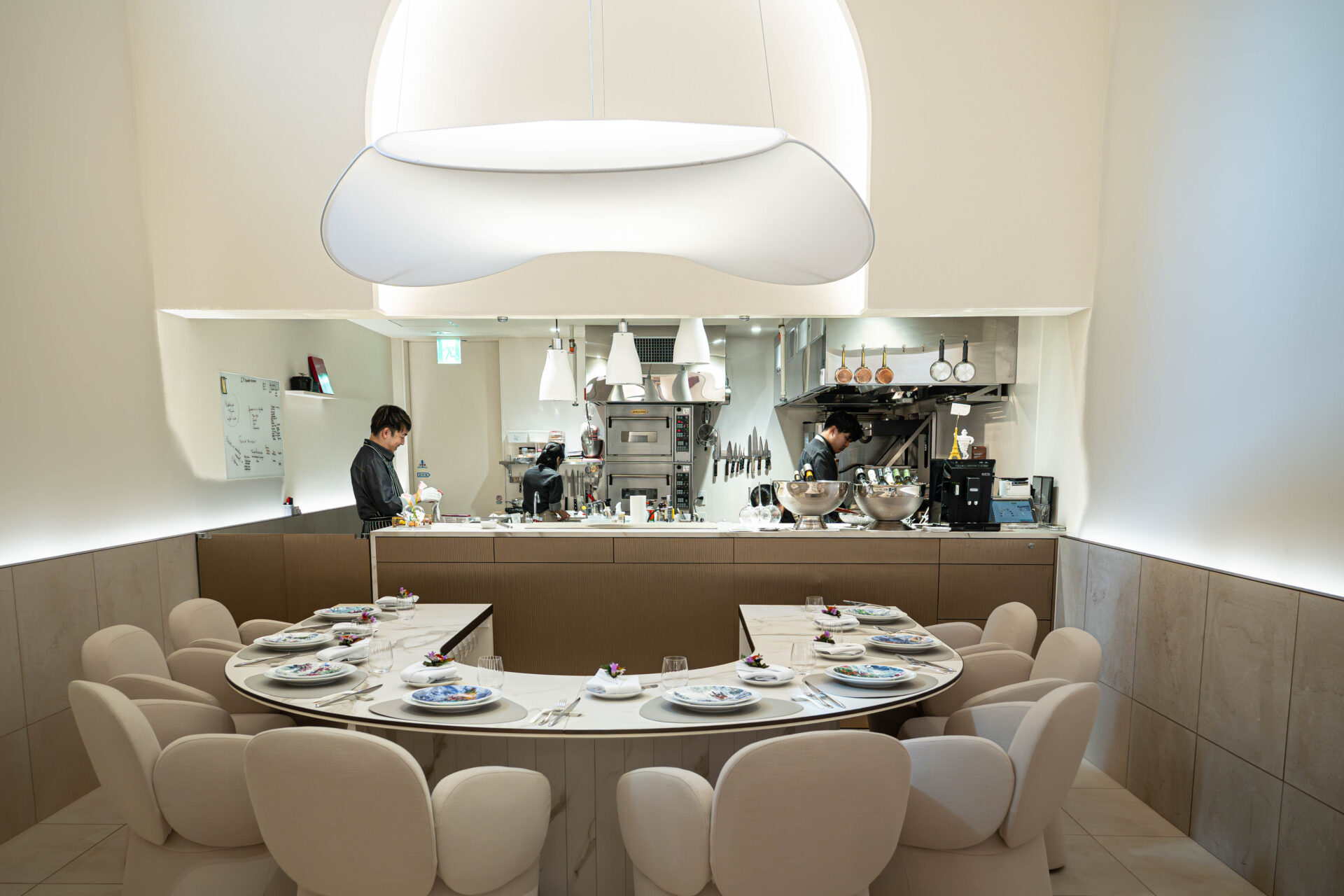
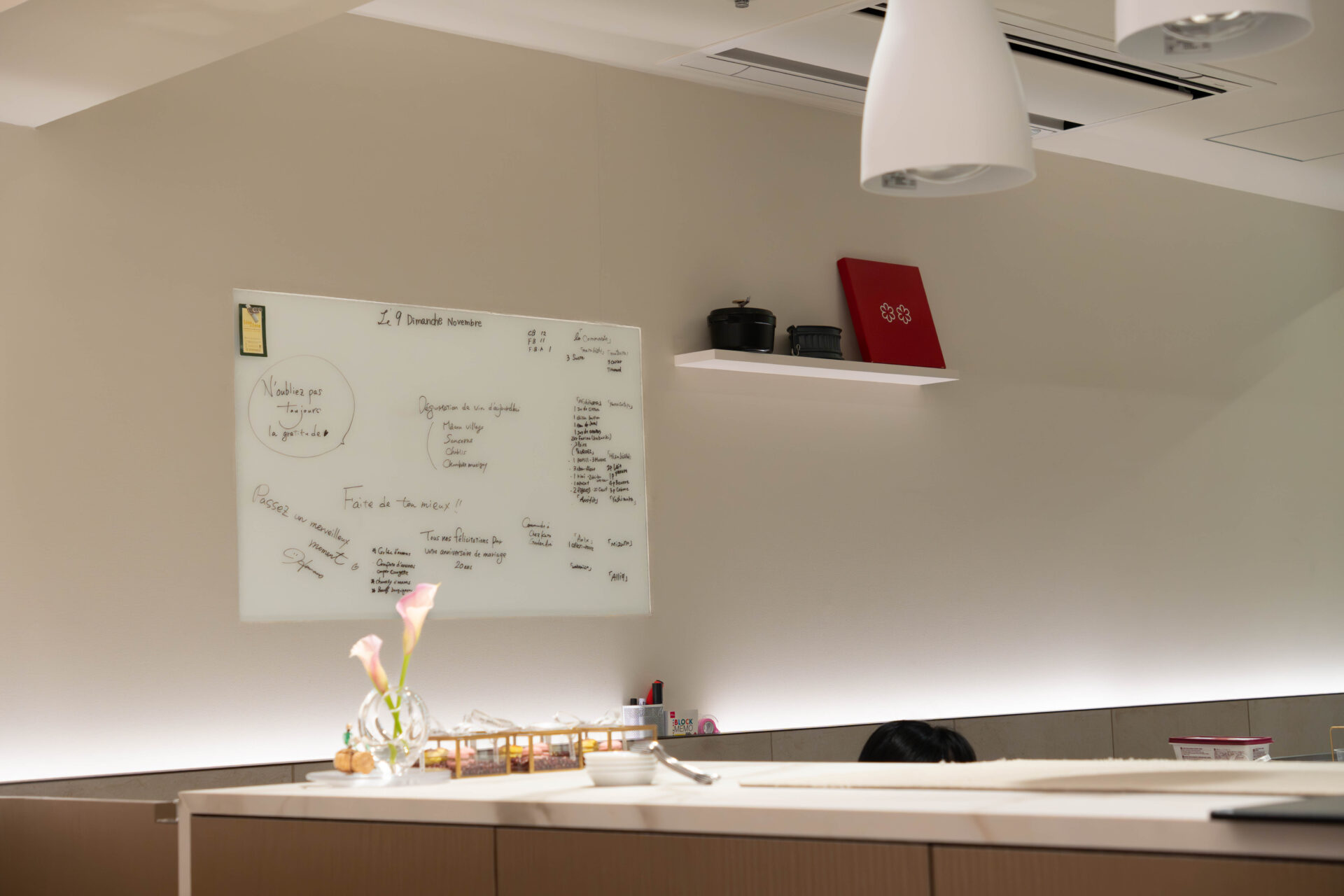
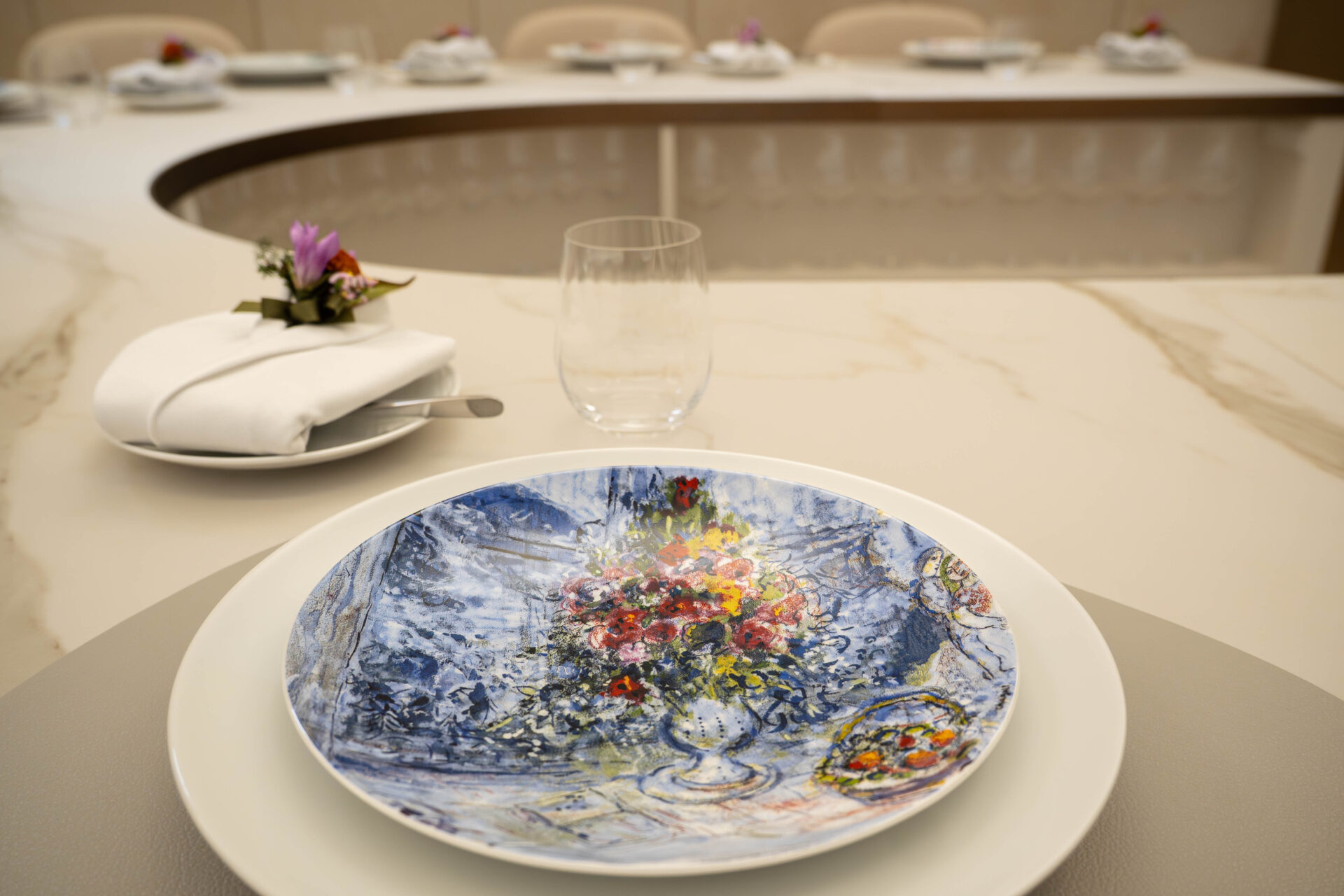
The dining room is built around an eight-seat counter that curves gently toward the kitchen.
A large light fixture floats overhead at the center, beneath which dishes are quietly assembled.
The distance between guests and kitchen is remarkably close, letting the fragrance of ingredients, the sound of the moment they hit the heat, and the temperature of each plate reach guests directly.
It feels less like an “open kitchen” and more like a small theater where the boundary between stage wings and audience blurs entirely.
Comfortable chairs are arranged in a circle, with all eight seats facing the same direction,
allowing every guest to experience the flow of the meal with the same intensity.
Lighting reflects only softly off ceiling and walls — there’s no flashy staging.
Instead, everything is calculated so that the color and fragrance of each dish naturally emerges the moment it’s set down.
The transition from waiting area to dining room is remarkably smooth, and by the time guests are seated, the outside air has already quietly fallen away.
The intention that “this is not just a place to eat, but a device designed to begin an experience” comes through quietly from every corner of the space.
The Menu Experience
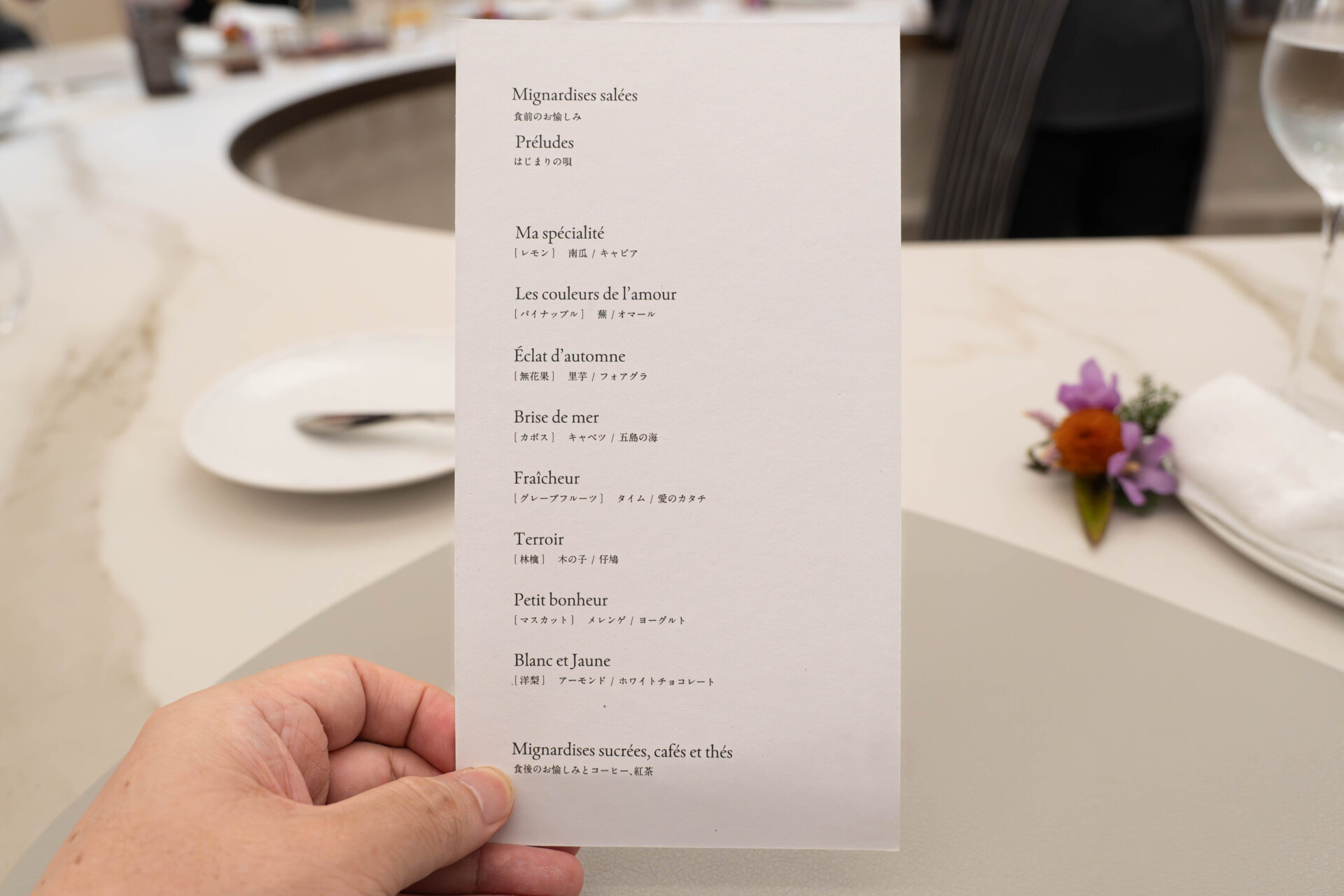
L’Unique labo’s menu is accompanied by a single illustration by Chihiro Miyata, a painter living in Itoshima.
A new piece is commissioned every two months, matched to the season’s evolving course.
The landscape of Itoshima, framed within a window-like arch, quietly symbolizes the restaurant’s worldview — the moment you pick it up, it already hints at the beginning of the course to come.
A distinctive feature of the cuisine here is that every single dish incorporates fruit.
This is Chef Hamano’s own signature approach, built around “fragrance,” “the balance of acidity and sweetness,” and “connection with the wine” — fruit functions as the key that ties the whole dish together without disrupting the natural character of the ingredients themselves.
From amuse-bouche to appetizer, fish, meat, and dessert, the way fruit is incorporated shifts from dish to dish.
Juice adds fragrance, purée adjusts texture, and pairing with skin or herbs shapes the lingering finish — each addition has a clear purpose, and as the course progresses, that shifting “role” gradually becomes apparent.
The menu changes hand in hand with Miyata’s artwork, both refreshed every two months.
This shared rhythm between the visual and the culinary, both renewing together with the seasons, is one of the restaurant’s most distinctive charms.
The Dishes
【Mignardises salées: A Pre-Meal Delight】
The course opened not with a single small dish, but with a set of mignardises bringing together several distinct elements.
Each with its own direction in flavor and aroma, together they served as a proper introduction into the world of Chef Hamano’s cuisine.
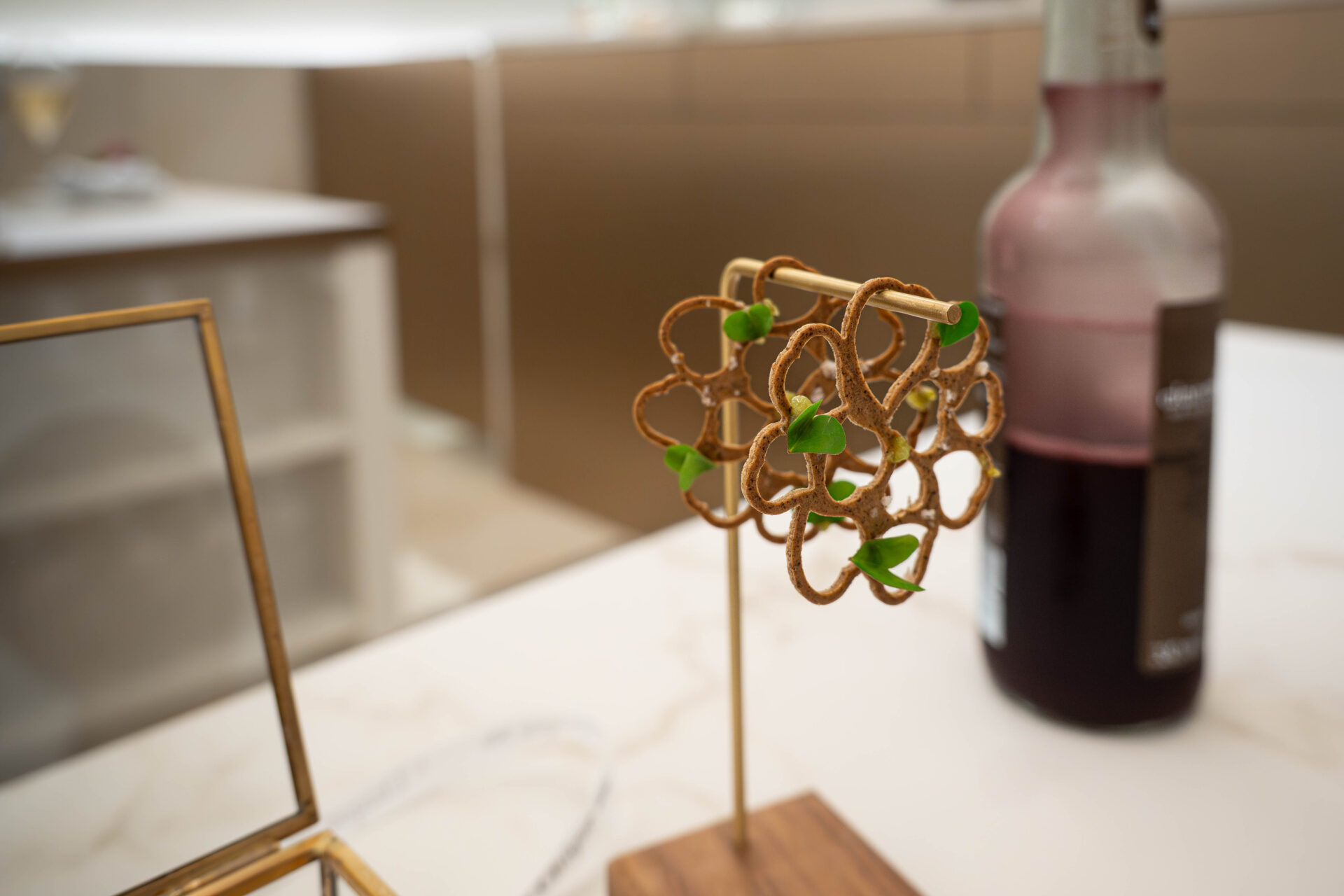
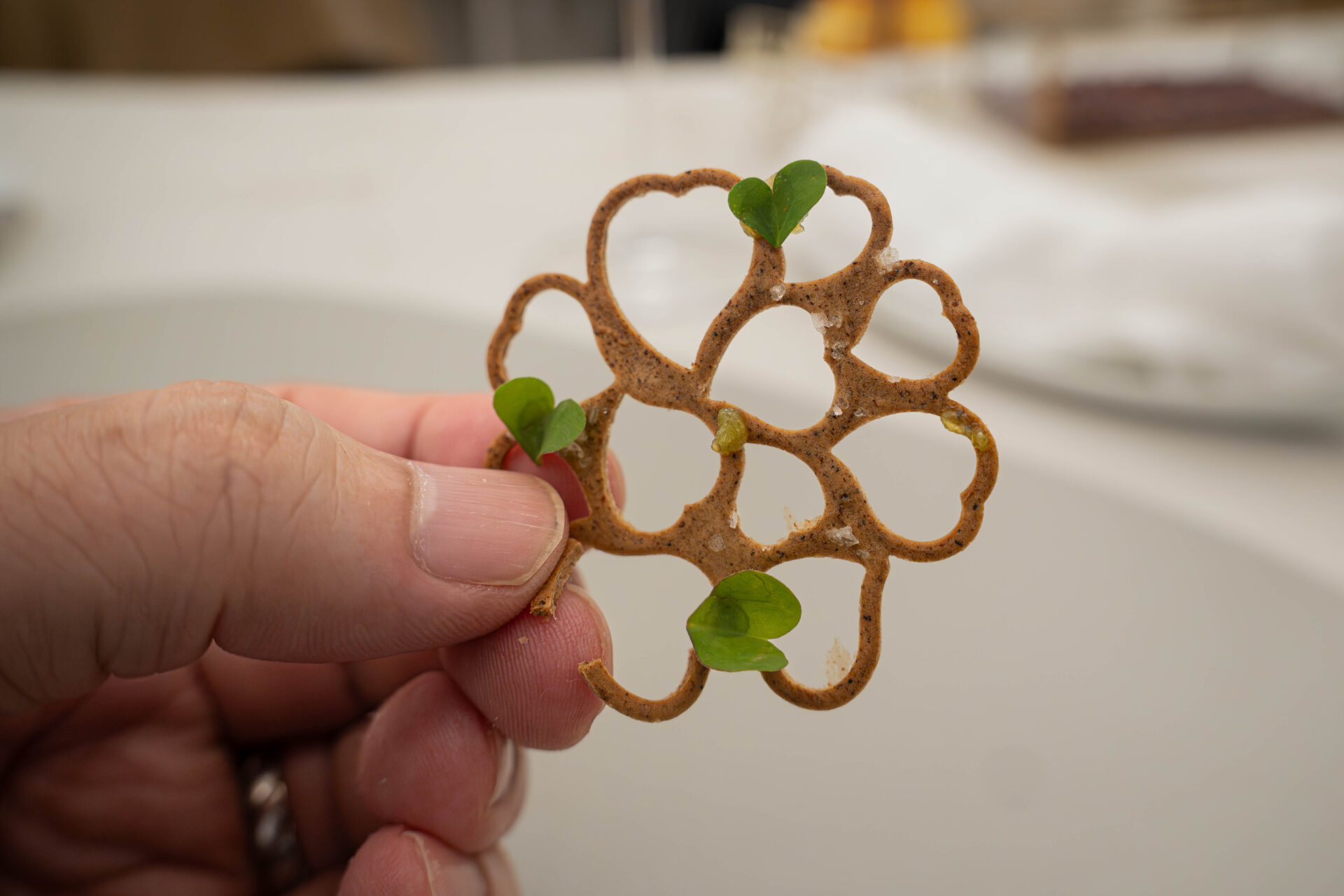
Porcini Baked Confection
The first item was a lightly fragrant porcini baked confection.
Restrained in sweetness, it let the mushroom’s aroma rise quietly.
An unexpected choice to open with a baked good, yet it carried the light touch fitting for the start of the course.
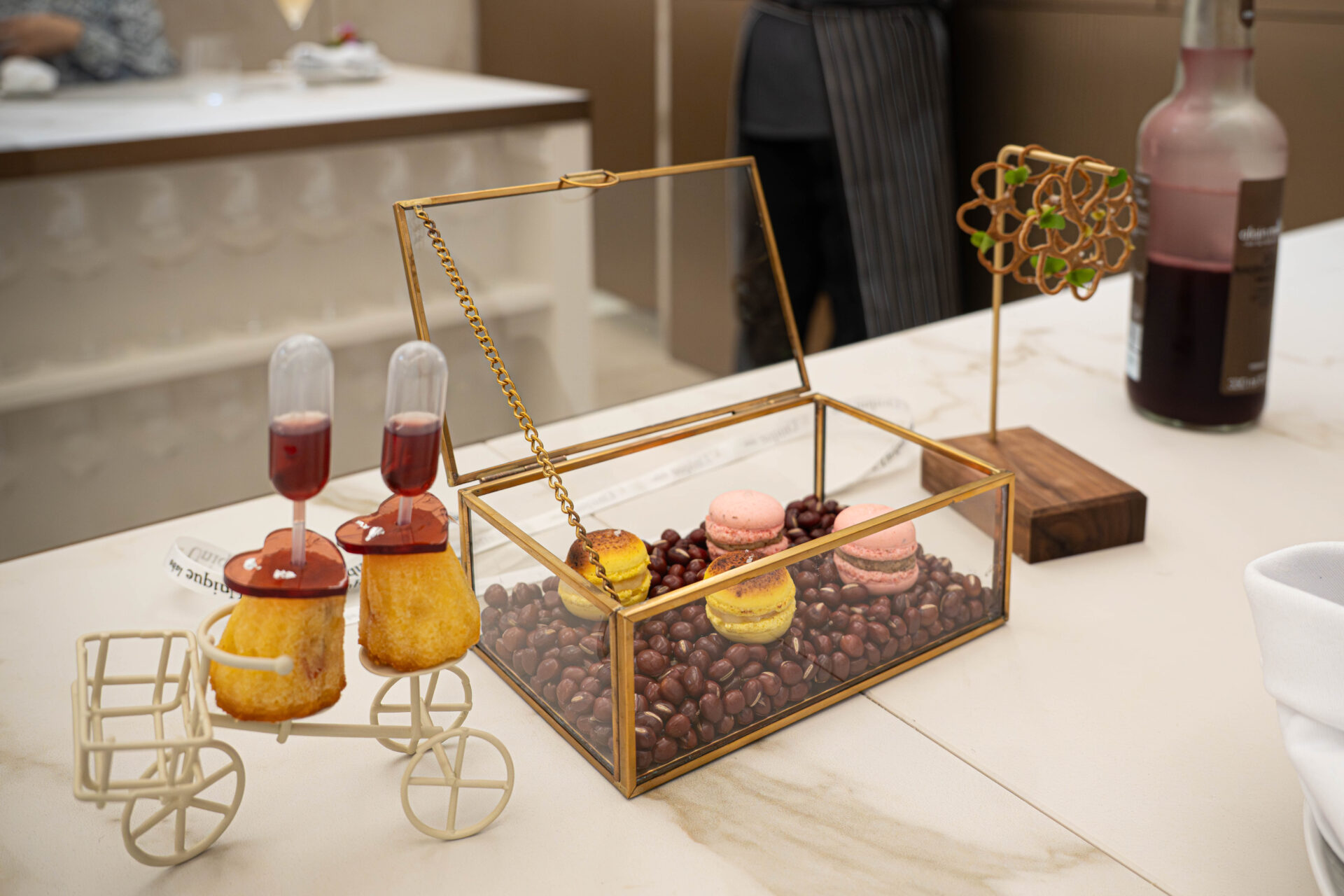
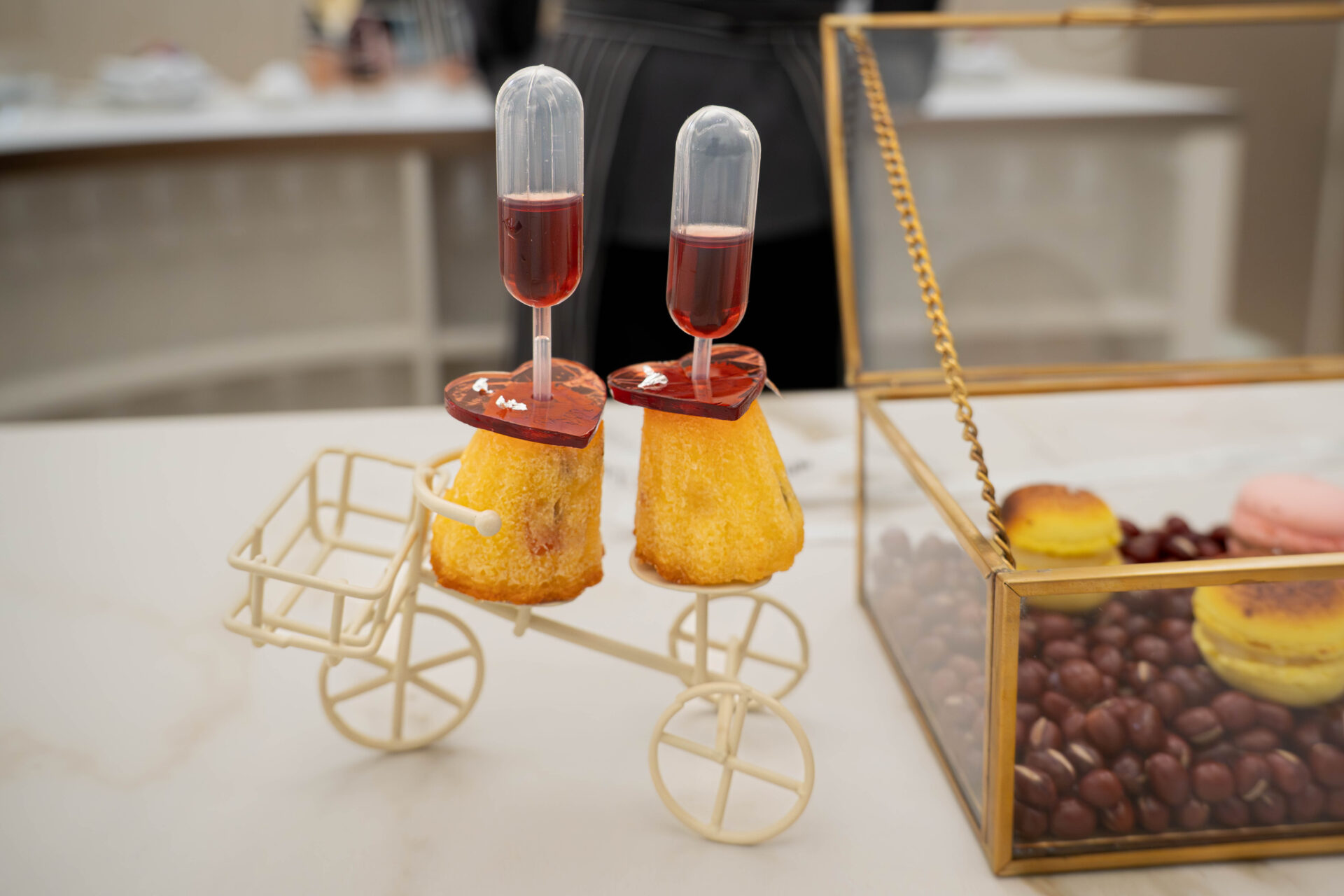
Olive and Prosciutto Madeleine × Grape Juice
A madeleine arrived riding atop a tiny bicycle-shaped stand.
A clear dropper was inserted on top, filled with grape juice.
We were instructed: “First take the whole madeleine into your mouth, then press down on the dropper.”
The madeleine’s warm salinity spread alongside the sweet-tart burst of grape,
creating within a single bite less the nuance of “an appetizer” than of “a beginning.”
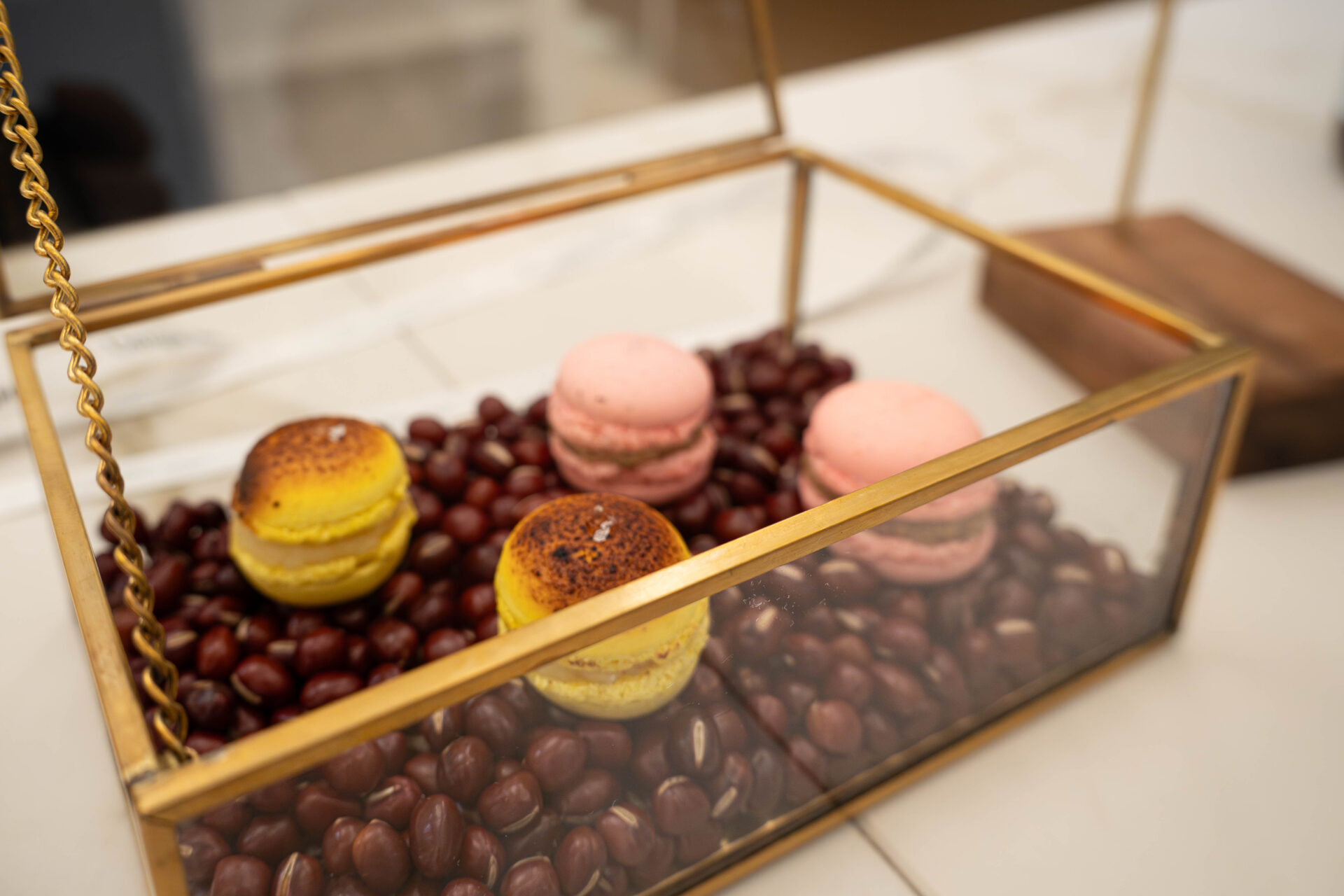
Two Macarons
Two macarons displayed atop a bed of red beans in a glass case.
1. Yellow (curry × pecorino)
We were guided to try this one first.
The spice of curry comes through fragrantly, meshing well with pecorino’s salinity.
Restrained in sweetness, it pairs surprisingly well with wine or an acidic drink.
2. Pink (rose flavor × Itoshima pork rillettes)
It looks like a completely sweet confection, but inside is Itoshima pork rillettes.
The rose’s floral fragrance and the pork’s umami quietly coexist in one bite,
and it’s here that the intent behind the “salées” (savory mignardises) finally clicks into place.
Salt, sweetness, spice, fragrance.
Elements pointing in completely different directions arrived one after another, yet the balance never grew heavy — handled with real skill.
As a small collection of confections, it functioned beautifully as an introduction to the course’s central themes: “fragrance,” “gradation,” and “the handling of fruit.”
【Préludes: The Early Moments (Three Amuse-Bouches)】
After the mignardises loosened the senses,
the following “early moments” section was built around three amuse-bouches, each pointing in a different direction.
Though each was small in size, the fragrance, temperature, and texture were all clearly defined,
and here the course’s underlying theme — “a gradation built around fruit” — suddenly took on real shape.
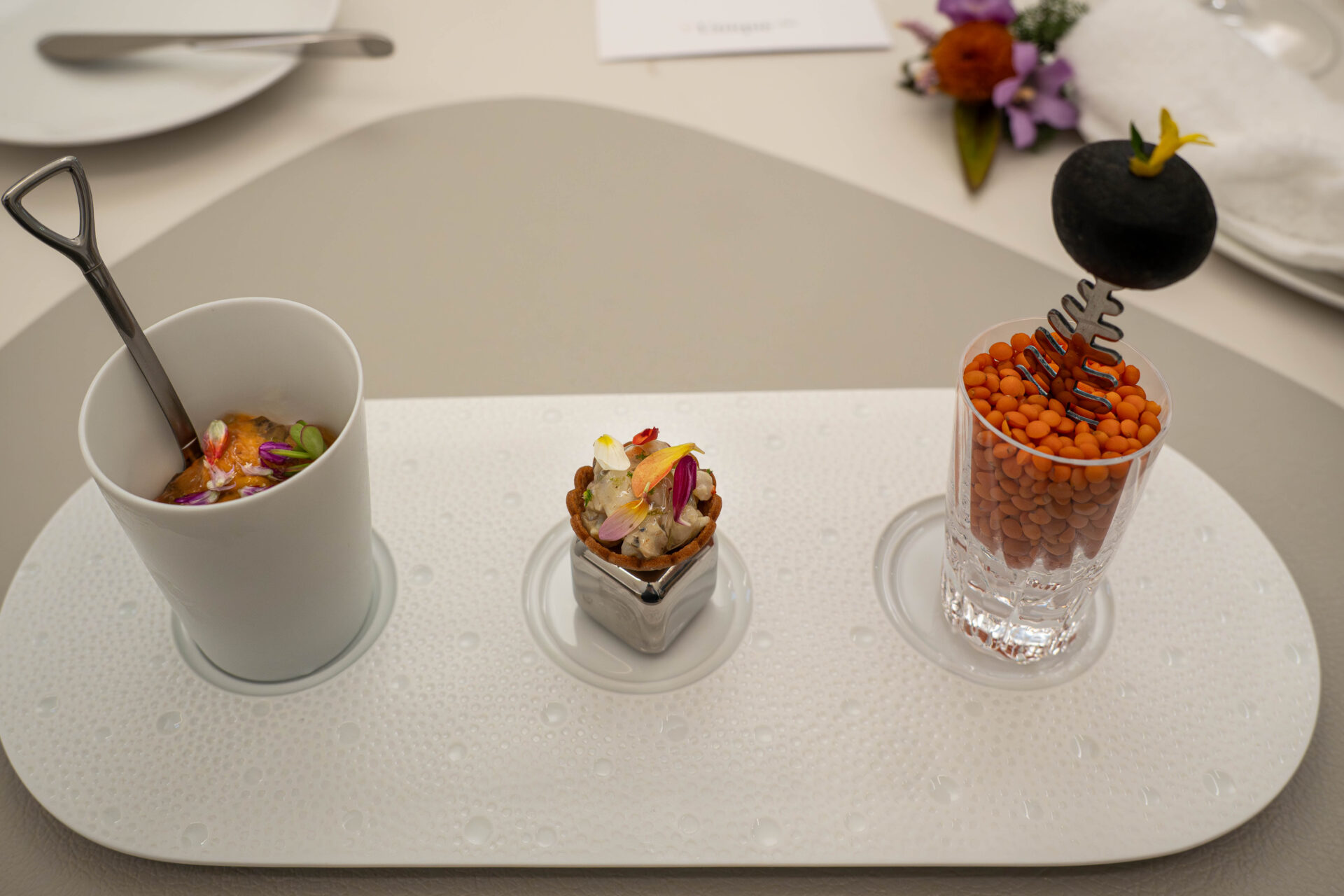
Miyazaki Bamboo Charcoal “Corn Dog”
Its round black exterior looks sleek and understated, but the first bite reveals
a purée of wild grouper from Goto inside.
Within its moist texture, the fish’s umami spreads quietly.
The fruit paired here is orange.
In contrast to its weighty exterior, the first impression of fragrance leaps up lightly,
playing the role of unlocking the fish’s umami rather than sealing it too tightly.
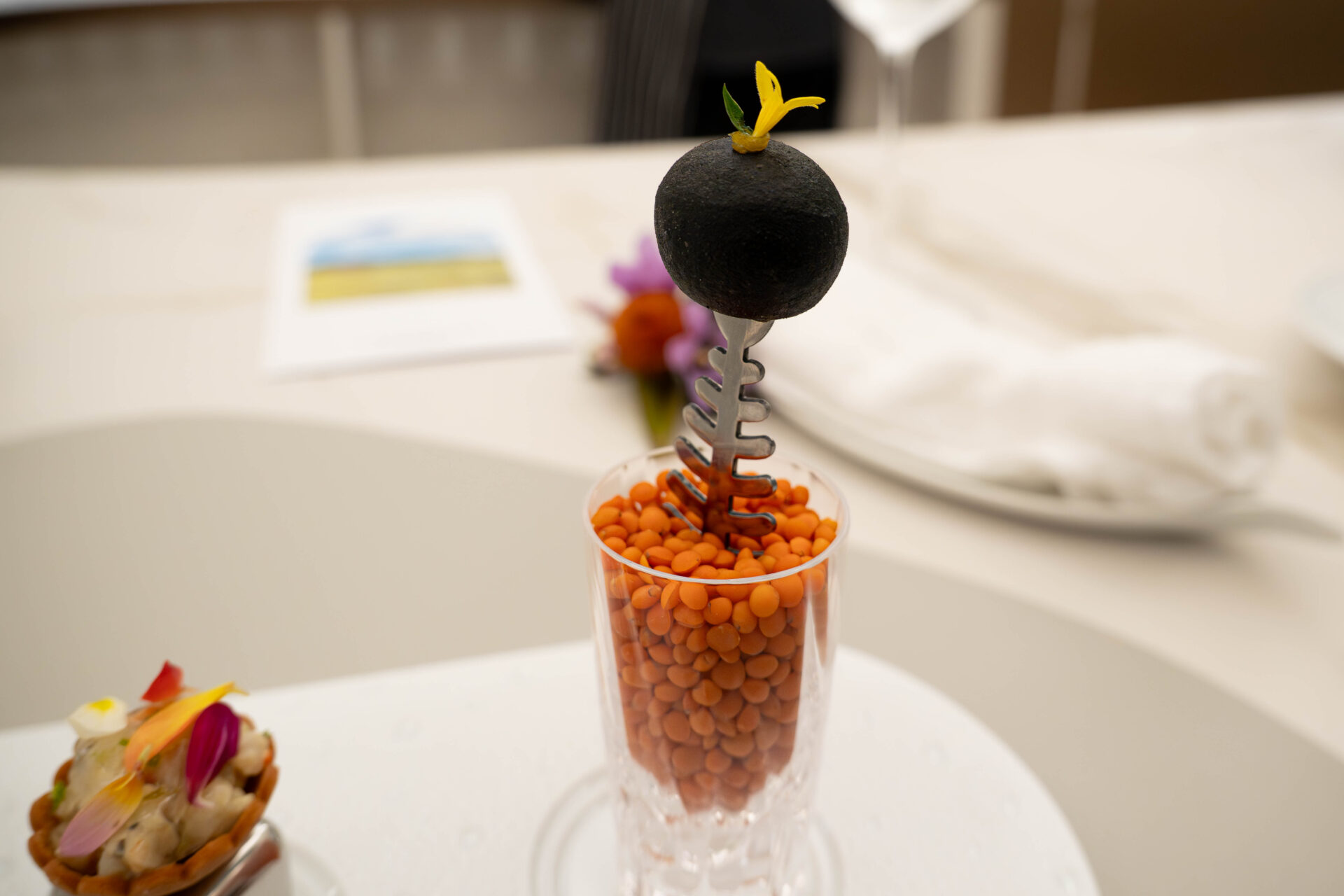
Kuruma Prawn and Avocado Tartlet
A tiny tart shell layered with kuruma prawn and avocado,
topped with scattered flower petals for color.
Paired with the tart’s toastiness is lime.
It brings out the prawn’s sweetness while giving the avocado’s mellowness a sharper outline,
resulting in a beautifully organized flow of temperature and fragrance within a single bite.
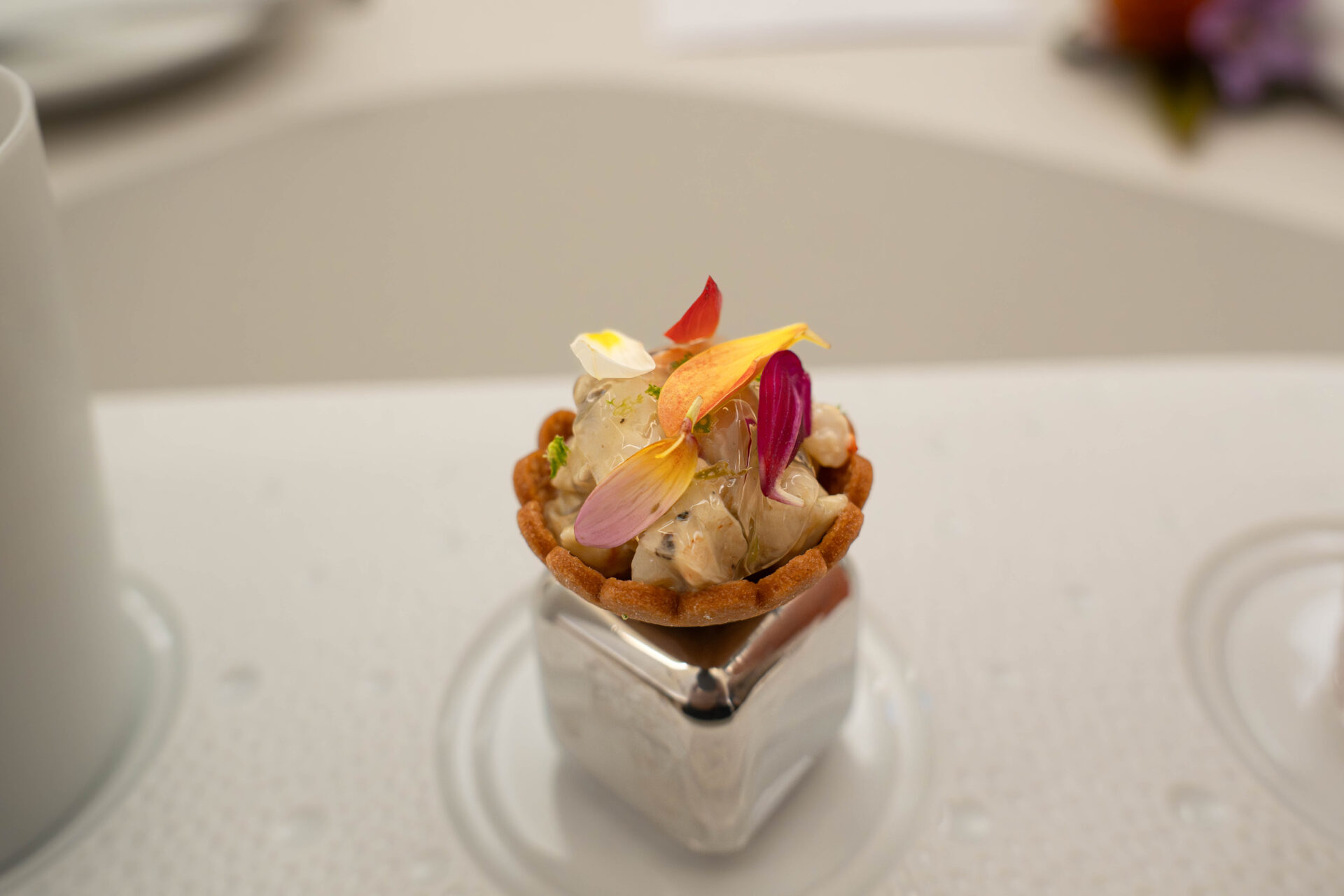
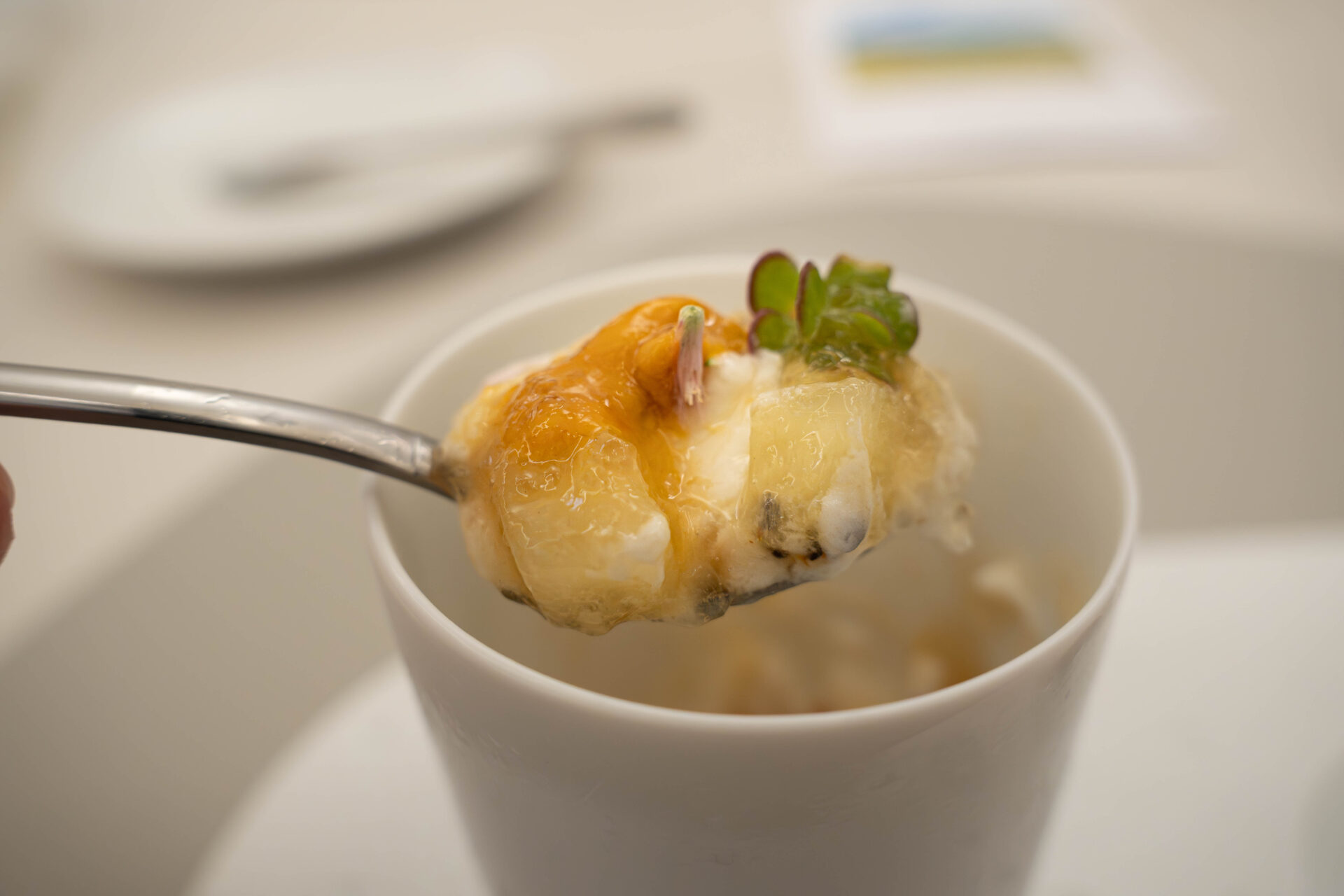
Celeriac Mousse
Scooped into a white vessel was a soft, airy celeriac mousse.
Hidden within were fried celeriac, prosciutto, and sea urchin,
all wrapped in a clear jelly made purely from vegetable dashi.
Here, golden kiwi serves as the accent.
The kiwi’s gentle acidity
ties together the celeriac’s earthy sweetness, the prosciutto’s salinity, and the sea urchin’s density,
bringing the dish into a single, unified direction.
What all three dishes shared was that the fruit never overasserted itself,
quietly steering only the “direction” of the fragrance and acidity.
Chef Hamano’s stated concept — “connecting flavor through fruit” — came through clearly in this opening set of amuse-bouches.
【Ma spécialité: Chef’s Specialty】
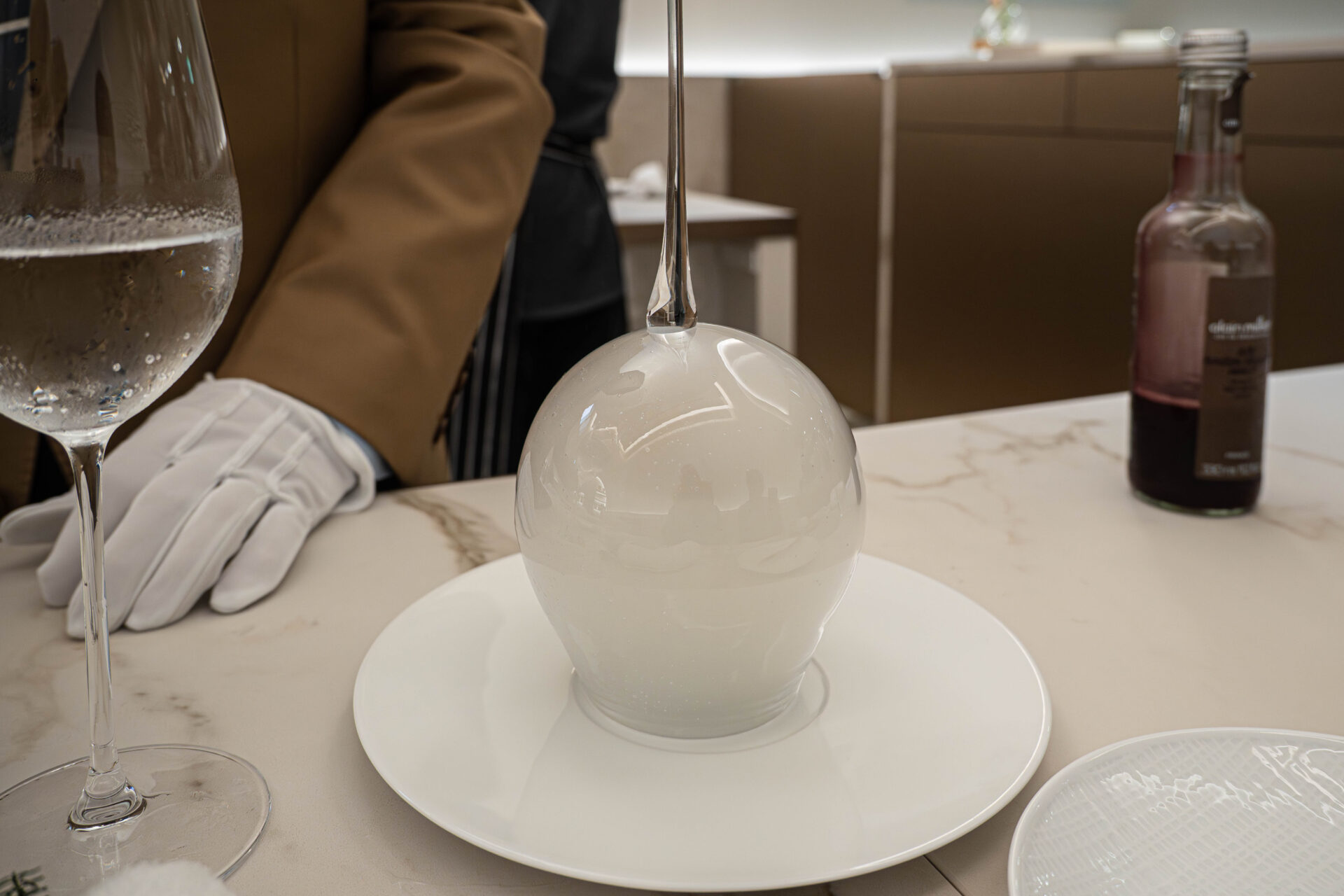
This dish opened with smoke drifting inside a glass dome,
a memorable presentation of layered fragrance and texture that felt like a symbol of Chef Hamano’s cuisine right now.
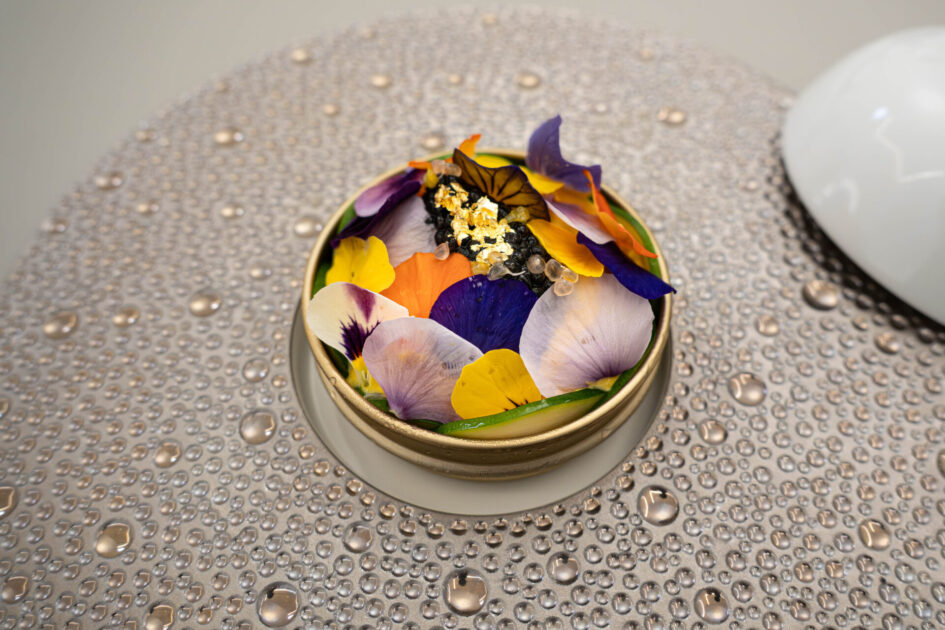
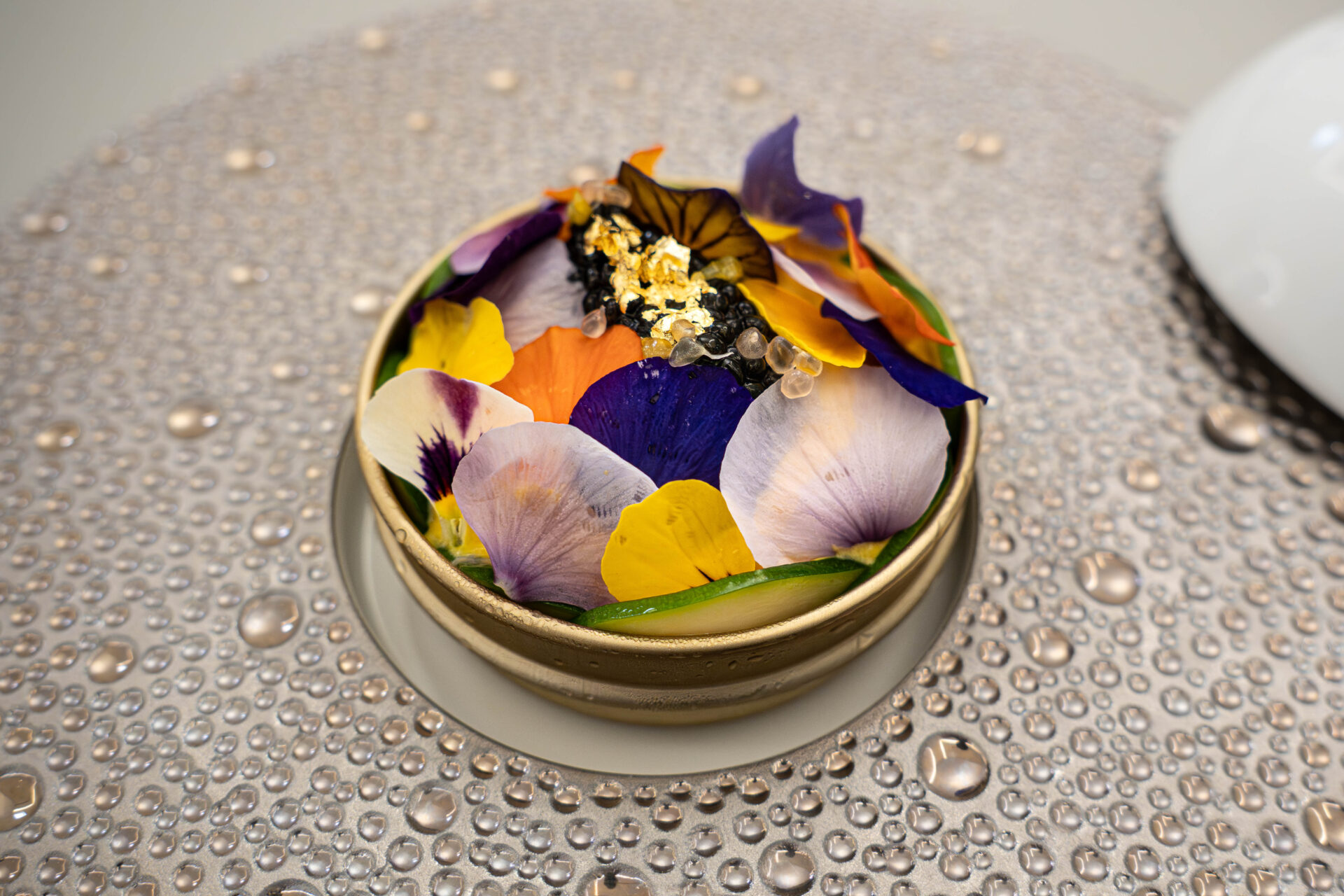
When the dome was lifted, a dish covered in vivid flower petals appeared.
At the center sat white caviar, topped with gold leaf and a lemon sauce.
Scattered further with finger lime flesh, adding a delicate acidity layered atop the caviar’s salinity.
Beneath the flowers lay a smooth pumpkin mousse.
And at the very bottom,
snow crab and napa cabbage, gently steamed, quietly grounded the dish,
supporting the fragrant flourish above with real oceanic depth.
Surrounding it all were thin slices of zucchini,
their gentle texture softly rounding out the shape of the whole dish.
Accompanying this dish was
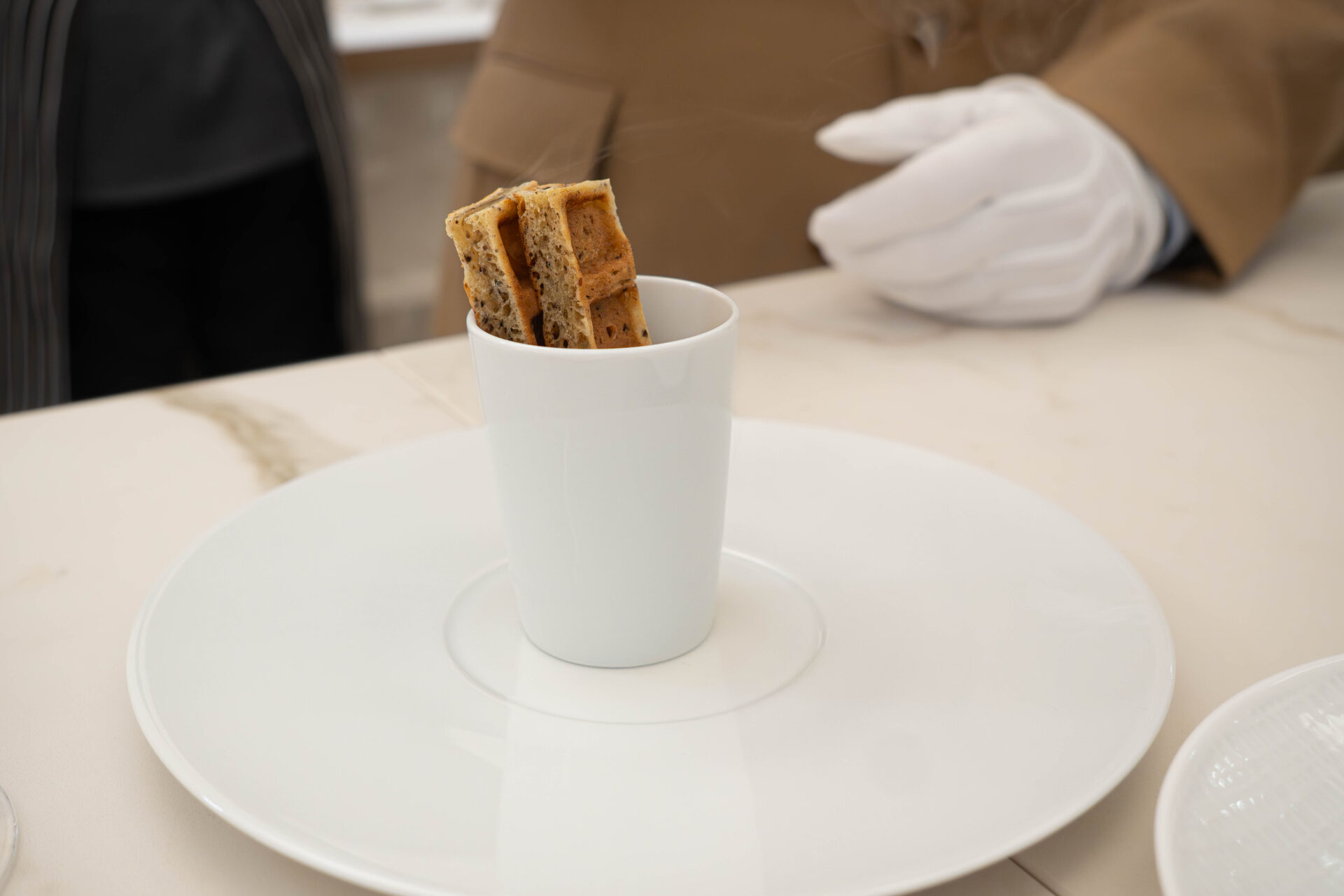
house-made smoked waffle.
Jack Daniel’s barrel chips are smoked right at the table,
the rising sweet smoke lightly settling onto the waffle.
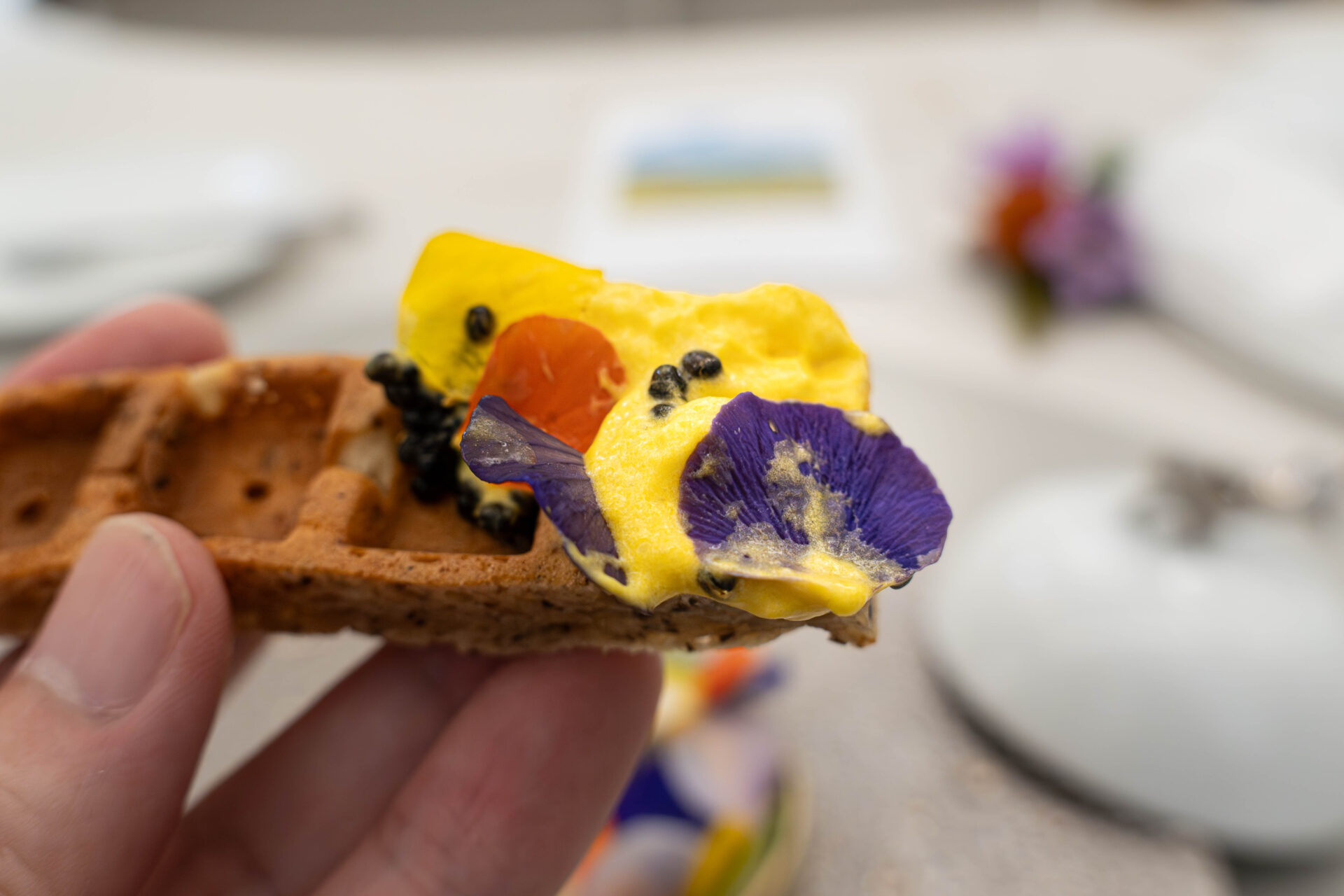
Taking a little of the caviar and mousse onto the waffle,
a brief hint of smoke rises,
then salinity, acidity, and sweetness merge into one and gently fade away.
Layers of fragrance, shifting temperature, the lightness of the petals, the umami of the sea.
None of it overasserted itself,
and this dish carried real conviction as a “specialty.”
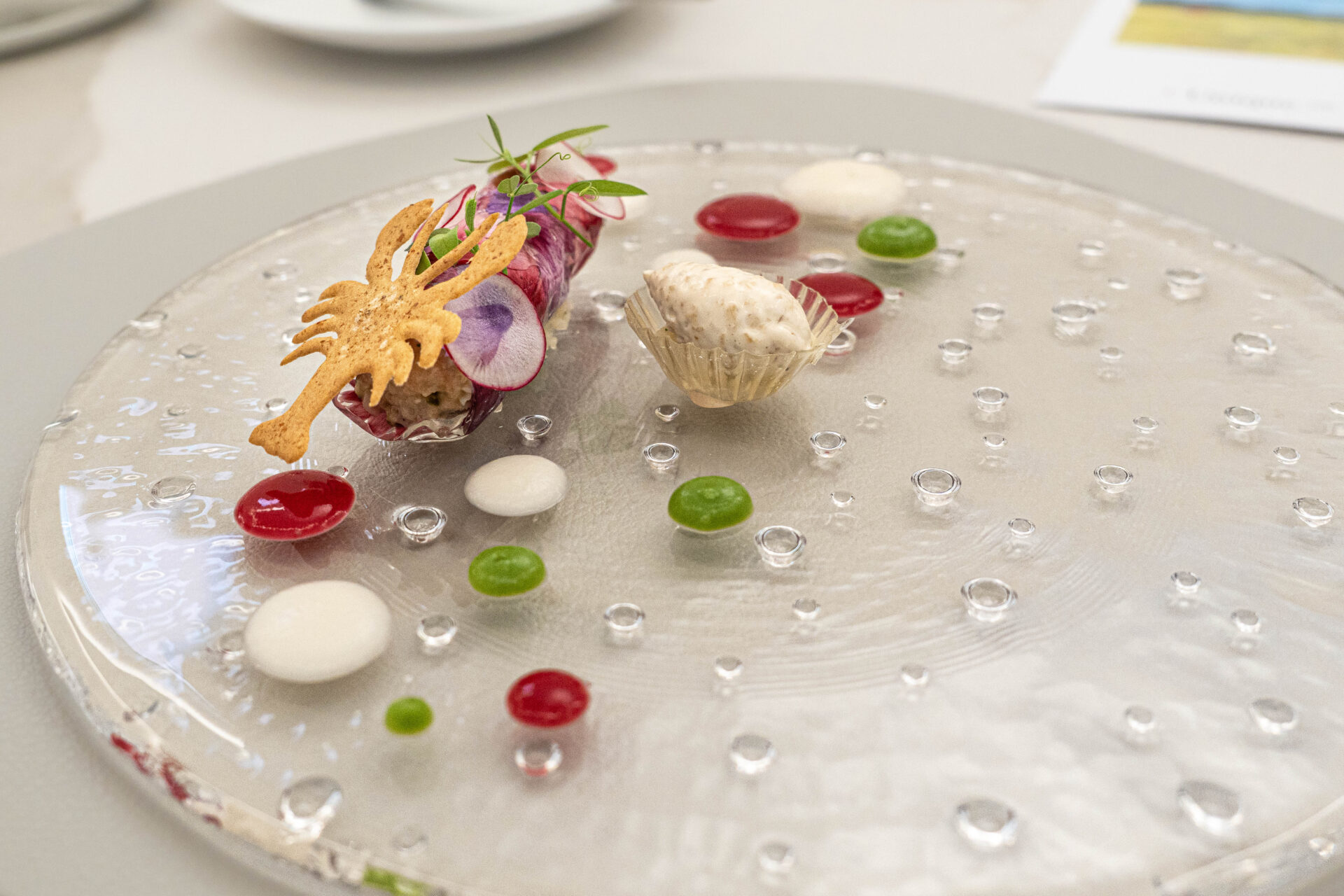
【Les couleurs de l’amour: Pineapple × Lobster × Salmon】
Water-droplet patterns scattered across a clear glass plate,
and the color contrast placed atop it was strikingly vivid.
True to its name, this dish speaks through “color,” yet the composition itself is remarkably rational,
with a clear throughline in flavor.
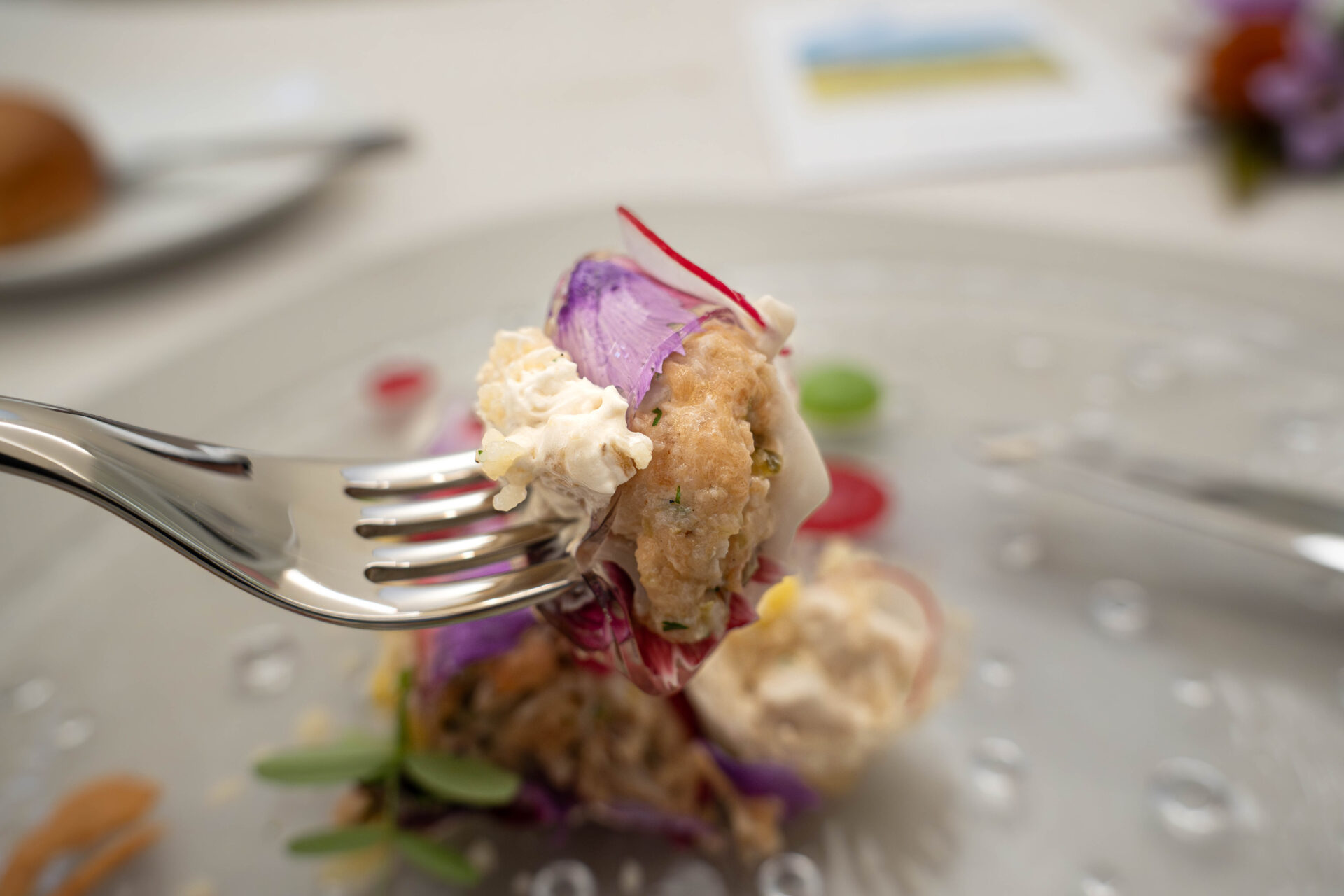
Brittany Lobster and Miyazaki Nishimera Salmon Tartare
The centerpiece is a rod-shaped element: lobster and Nishimera salmon, finely chopped
and combined with aromatic vegetables into a tartare.
Rich in umami but never heavy with fat,
it achieves a natural unity where “sea” and “river” seem to blend seamlessly together.
Wrapped in Pineapple Gelée and Flower Petals
The tartare is wrapped in a sheet of pineapple gelée,
scattered with flower petals on the outside.
The fruit gives the first impression of fragrance a light lift,
after which the lobster’s density gradually rises up.
Pineapple-Scented Cream and Couscous
Served alongside is a pineapple-scented cream,
rounding out the tartare’s texture and fragrance.
The fine grain of the couscous lightens the rhythm of the whole dish.
Three Sauces
- Red: Beet
- Green: Broccoli
- White: Turnip
Beyond color, each carries its own subtlety and direction of aroma,
designed to let guests choose which direction to pull
the pineapple’s acidity and the tartare’s umami toward.
This was a dish where “beauty” and “charm” both rose up at first glance.
The layering of colors is delicate, yet there’s a playful spirit woven throughout,
the sway of petals and gelée feeling more like a small art piece than a dish.
Never pulled off course by its visual flourish,
the flavor composition remained genuinely coherent —
a dish that draws you in with its looks and satisfies you upon tasting.
【Éclat d’automne: Foie Gras and Taro, a Warm Appetizer】
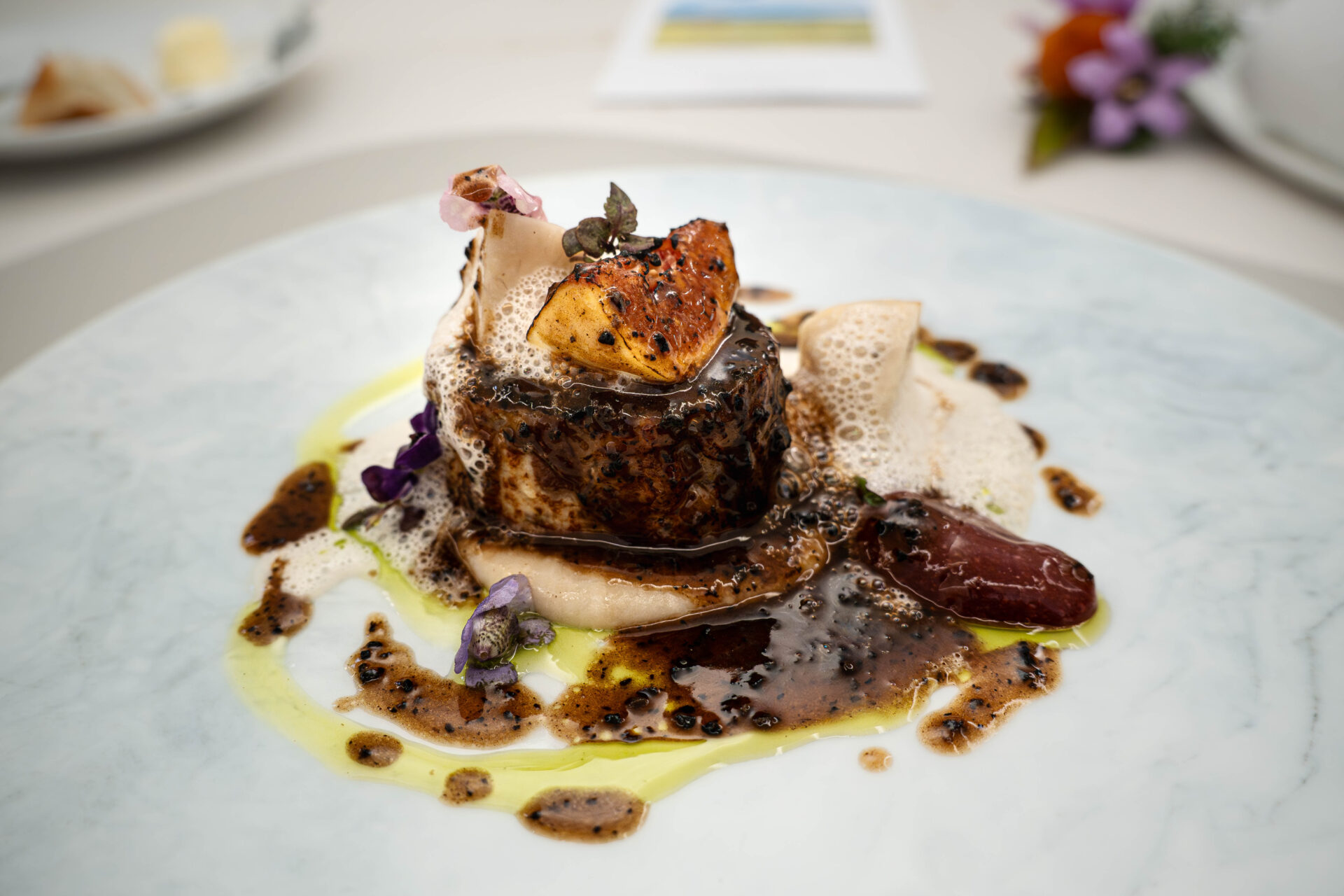
A dish carrying a gentle, autumnal fragrance and a rich depth of flavor.
At the center of the plate sits a beautifully seared foie gras.
Beneath it lies a warm cream sauce infused with the umami of Amakusa guinea fowl, alongside a smooth taro purée.
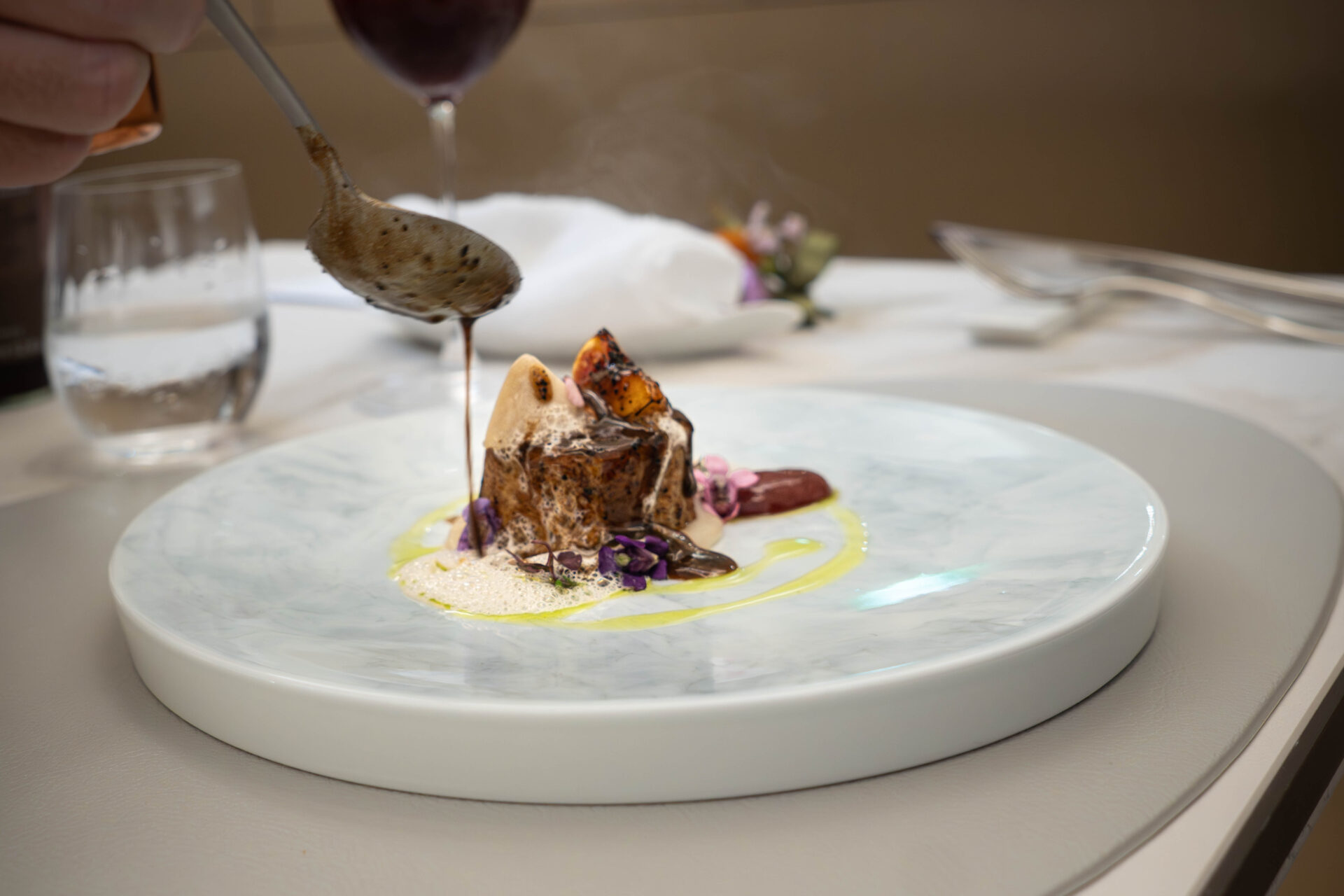
Rather than letting the foie gras’s richness stand alone,
the dish is balanced by the taro’s sweetness and the cream’s light umami.
Some of the taro is also simmered in white port,
its subtle sweetness and fragrance adding depth to the dish.
As an accent, a red-wine-stewed fig from Fukuoka.
Its soft acidity and deep sweetness naturally complement the richness of the foie gras.
A single drop of fig-leaf oil
sharpens the fragrance’s outline, bringing the whole dish into a settled, composed tone.
A foie gras appetizer that never felt heavy.
Rather than simply depicting ingredient pairing at face value,
this dish felt like autumn itself, built through layers of temperature and fragrance.
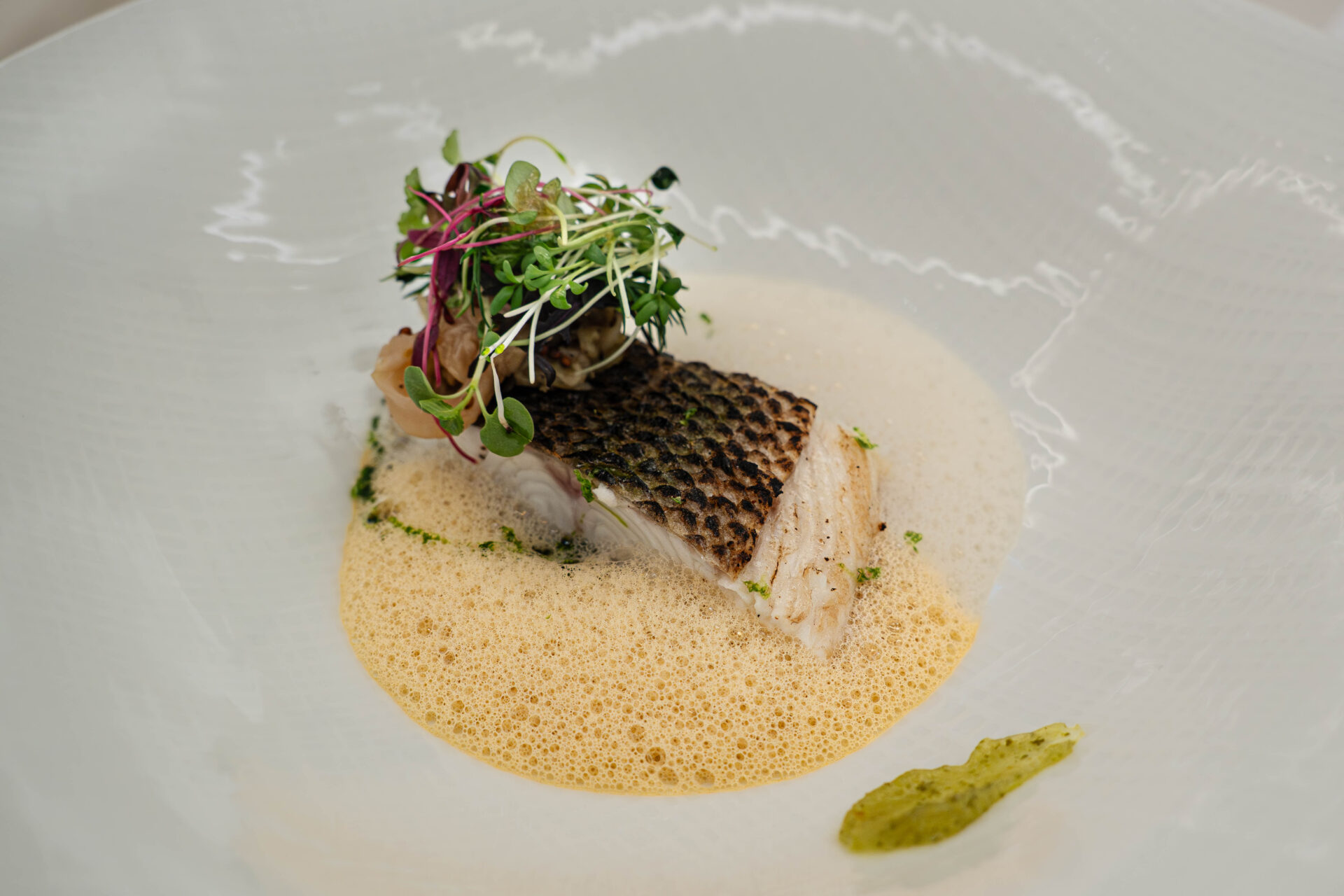
【Brise de mer: Goto Hirasuzuki and Cabbage, A Note of Sea Breeze】
A dish carrying the clean fragrance of the Goto seas.
Hirasuzuki (largescale blackfish) arrives with a fragrant, seared skin and moist, gently cooked flesh,
its softness spreading beautifully with the first bite.
Beneath the fish is a cabbage purée, gently receiving its umami.
Layered on top are marinated cabbage
and Itoshima herbs, arranged lightly.
The dish builds the natural sweetness and fragrance of its ingredients in careful layers.
Two sauces accompany the dish.
- Sauce Américaine (a deep umami drawn from the toasty character of shrimp and crab shells)
- Beurre Blanc (rounding out the finish with the gentle richness of butter)
The point where the two sauces meet shifts the intensity of flavor,
drawing out the delicate fat of the hirasuzuki.
A kabosu paste at the edge of the plate
acts almost like a small outline, sharpening the fragrance.
Mixed lightly into a single bite,
it instantly lightens the overlap of sea and butter.
Quiet, yet a fish dish that let the fragrance of the sea and a sense of negative space come through clearly.
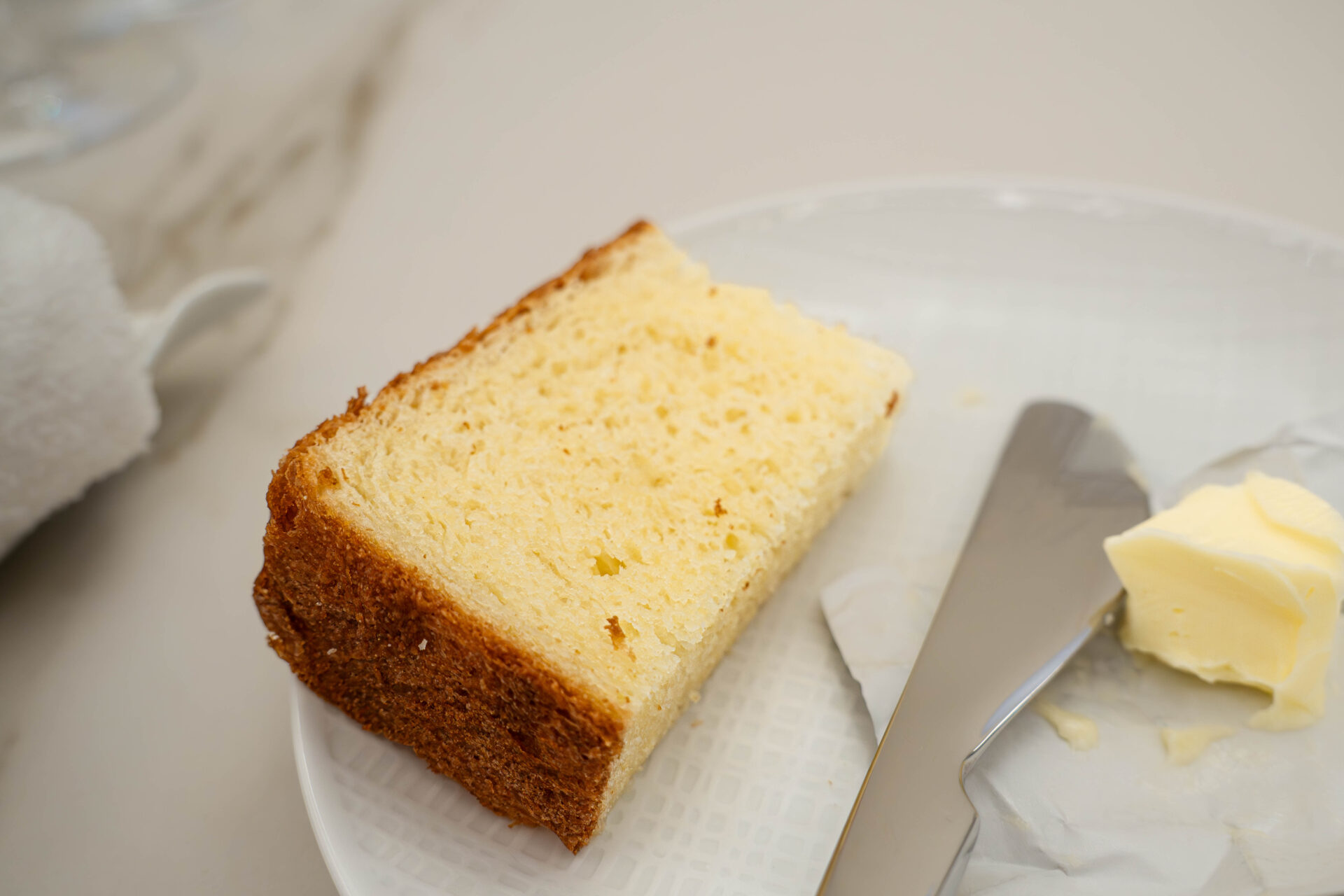
House-Made Brioche
Served alongside the fish course, this house-made brioche
carries a light sweetness and a soft buttery aroma that rises gently.
With a moist, tender crumb,
it’s designed to gently receive the lingering finish of the Américaine and beurre blanc sauces,
serving almost as a bridge continuing the “balance between sea and dairy” found in the hirasuzuki dish.
Never over-buttered, it stands perfectly well on its own.
A slice meant to gently accompany the fish’s umami and the sauce’s aroma.
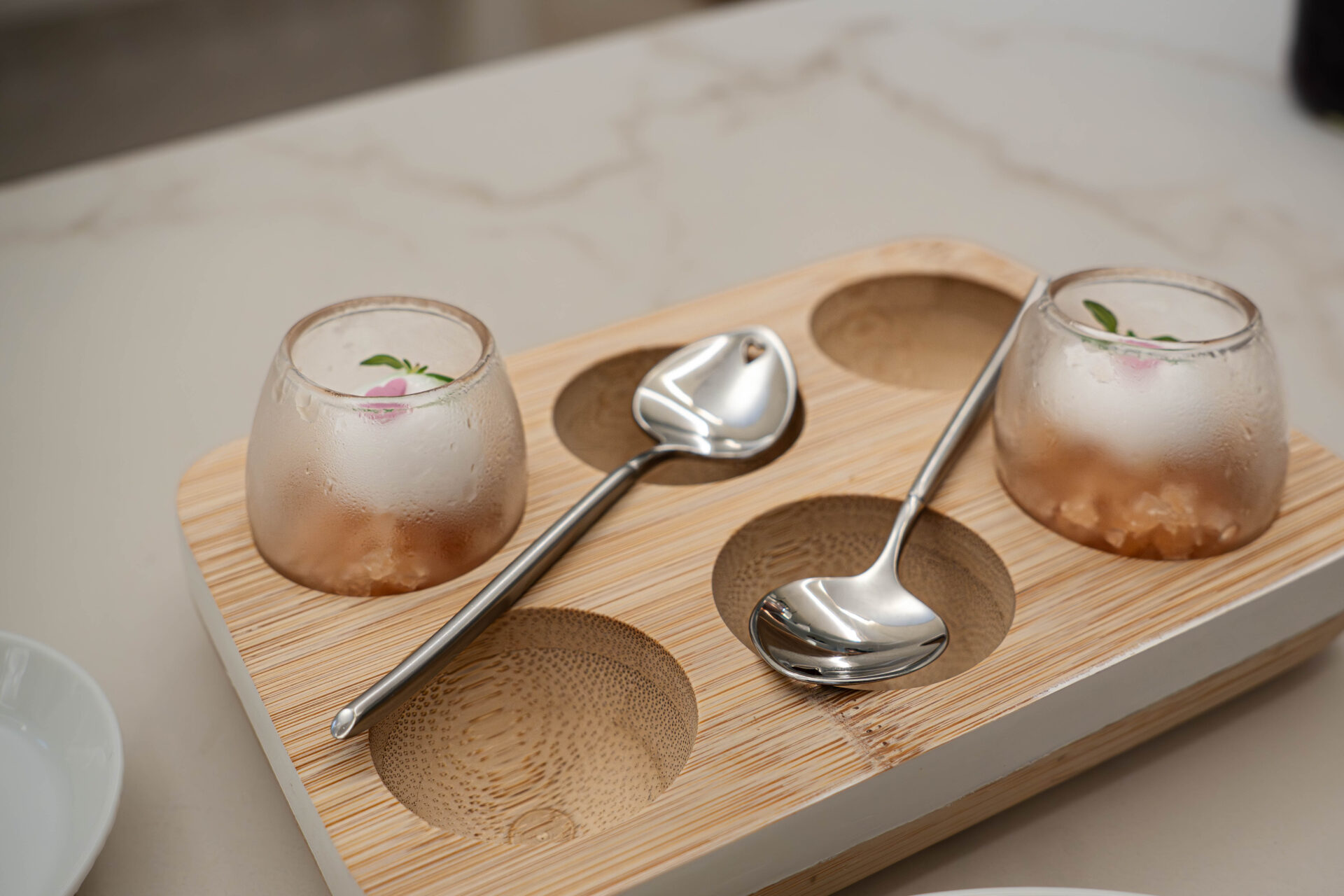
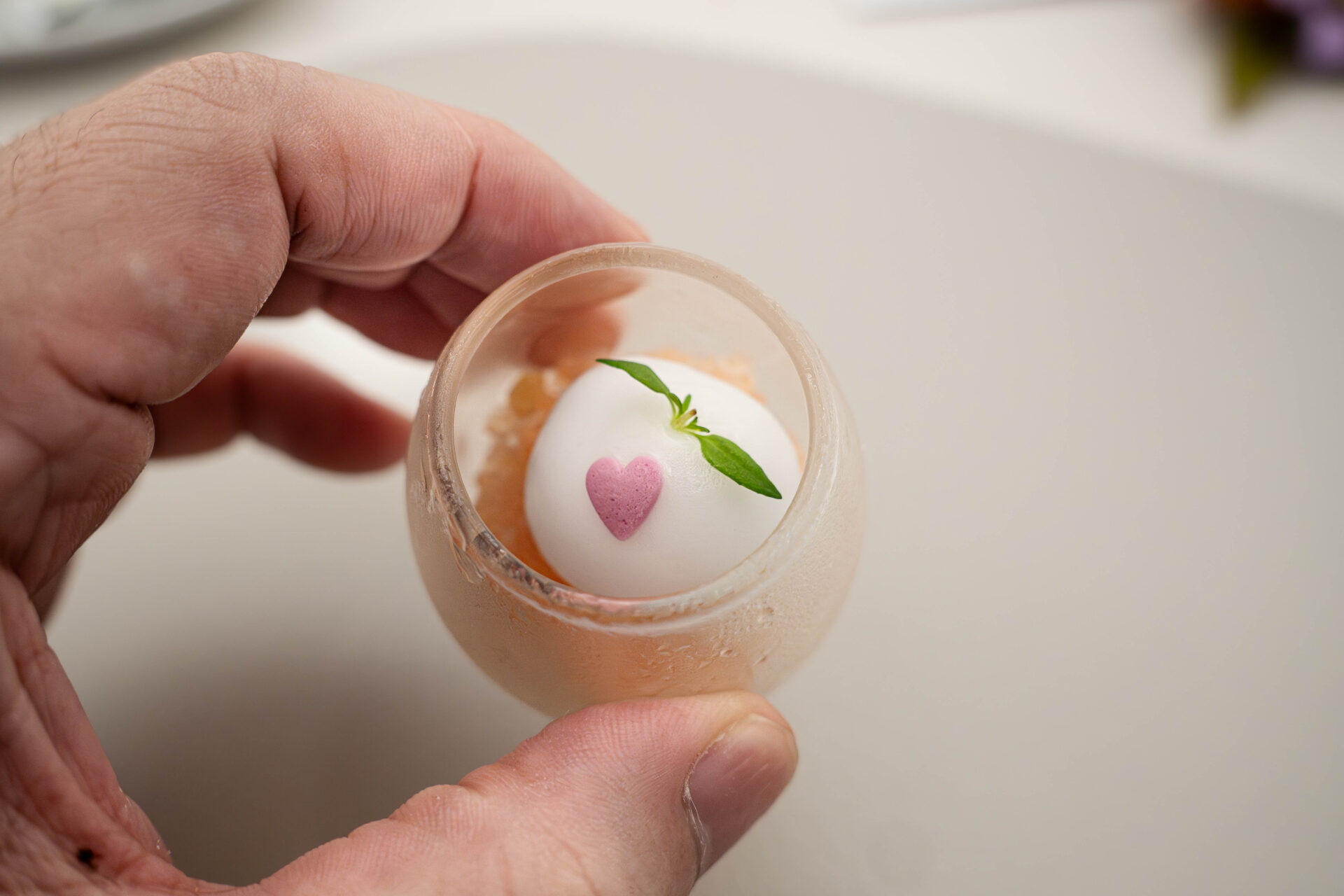
Palate Cleanser: Grapefruit Granité and Lemon Thyme Espuma
A small, refreshing dish that neatly resets the palate after the warm course before it.
At the bottom of the vessel is grapefruit granité,
its natural bitterness and acidity flattening the palate back to neutral.
Layered gently on top is
an espuma scented with lemon thyme.
Its restrained herbal fragrance softens the citrus’s bitterness,
leaving behind only a quiet, aromatic finish.
Not a palate cleanser built on sweetness,
but one that “resets the mood through fragrance and temperature.”
A small course that gently prepared the senses for what came next.
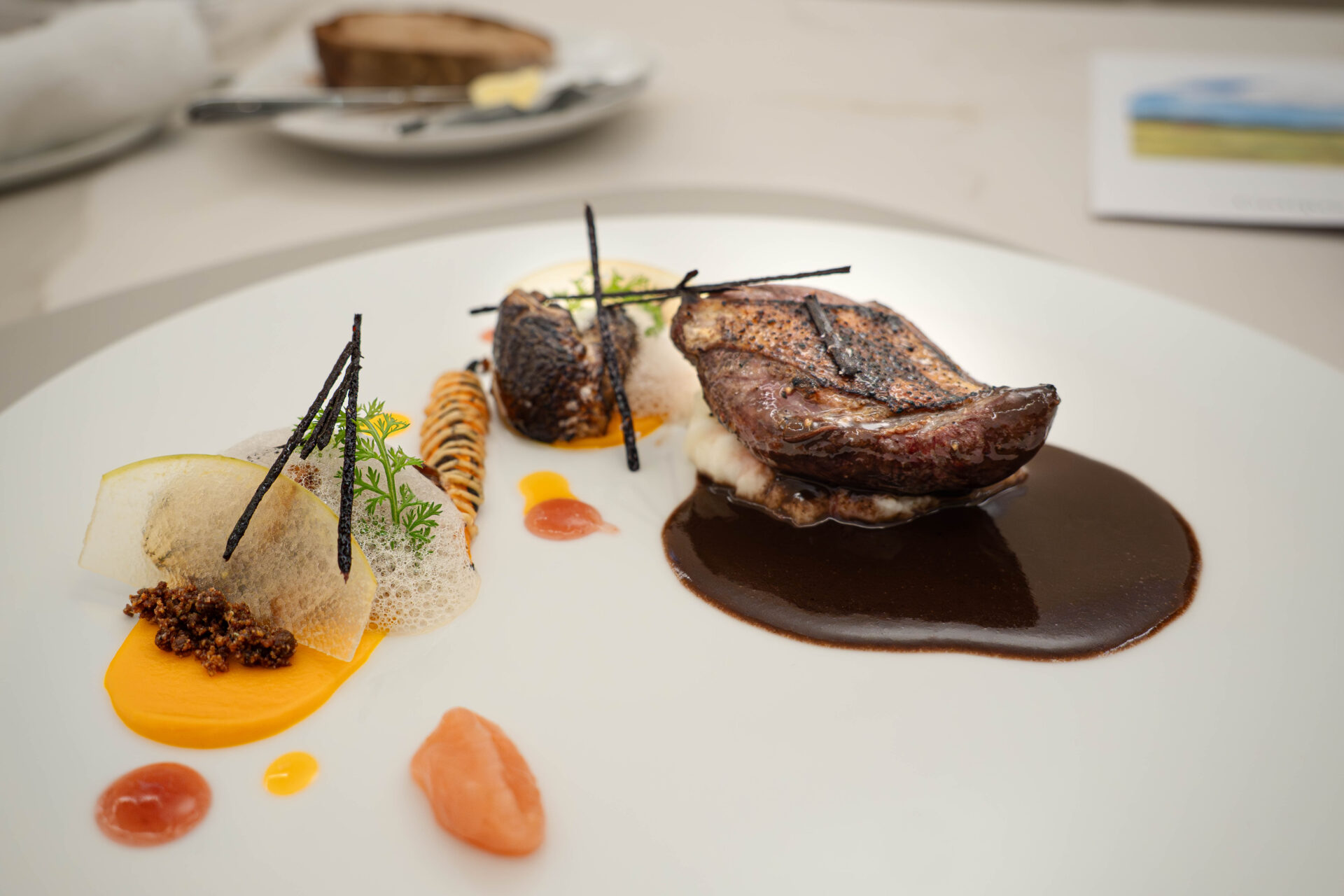
【Terroir: Loire Squab — A Lingering Note of Heat and Fragrance】
The main course featured pigeon (squab) from France’s Loire region.
The breast and thigh were each cooked using a different technique,
building a single dish that reads almost like a portrait of a terroir.
Breast: Low Heat, Then Charcoal
The breast is first slowly cooked at low temperature,
then finished briefly over charcoal to add fragrance.
Its moist texture is traced with a fine outline of smoky char.
The type that reveals more umami with every bite — never loud, but with a firm core.
Thigh: Confit and Binchotan
The thigh is a confit, slow-cooked in low-temperature oil.
Its fibers fall apart naturally, tender to the bite,
and finishing it over binchotan charcoal lifts the fragrance a notch further.
In contrast to the breast, its density of umami is firmly present.
Garnish and Sauce Composition
Surrounding the meat are
baby carrot, pearl onion, girolle mushrooms, other mushrooms, and sliced apple.
Each plays a role in softening the pigeon’s gaminess,
with cooking technique varying by vegetable.
The sauce is split three ways:
- Carrot sauce (yellow): an axis of vegetable sweetness that softens the dish
- Plum sauce (red): adds a light acidity that sharpens the pigeon’s fragrance
- Apple purée (pink): softens the edges of the finish with fruit sweetness
And laid beside the centerpiece is
salmis sauce.
A rich game sauce layered with the depth of liver and offal,
meshing perfectly with both the breast and thigh preparations.
Gentleness and gaminess, acidity and sweetness,
contrasting aromas born from different cooking techniques.
Despite its complex construction, the arc of the dish never wavered,
delivering the density and fragrance characteristic of Loire pigeon without any strain — a genuinely accomplished main course.
【A “Tangy Bread” Paired with the Meat Course】
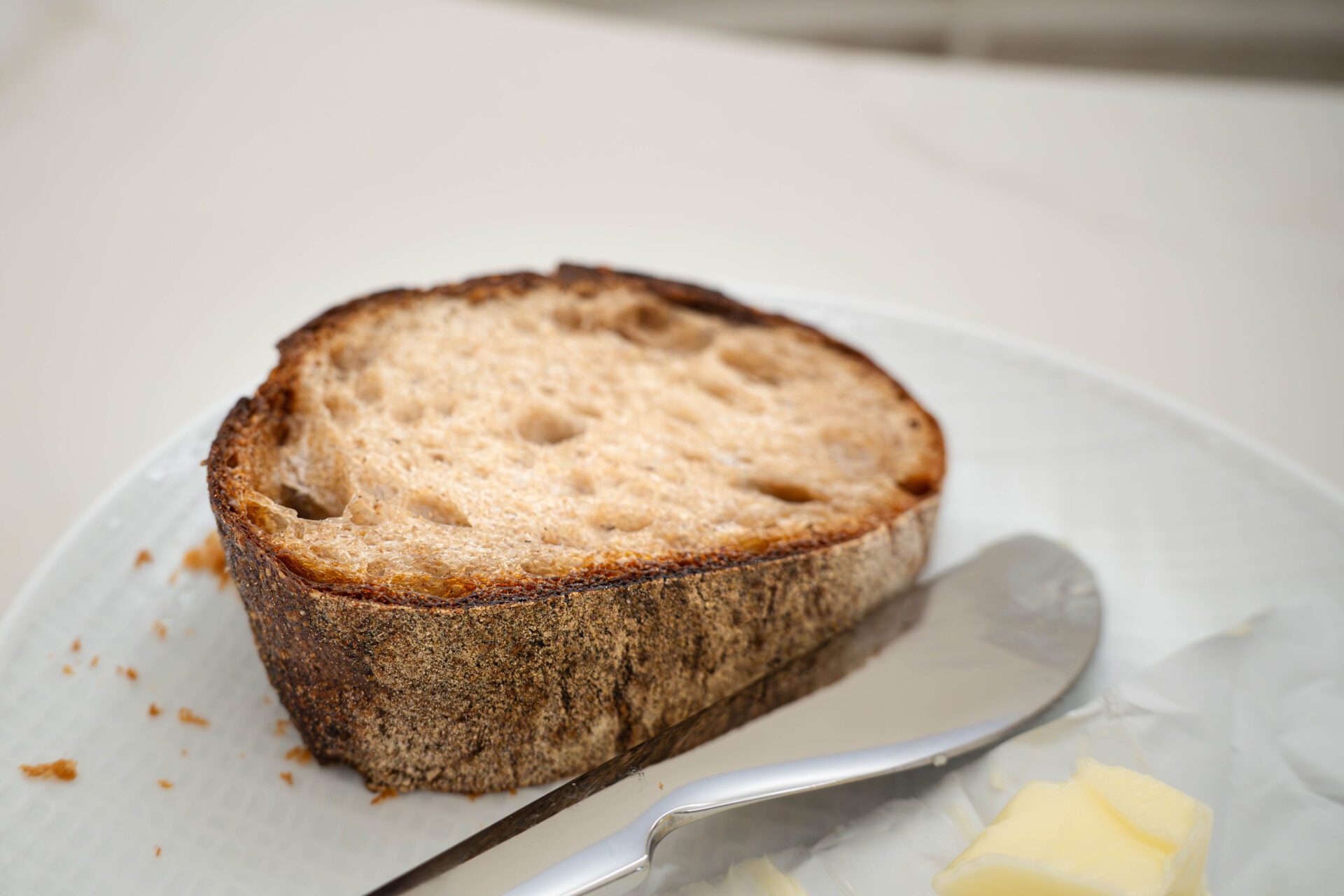
Served with the main course was
a somewhat deeply baked, tangy campagne-style bread.
It received the pigeon’s robust umami and the salmis sauce’s richness beautifully,
while its carefully judged acidity kept the dish from feeling heavy.
Crisp and fragrant on the outside,
moist within, with real depth of aroma.
It paired beautifully with butter, but especially
the moment it was coated in sauce, the whole dish came together — that was the role it played.
Dessert & Finale
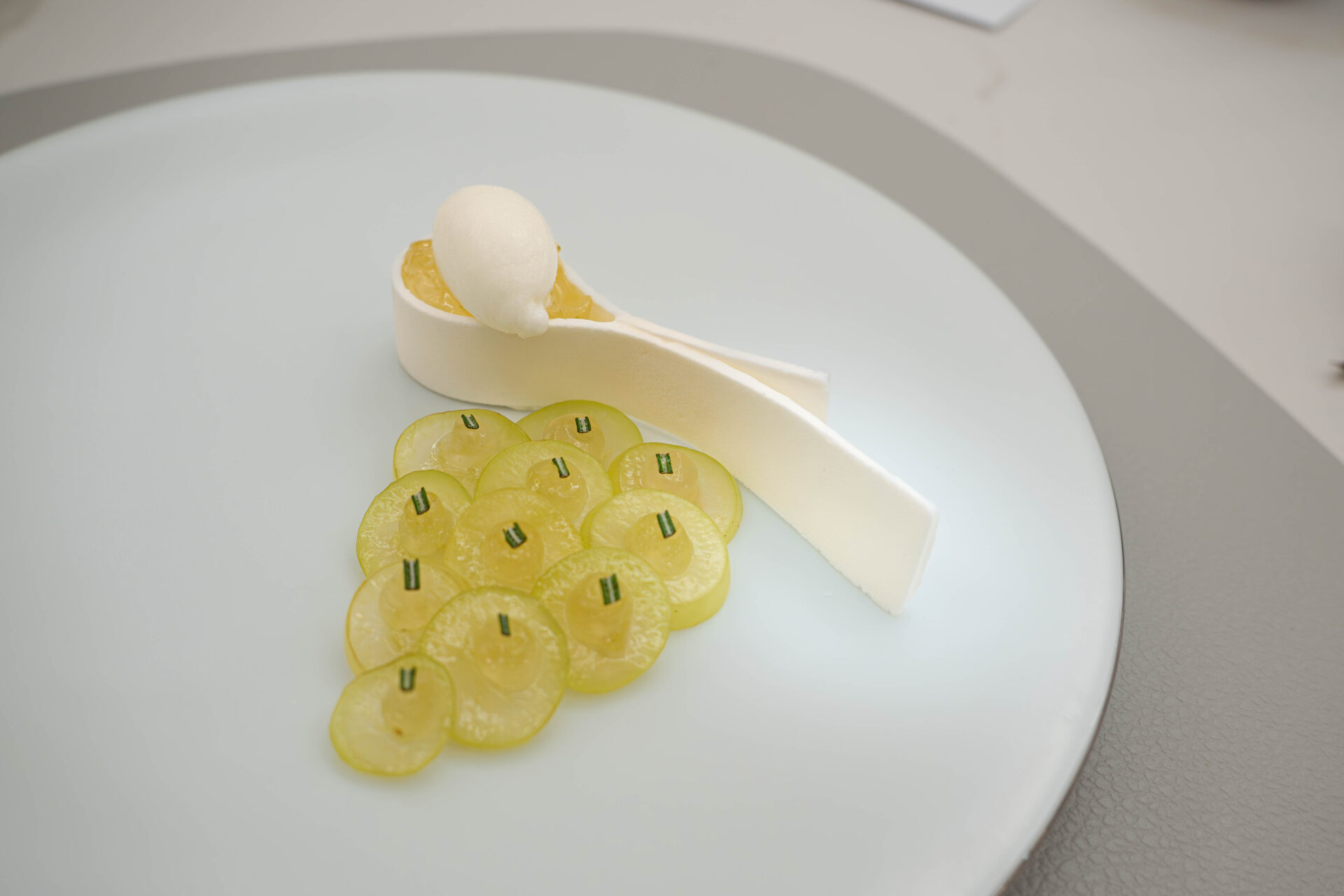
Shine Muscat × Meringue × Citrus Gelée
Translucently thin slices of Shine Muscat grapes hold a glossy jelly within,
finished with finely minced rosemary for a subtle fragrance.
Amid the fruit’s freshness, a crisp, herbal nuance rises up.
Inside a light, crisp baked meringue shell,
shikuwasa gelée and yogurt gelée.
The citrus’s acidity layers with the yogurt’s mellow tang,
and a white quenelle resembling ice cream ties the flavors further together.
Minimal and clean in appearance.
On the palate, fruit, herb, and citrus unfold in sequence —
a dish where delicacy truly stood out.
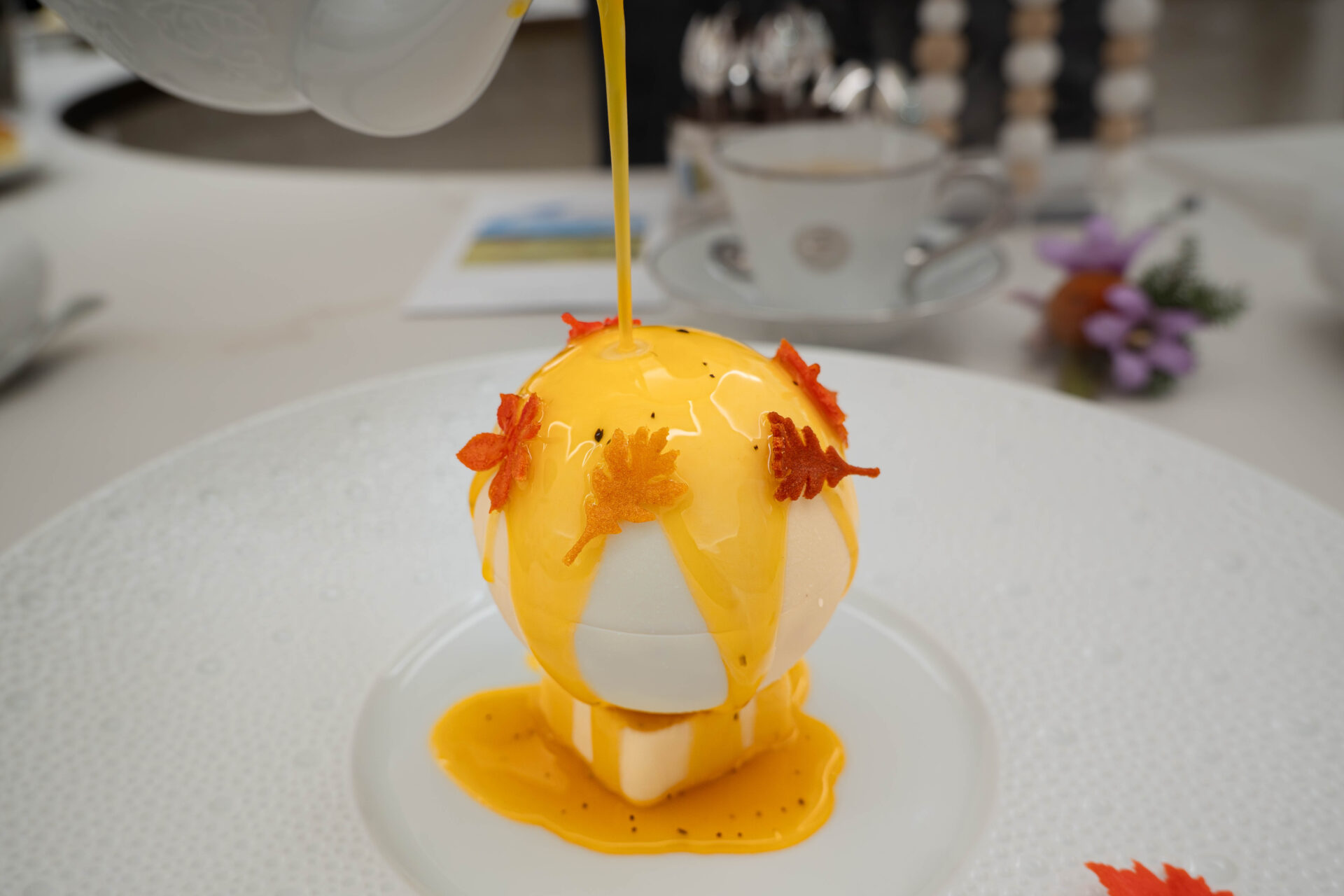
White Chocolate Dôme — A Dramatic Finale, Blooming with Warm Passion Fruit
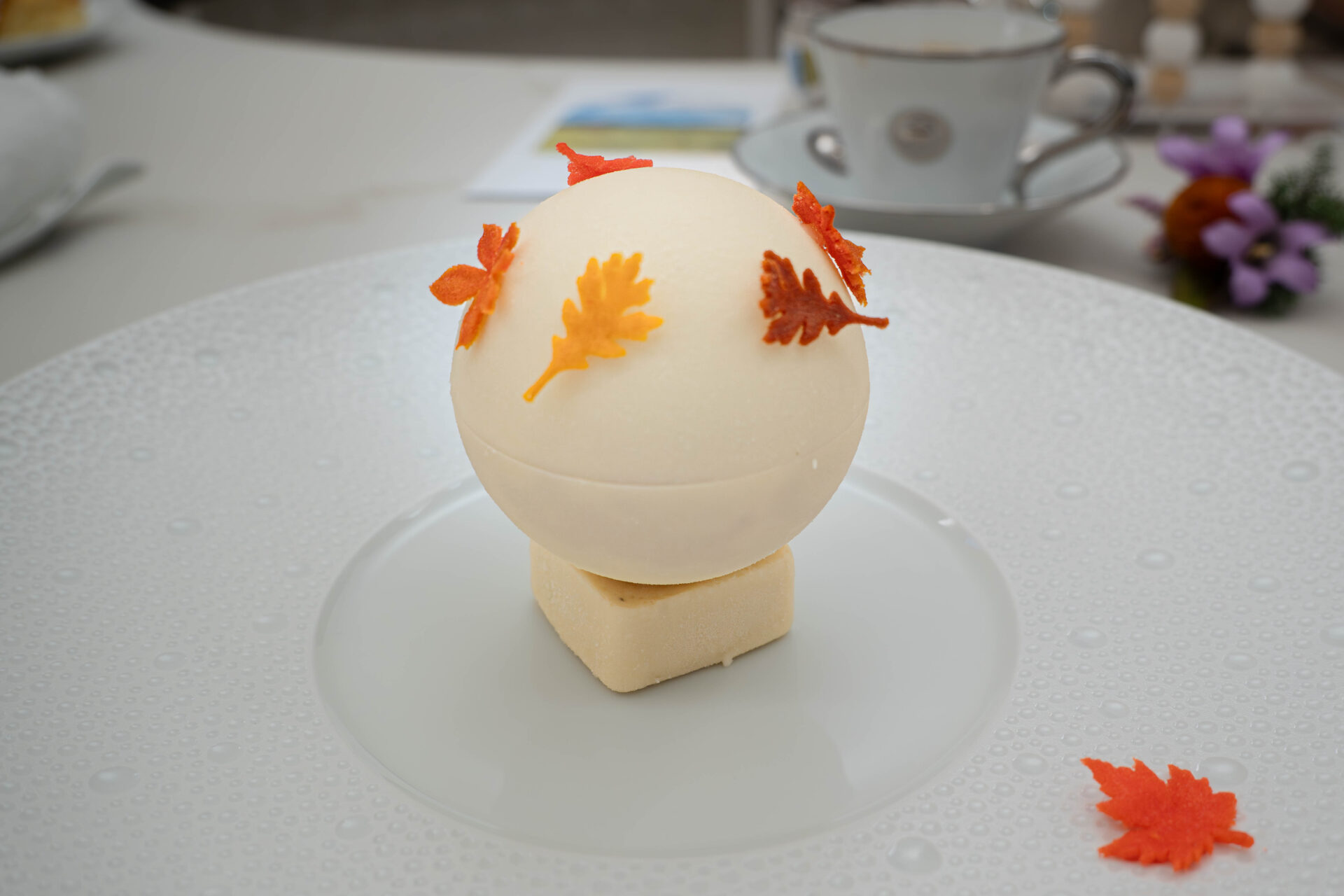
A delicate dessert: a pure white sphere scattered with autumn-hued leaves.
Holding back the urge to dig in right away,
a warm passion fruit sauce is gently poured over the top at the finish,
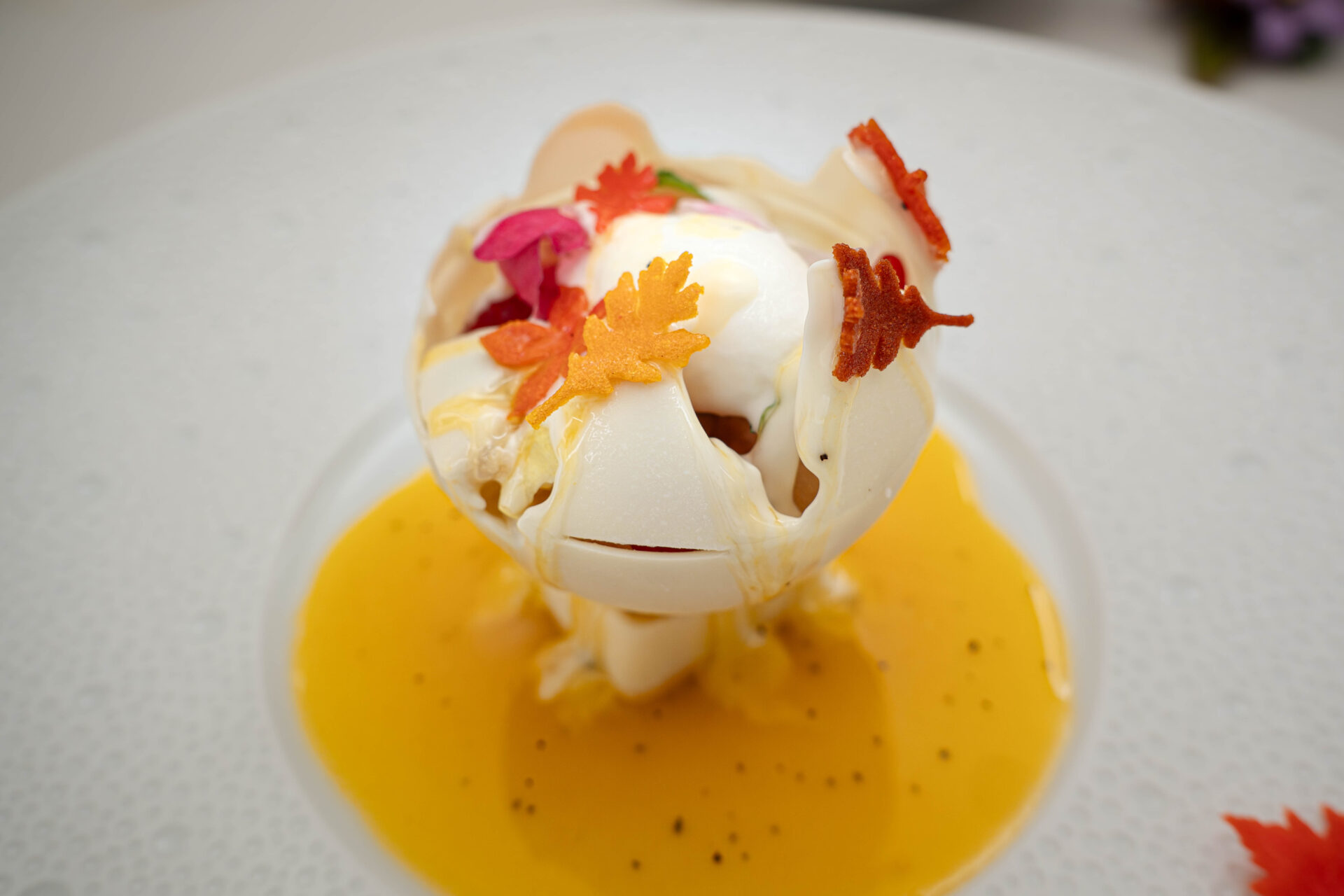
slowly melting the white chocolate shell,
revealing a vivid world within.
Hidden inside was—
- Fromage blanc mousse (a light acidity)
- Pear compote (a gentle sweetness)
- Raspberry (a sharp acidity)
- Milk ice cream (a gentle richness)
- Almond crumble (a fragrant crunch)
Warm sauce, cold ice cream, the melting sweetness of the white shell.
Temperature and fragrance, sweetness and acidity, texture — all unfolding at once,
a truly fitting piece of theater for “the very last dish.”
Petits Fours: Three Bites to Gently Close the Meal
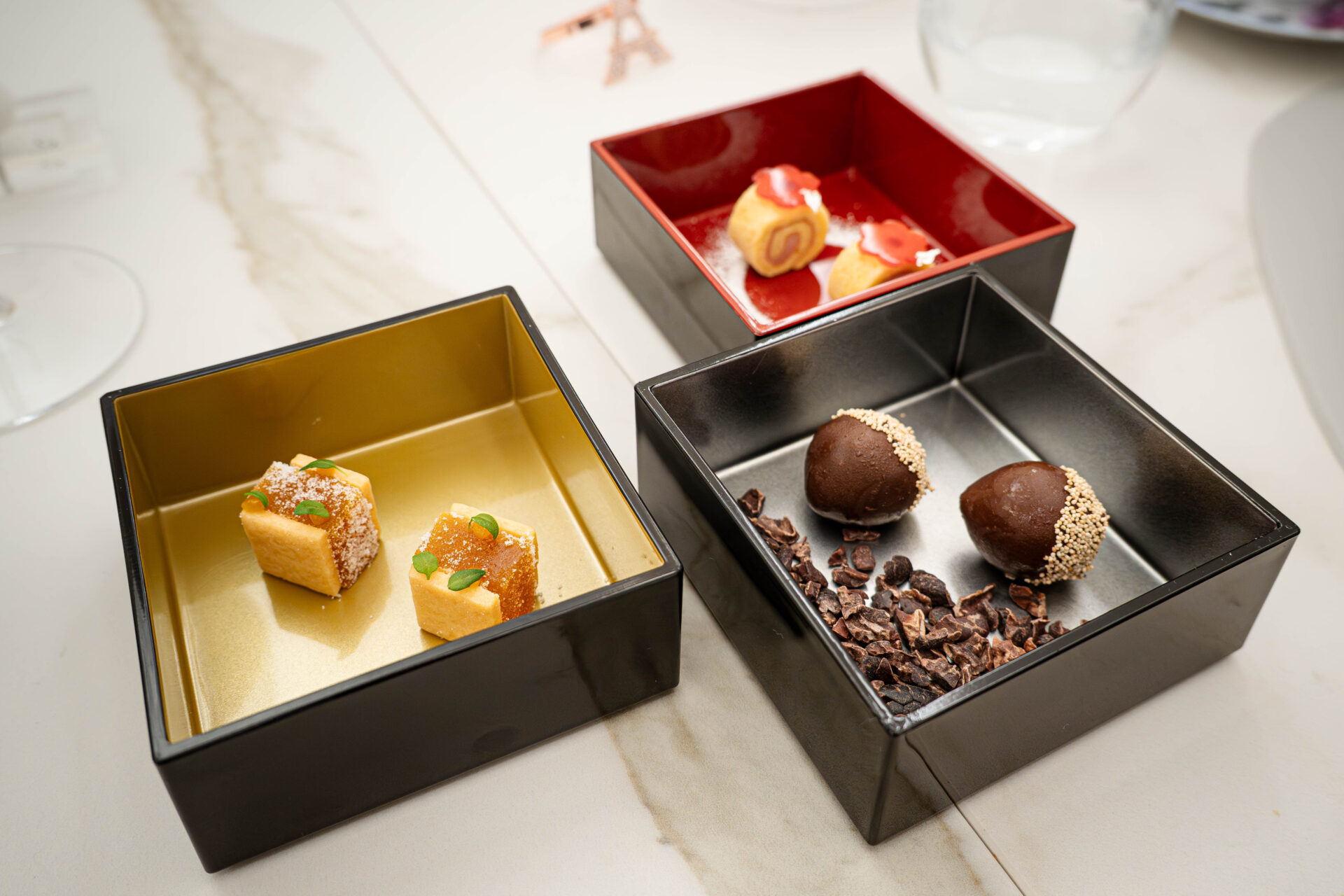
A trio of jewel-like mignardises, gently accompanying the meal’s final afterglow.
◆ Acorn-Shaped Chestnut and Cassis Chocolate
An adorably round chocolate shaped like an “acorn.”
The chestnut’s mellow character melds with cassis’s acidity,
a single piece that carries the season firmly within it.
◆ Mini Raspberry Roll Cake
A tiny roll cake, its airy sponge rolled around raspberry’s sweet-tart brightness.
A light, vibrant accent in a single bite.
◆ Mango Pâte de Fruit
A jelly capturing mango’s fragrance in concentrated form,
paired with a sablé-like base.
A refreshing close, with the fruit’s intensity spreading pleasantly.
Final Thoughts
Each dish carried a clear theme, with fragrance, color, and temperature layered together with real care.
From amuse-bouche to dessert, the meal followed a single continuous narrative,
striking a memorable balance between “visual delight” and “flavor with genuine purpose.”
The style Chef Hamano pioneered in France — effectively pairing fruit with every single dish —
translates naturally to this new stage in Japan,
functioning as the very backbone that shaped the fragrance and acidity throughout the entire course.
Built around ingredients from across Kyushu — Miyazaki, Goto, Itoshima —
the approach of finishing everything lightly with French technique
never grew heavy, holding its energy right through to the end.
In particular,
— the caviar × waffle chef’s specialty
— the two-sauce hirasuzuki
— the pigeon and salmis main course
all showcased a genuinely delicate layering of fragrance and clear compositional intent.
The dessert course was equally varied,
with a well-balanced mix of freshness, playfulness, and temperature contrast,
carrying through consistently right to the closing petits fours, always leaving guests with a genuine lift in mood.
Beauty pursued alongside genuine flavor,
down to every detail — this was a meal that let guests carefully experience the chef’s own world.
Reservation & Access Information
Reservations
“L’Unique labo” is a fully reservation-only French restaurant. Reservations are primarily made through the online booking system “TableCheck,” rather than by phone. Bookings can be made either via the reservation link on the official website (lunique-labo.jp) or directly through the restaurant’s TableCheck page (tablecheck.com/ja/lunique-labo), selecting the desired date, time, and party size.
A phone number (080-4378-1573) is also published, so guests who prefer not to book online, or who wish to check same-day availability, may also inquire by phone. With only eight counter seats available, early reservations are strongly recommended, especially for popular time slots.
The course is offered solely as the eleven-dish “Menu L’Unique” (¥27,500, tax included, service charge separate). Since September 2025, a shortened course, “Menu L’Esprit” (¥16,500, tax included, service charge separate), has also been available exclusively for Saturday lunch.
Access Information
“L’Unique labo” is located at 3-13-1 Haruyoshi, Chuo Ward, Fukuoka City, within the grounds of “HOTEL IL PALAZZO,” known as Japan’s first design hotel. The restaurant occupies a renovated building that once served as the hotel’s chapel, standing as an independent structure separate from the hotel’s main building.
The nearest station is Tenjin-Minami on the Nanakuma subway line, approximately a 6-7 minute walk (about 500m) away. It’s also accessible from Nakasu-Kawabata Station on the Kuko (Airport) subway line, and the location is easily reachable on foot from the heart of both the Tenjin and Hakata areas. Please check the official website regarding dedicated parking availability.
Hours
Lunch runs from 12:00, with last order at 13:30; dinner runs from 18:00, with last order at 19:30. Rather than fixing a strict start time, the restaurant follows a relaxed pace suited to each guest, and many visitors report that three hours pass before they realize it.
Closed days are irregular, so guests should check the official website or TableCheck’s booking page for current availability and open days.
With only eight counter seats, dishes finished right in front of guests by the chef himself, and a stage-like designed space — this operating style seems tailored specifically to let guests fully savor that sense of total immersion.
L’Unique labo — Visitor Information
| Item | Details |
|---|---|
| Address | 3-13-1 Haruyoshi, Chuo Ward, Fukuoka City, Fukuoka Prefecture (within HOTEL IL PALAZZO) |
| Nearest Station | Approximately 6–7 minute walk (about 500m) from Tenjin-Minami Station on the Nanakuma subway line / Nakasu-Kawabata Station on the Kuko (Airport) subway line |
| Phone | 080-4378-1573 |
| Hours | Lunch 12:00–13:30 L.O. / Dinner 18:00–19:30 L.O. |
| Format | Fully reservation-only, counter seating for 8 only |
| Closed Days | Irregular (please check the official website or TableCheck for open days) |
| Reservations | Online: tablecheck.com/ja/lunique-labo (phone reservations also accepted) |
| Menu | Menu L’Unique (11 courses) ¥27,500 / Menu L’Esprit (Saturday lunch only) ¥16,500 *Both tax included, service charge separate |
| Official Website | lunique-labo.jp |
| Official Instagram | instagram.com/lunique_labo |
- TAGS