
This content is duplicated once more — translating it in full, one time only:
CONTENTS
- Prologue | Chasing a Skyline and a Plate Only This Moment in Hong Kong Can Offer
- Gastronomy Journey | Day 1
- Fukuoka to Hong Kong: The Journey Begins
- Fueling Up at the Newly Renovated Food Court
- Heading to the Gate
- Arrival at Hong Kong International Airport
- Exchanging Currency Before Heading Into the City
- Airport Express to Hong Kong Station
- An Unexpected Encounter With a POP MART Vending Machine
- Roast Goose Lunch at the Storied Yat Lok Restaurant
- Check-In at THE PARK LANE HONG KONG
- Walking Tsim Sha Tsui by Night: Toward Victoria Harbour
- Fueling Up at the Storied Mak’s Noodle
- Second Stop: The Local Diner Hing Kee Restaurant
- Closing Out the Night of the Approaching Typhoon With an Unboxing Session
- Gastronomy Journey | Day 2
- In Search of Breakfast
- Fueling Up at Sang Kee Congee Shop in Sheung Wan
- The Day’s Main Event: The Chairman, Cantonese Cuisine at Its Peak
- Seeking Out Shingo Katori’s Wall Art
- A Rest at the Hotel, Then On to Victoria Peak
- A Break at % ARABICA and Silk.
- Into the Quiet Corners of the Back Streets: Neighborhood
- A Chance Encounter With Dogs in the Park
- Gastronomy Journey | Day 3
- One More Stop Before Checkout on the Final Day
- To the Monster Building
- A Quick Bite at a Local McDonald’s on the Way Back to the Hotel
- Finally, on the Last Day, Clear Skies
- Checking Out for the Last Destination
- Morning Dim Sum at Lin Heung Tea House, Central
- Airport Express to the Airport
- One Last Attempt at Labubu, at the Airport POP MART
- Epilogue | From a Bowl of Congee to the Best Table in the World
Prologue | Chasing a Skyline and a Plate Only This Moment in Hong Kong Can Offer
Paris, Barcelona, Taipei — the “50 Best Gastronomic Journey” continues. This time, the destination is Hong Kong.
What comes to mind first is the glow of Victoria Harbour at night, and memories of Cantonese cuisine. The cityscape still carries traces of British colonial rule, even as it slowly takes on the character of “mainlandization” — and yet, by all accounts, it holds onto a face entirely its own. What would the food culture shaped by that colonial history look like now, refracted through today’s shifting times?
This particular trip came together through a foodie friend based in New York, who planned the itinerary and arranged the restaurants — a genuinely special one. With a lineup drawing heavily from the upper ranks of Asia’s 50 Best Restaurants, anticipation was already running high before departure.
The forecast checked before leaving showed two typhoon symbols side by side. Still, that was no reason to change the itinerary.
Two nights, three days — how much of Hong Kong could be discovered in that time? Carrying that anticipation, I headed for Fukuoka Airport.

Gastronomy Journey | Day 1
Fukuoka to Hong Kong: The Journey Begins
The morning of departure, arriving at Fukuoka Airport. Carrying the anticipation of the days ahead, the first stop is security.


Fueling Up at the Newly Renovated Food Court
Past security lay the newly renovated food court, HAKATA FOOD HALL. Warm wood-toned interiors, and a duty-free area lined with familiar brands like PORTER and SK-II. A noticeably more polished atmosphere than the Fukuoka Airport of before, and it caught me a little off guard.


Udon, hamburg steak, unagi, tempura, motsunabe, tonkatsu, ramen — faced with an almost overwhelming range of choices, I settled on Kamakiri Udon.
I ordered the niku gobo-ten udon — a bowl piled generously with sweet-savory braised beef and fragrant fried burdock root. The dashi-rich broth made the start of the trip feel real, settling in slowly with every sip.

From the neighboring Takenoya, I added chicken skin skewers to the order. Grilled to a crisp, they were exactly the kind of thing that calls for a beer on its own. Altogether, it made for an almost indulgently generous meal before boarding.


- ADDRESS
778-1 Oaza Shimousui, Hakata-ku, Fukuoka City, Fukuoka Prefecture, Fukuoka Airport International Passenger Terminal Building 3F, HAKATA FOOD HALL
Located past security, in the Fukuoka Airport international departures area
- OPEN
07:30-20:30
- COMMENT
- The airport branch of a popular Fukuoka udon izakaya, known for signature dishes like its niku gobo-ten (beef and burdock tempura) udon.



- ADDRESS
Takenoya — Fukuoka Airport International Terminal
778-1 Oaza Shimousui, Hakata-ku, Fukuoka City, Fukuoka Prefecture, Fukuoka Airport International Passenger Terminal Building 3F, HAKATA FOOD HALL
Located past security, in the Fukuoka Airport international departures area
- OPEN
07:30-20:30
- COMMENT
- A yakitori/izakaya chain known for its popular Hakata specialty: coiled grilled chicken skin skewers.

Heading to the Gate
Meal finished, on to the boarding gate. The monitor showed “Hong Kong” and flight UO601, departing 12:55. Operated solely by HK Express, but apparently also a codeshare flight with Cathay Pacific.


The direct flight from Fukuoka to Hong Kong runs roughly three and a half hours. Being a low-cost carrier, there was no in-flight meal. With that in mind, we finally lifted off toward Hong Kong.
Arrival at Hong Kong International Airport
Local afternoon, safe arrival at Hong Kong International Airport. In the arrivals area, a large illuminated “100” caught the eye — apparently a display marking the airport’s 100th anniversary. An unexpected chance to witness a genuine milestone.


Through the arrivals lobby and out into the city ahead. The rush that comes right after clearing immigration never gets old, no matter how many trips it’s been.

Exchanging Currency Before Heading Into the City
Before heading downtown, a stop to exchange currency. Learning from the “not enough cash” mishap during the Taipei trip, I made sure to exchange plenty this time. What came back was a HKD 500 note, its distinctly Hong Kong lion motif front and center.

Airport Express to Hong Kong Station
From the airport, the Airport Express carries us into the city. Kowloon’s high-rises pass by the window, the sea stretching out beyond them. In the quiet of the train car, thoughts drift ahead to the days in Hong Kong still to come.


An Unexpected Encounter With a POP MART Vending Machine
Getting off at Hong Kong Station and walking toward the day’s first destination, a bright yellow “POP MART ROBO SHOP” caught the eye. With a faint hope of maybe landing a Labubu — the toy everyone seemed to be talking about at the time — I gave it a try without really knowing what I was doing.


What came out was a “Romantic Ring Box.” Not a Labubu, as expected, but a fittingly Hong Kong detour all the same. Day one, and already the trip’s small game of chance had begun.

Roast Goose Lunch at the Storied Yat Lok Restaurant
Past a market area with its distinctly Hong Kong steep stone steps, and through a shopping street lined with fluttering red flags.

The destination: Yat Lok Restaurant, founded in 1957 and a longtime holder of a Michelin star.

Known for its roast goose, prepared through more than twenty separate steps, the shopfront displays whole geese hanging behind glass. A fragrance of charcoal and rendered fat drifted gently out into the street.

The interior was small, communal seating the norm — a genuinely local, unpretentious spot. Facing a pink menu covering an entire wall, dense with Chinese characters, I honestly ordered without fully understanding what I was getting. Only afterward did it become clear the set menu would have been the better value — the kind of small mishap that seems to happen on every trip.

What arrived was half a roast goose with white rice. The skin crackled with a deep char, the meat carrying a rich, fatty depth. It wasn’t cheap, but the satisfaction afterward held up completely. This isn’t a place to stop by mid-sightseeing — it’s a place worth going to specifically for this one dish. For roast goose in Hong Kong, this is the place to choose without hesitation.

- ADDRESS
G/F, 34-38 Stanley St, Central, Hong Kong
About a 3-minute walk from Exit D2 of Central MTR Station
- OPEN
10:00–20:30 (Sundays & public holidays: 10:00–17:30 / Closed Wednesdays)
- AWARD
Michelin One Star
Check-In at THE PARK LANE HONG KONG
After lunch, on to the day’s lodging: THE PARK LANE HONG KONG.
As a member of the Autograph Collection, its refined character was evident from the entrance onward.

Check-in complete, the assigned room was 1522 — a Deluxe Room with a king bed and city view. The city of Hong Kong stretched out beyond the window, an entirely fitting base for the trip ahead.

Bags set down, it was time to unbox the POP MART haul from earlier. Still no Labubu inside, but that lighthearted uncertainty is its own kind of travel memory.
- ADDRESS
310 Gloucester Rd, Causeway Bay, Hong Kong
About a 2-minute walk from Exit E of Causeway Bay MTR Station
- OPEN
Check-in: 2:00 PM / Check-out: 12:00 PM
- COMMENT
- Part of the Autograph Collection
A luxury hotel adjacent to Victoria Park, featuring Deluxe Rooms and the rooftop bar SKYE.

Walking Tsim Sha Tsui by Night: Toward Victoria Harbour
After a short rest at the hotel, the MTR carries us to Tsim Sha Tsui. The goal: A Symphony of Lights, viewed across Victoria Harbour toward Hong Kong Island.

Unfortunately, the sky was overcast. One typhoon had just passed through, with another closing in. The skyline that should have shone brilliantly instead performed half-hidden behind thick cloud.

Walking along the Avenue of Stars, a Bruce Lee statue and a golden piglet statue both made an appearance. Even under grey skies, the energy of passing tourists never let up.


- ADDRESS
Avenue of Stars, Tsim Sha Tsui, Hong Kong
Just a short walk from Exit J of Tsim Sha Tsui MTR Station, or from East Tsim Sha Tsui Station
- OPEN
Open all day (A Symphony of Lights runs nightly from 8:00 PM)
- COMMENT
- A waterfront promenade along Victoria Harbour, lined with a Bruce Lee statue and handprints of film industry figures.
Fueling Up at the Storied Mak’s Noodle
After the walk, a stop at Mak’s Noodle, a longtime wonton noodle specialist along Lock Road in Tsim Sha Tsui. Founded on the recipe of a man once called the “King of Wonton Noodles” in 1920s Guangzhou, the shop still finishes each bowl using traditional methods.

I ordered the signature shrimp wonton noodles — clear broth, thin noodles, springy shrimp wontons. A modest bowl carrying a genuinely layered depth of umami, distinctly Hong Kong in character. Sized well for eating on the go, it was a bowl that embodied “the essence of Hong Kong” — its craft unchanged even sitting at the center of a tourist district.


- ADDRESS
G/F, 19 Lock Rd, Tsim Sha Tsui, Hong Kong
About a 1-minute walk from Exit A1/C1 of Tsim Sha Tsui MTR Station
- OPEN
11:00-23:00
- COMMENT
- A renowned wonton noodle shop carrying on a tradition dating back to 1920s Guangzhou, known for the harmony between its ultra-thin noodles and springy shrimp wontons.
Wonton noodles taking the edge off hunger, the walk continued toward the next stop. In search of a Labubu, I tracked down POP MART’s Ocean Terminal store. Inside, the energy was palpable, a steady wave of people picking things up one after another.

Scanning row after row of figures and keychains, I once again found myself reaching for a Labubu-related box. Following the vending machine, this made round two of POP MART for the day.

Second Stop: The Local Diner Hing Kee Restaurant
Still hungry after the wonton noodles, one more stop: Hing Kee Restaurant, its plastic curtain entrance radiating genuine local character.

I ordered the stone-pot beef rice — a soft-boiled fried egg and a generous scattering of chopped scallion on top, the taste of Hong Kong home cooking through and through.

Dish after dish followed — Hong Kong-style fried chicken piled with dried chili, stir-fried water spinach, fritters of green vegetables. Somewhere around here, the camera or SD card started acting up, leaving a stretch of poorly captured photos. Even that ended up part of the memory of a lively Hong Kong evening.


Raising a cold Hoegaarden in toast, it became a chance to slowly look back on the whole day in Hong Kong.
- ADDRESS
15 Temple St, Yau Ma Tei, Hong Kong
About a 3-minute walk from Exit C of Yau Ma Tei MTR Station
- OPEN
1:30 PM–11:30 PM
- COMMENT
- A claypot rice (bo zai fan) specialist on Temple Street ("Men's Street"), popular for its stone-pot beef rice and Hong Kong-style fried chicken.
Closing Out the Night of the Approaching Typhoon With an Unboxing Session
Heading back to the hotel after dinner, a stop at MR.TEA, a drink stand just steps from the hotel. Marked by its black kaiser-mustache logo — a distinctly Hong Kong kind of tea stand — I picked a drink to go from the wall-length menu.


- ADDRESS
Shop 3, G/F, 2-10 Sugar St, Causeway Bay, Hong Kong
About a 1-minute walk from Exit E of Causeway Bay MTR Station
- OPEN
11:00-23:00
- COMMENT
- A tea stand marked by its black kaiser-mustache logo, offering a wide range of fruit teas and milk teas to go.
Back in the hotel room, the day’s last event: unboxing the day’s full POP MART haul. Four boxes lined up on the bed — two from the Labubu series, THE MONSTERS ONE PIECE (a collaboration with One Piece), and THE MONSTERS Wacky Mart. Somehow, that much had been collected in a single day.

This particular day in Hong Kong sat between one typhoon just passed and another closing in. No rain yet, but the windows had fogged over completely with condensation.
Following the Taipei trip, complete with its own unexpected mishaps, this was a day spent feeling Hong Kong’s humidity and energy in full. Tomorrow, finally, comes the main event of the trip.
Gastronomy Journey | Day 2
In Search of Breakfast
Day 2 begins with the subway ride from the hotel’s neighborhood. Hong Kong’s MTR escalators run noticeably faster than Japan’s — fast enough that an unaccustomed traveler might hesitate even about when to step on, an initiation that couldn’t help but draw a laugh.

Stepping off the train heading toward Sheung Wan.
Fueling Up at Sang Kee Congee Shop in Sheung Wan
The destination: Sang Kee Congee Shop, a longtime congee specialist tucked quietly down a side street. Originally a street stall, it still finishes each bowl individually in a copper pot, holding to old-fashioned methods. Listed in the Michelin Bib Gourmand, it’s a genuine emblem of Hong Kong’s congee culture.

The menu, plastered across the wall, offered a wide range at genuinely modest prices.

I ordered the small “kap tai” congee and a fragrant fried fish cake. Kap tai congee is something close to a “complete edition” — liver, offal, and meatballs all packed into a single bowl. The rice, cooked down until it fully breaks apart, flows smoothly off the spoon.

Each ingredient was cooked to just the right degree — the liver tender, the offal retaining a pleasant bite without any off-flavor.

A touch of the accompanying ginger-scallion soy sauce brought a savory edge and salinity that pulled the mild congee into sharper focus.

The fried fish cake was fragrant on the outside, airy within, its natural fish sweetness coming through clearly — a satisfying textural contrast alongside the congee. Simple, but a genuinely good breakfast in every sense.

- ADDRESS
7-9 Burd St, Sheung Wan, Hong Kong
About a 3-minute walk from Exit A2 of Sheung Wan MTR Station
- OPEN
6:30 AM–8:30 PM (Closed Sundays)
- AWARD
Michelin Bib Gourmand
- COMMENT
- A storied congee specialist that got its start as a street stall, known for its kap tai congee and fragrant fried fish cake, each bowl finished individually in a copper pot.
The Day’s Main Event: The Chairman, Cantonese Cuisine at Its Peak
Breakfast finished, a brief return to the hotel, then on toward Central after a short rest. Walking along Queen’s Road Central, lined with scaffolding and construction sheeting.

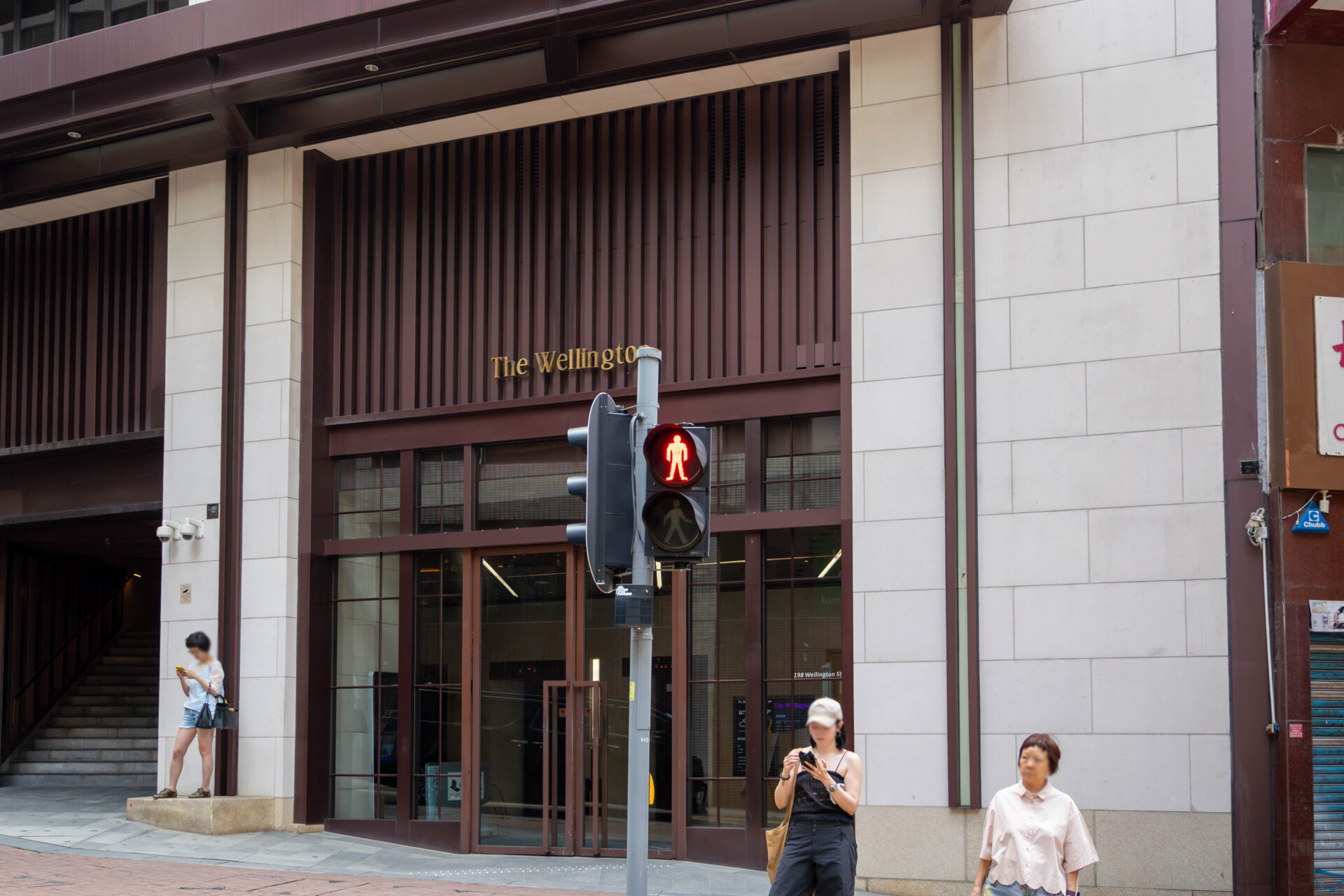
The destination: The Chairman, on the third floor of The Wellington, at 198 Wellington Street.
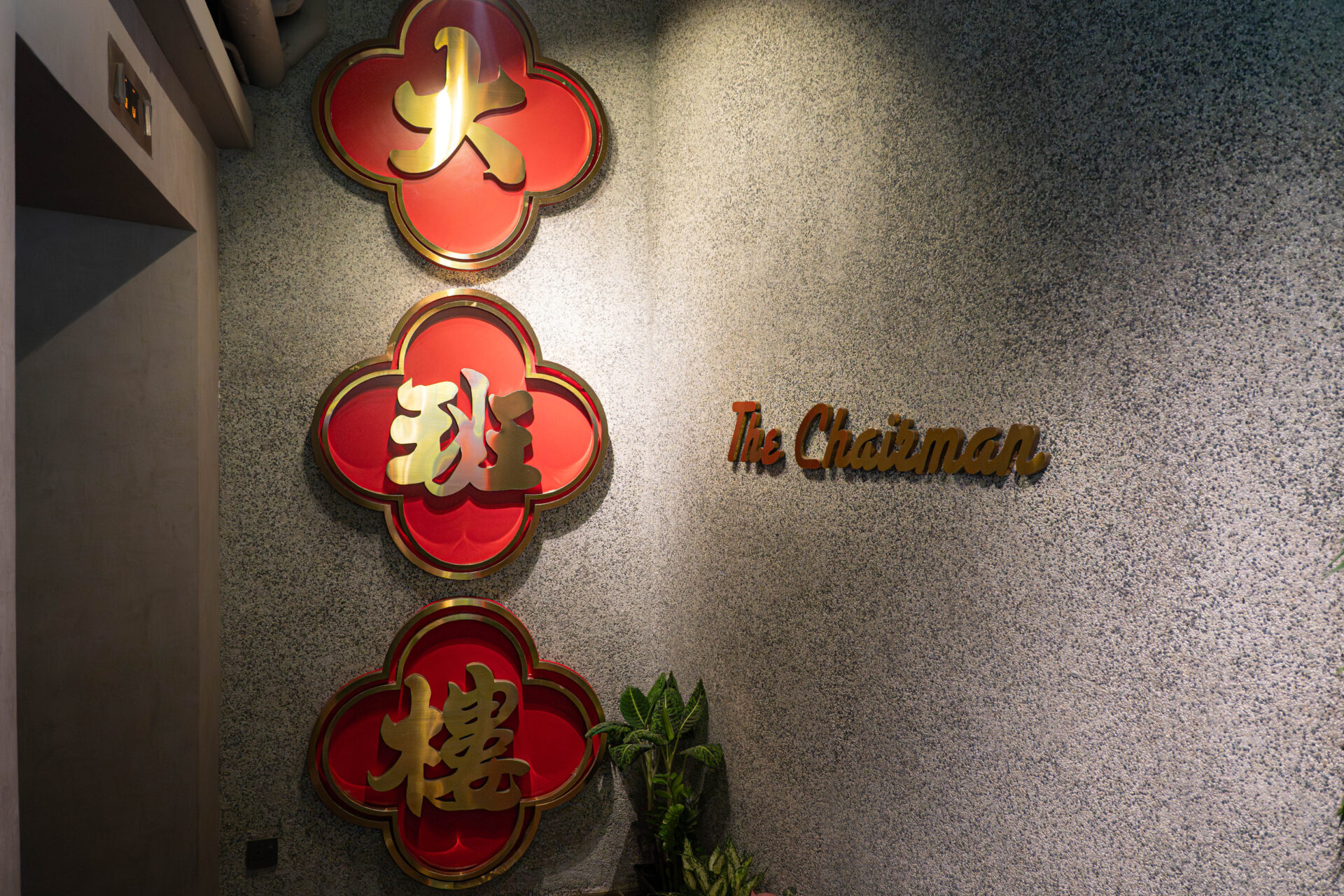
 A Cantonese restaurant built without imported ingredients, relying instead on seafood from Hong Kong’s own waters and close ties with local producers, layering in the dimension of time through aging and fermentation. Owner Danny Yip’s philosophy is simple: the best ingredients, the most fitting technique, and the most natural seasoning. Avoiding flashy presentation altogether, the kitchen is devoted entirely to drawing out an ingredient’s flavor in its purest form.

No flashy presentation anywhere, yet satisfaction built steadily through layered aroma and temperature alone. That philosophy — facing an ingredient’s flavor head-on — came through clearly with every single dish.
- ADDRESS
3/F, The Wellington, 198 Wellington St, Central, Hong Kong
About a 5-minute walk from Exit A2 of Sheung Wan MTR Station, or walkable from Central Station
- OPEN
12:00-15:00 / 18:00-23:00
- AWARD
Asia's 50 Best Restaurants — All-Time No. 1 / Michelin One Star
Seeking Out Shingo Katori’s Wall Art
After lunch, on to a wall art piece by Shingo Katori. Past a “BUT NICE” sign, continuing up a street that keeps climbing.

Climbing Hong Kong’s characteristically steep stepped streets was genuinely tiring, leaving me a little breathless. The destination, a wall along Shelley Street, held a vivid mural built around motifs of dragons and the Hong Kong cityscape.

- ADDRESS
Shelley St, Central, Hong Kong
On a wall along Shelley Street, near the Central–Mid-Levels Escalator
- OPEN
Open for viewing all day
- COMMENT
- A large-scale street art piece by Shingo Katori, featuring motifs of a dragon and the Hong Kong cityscape.
A Rest at the Hotel, Then On to Victoria Peak
A brief return to THE PARK LANE hotel, and a stretch of downtime.
Energy restored, back toward Central once more, following the signs toward Peak Tram and Hong Kong Park.

At the intersections of Central, signs pointing toward the Peak Tram and Central Station stacked one atop another.

Arrival at the entrance to THE PEAK TRAM.

Entry via QR code, then a wait in line for the tram.

Standing in line alongside a large crowd of tourists, finally boarding the tram.

The view through the tram window climbs steadily higher with every meter of ascent.
The night view of Hong Kong from the observation deck
By the time we reached the Victoria Peak observation deck, the sky was shifting from dusk into full night.

Alongside a large crowd of visitors, looking down over Victoria Harbour. The high-rises begin lighting up one by one, the city emerging gradually through gaps in the cloud.

Once the sun had fully set, the skyline lit up in full, the kind of night view that could only be Hong Kong.
- ADDRESS
128 Peak Rd, The Peak, Hong Kong
Board the Peak Tram at the Garden Road Lower Terminus in Central
- OPEN
7:00 AM–10:00 PM (Peak Tram operating hours)
- COMMENT
- A landmark viewpoint overlooking Victoria Harbour and the skyline — Hong Kong's iconic night view.
A Break at % ARABICA and Silk.
After taking in the night view from the observation deck, a coffee to go from % ARABICA inside the Peak Tower.


A short rest with the simple % mark cup in hand. On the way back down, a stop at Silk., a milk tea specialist marked by an unmissable neon sign.

- ADDRESS
Shop G02, G/F, The Peak Tower, 128 Peak Rd, Hong Kong
Ground floor of the Peak Tower
- OPEN
08:30-20:00
- COMMENT
- A popular specialty coffee brand originating from Kyoto.
- ADDRESS
Inside The Peak Tower
- OPEN
Follows The Peak Tower's operating hours
- COMMENT
- A milk tea specialist known for its eye-catching neon sign, located inside The Peak Tower — a natural stop after taking in the night view from the observation deck.
Into the Quiet Corners of the Back Streets: Neighborhood
After descending from the Peak, with no clear sense of the bus system and Uber proving hard to catch, walking became the default.
The route, all slopes and stairs, was a genuine physical test, winding through streets lit up in neon.

Up and down graffiti-covered stone steps in the back alleys, deeper into the lanes off Hollywood Road. The destination: Neighborhood, a hideaway modern bistro.

Run by chef David Lai, the restaurant is built on a French foundation woven through with Asian and Mediterranean touches. Rather than a set course, the format lets guests freely combine small plates, alongside must-book signature large-format dishes like salt-baked chicken and Hokkaido kinki paella. Despite its Michelin star and history on Asia’s 50 Best Restaurants, the atmosphere is said to remain relaxed enough that local chefs come here on their own days off.
Full details on the course are covered in a separate article.

Beneath the casual atmosphere sat real technical precision, dish after dish. Nothing flashy, yet fully satisfying purely through the design of aroma and temperature. There was something genuinely comforting about finding real quality as a natural extension of everyday life.
- ADDRESS
61-63 Hollywood Rd, Central, Hong Kong
About a 7-minute walk from Sheung Wan or Central MTR Station (tucked down a back alley)
- OPEN
18:00-23:30(日曜定休)
- AWARD
Michelin One Star / Selected for Asia's 50 Best Restaurants
A Chance Encounter With Dogs in the Park
Stepping out of the restaurant, a park across the way held a small gathering of dogs — a Chihuahua paired with a much larger dog, enough to stop me in my tracks. Oddly, despite being in Hong Kong, the names being called out were Japanese, which struck me as quietly amusing.

Walking back to the hotel along the night-time slopes brought the day to a close.

Tomorrow, finally, is the last day of the trip.
Gastronomy Journey | Day 3
One More Stop Before Checkout on the Final Day
The final day, at last. Before checking out, there was one place I absolutely wanted to visit.
Boarding the MTR toward Chai Wan (Line 1), tracing the route map with a finger to confirm the way to the destination station.


To the Monster Building
Out through the ticket gates and up to street level, a distinctly Hong Kong scene unfolds — towering housing blocks, buses, and trams weaving through the streets.

Walking through the valley between apartment blocks, past colorful umbrella-covered stalls and a bus stop framed against green hillside.

And finally, arriving at the so-called “Monster Building,” its distinctive triangular, curved form unmistakable.

Stepping inside and looking up, an overwhelming grid of windows and air-conditioning units cuts across the sky above — a scene that made Hong Kong’s population density feel viscerally real.
- ADDRESS
1028 King's Rd, Quarry Bay, Hong Kong
About a 5-minute walk from Exit B of Tai Koo MTR Station, or about 7 minutes from Exit A of Quarry Bay MTR Station
- OPEN
Exterior viewing available all day (please be mindful — this is a residential building)
- COMMENT
- A landmark known around the world — five towering residential blocks fused together into a single ultra-dense complex, standing as a symbol of Hong Kong's crowded housing.
A Quick Bite at a Local McDonald’s on the Way Back to the Hotel
After exploring the Monster Building, on the way back toward the hotel, hunger from the early start led to a stop at a local McDonald’s.
Out front, a statue of Ronald McDonald seated on a bench, alongside a large golden M.

The self-order screen displayed the McGriddles — popular back in Japan too, and apparently just as beloved here in Hong Kong.

A quick meal to go, then back toward the hotel, passing a pillar styled after the layers of a hamburger.
Finally, on the Last Day, Clear Skies
Back in the hotel room, the view outside had finally, on this last day, cleared to brilliant blue skies. A full reversal from the typhoon-heavy days before, with a clear view stretching from the greenery of Victoria Park all the way to the harbor.


After days of overcast skies and typhoons, this final burst of blue felt like the trip settling its accounts at the very last moment.
Checking Out for the Last Destination
Bags packed, suitcase in tow, checkout complete.
The final destination: Lin Heung Tea House, a storied teahouse in Central.
Morning Dim Sum at Lin Heung Tea House, Central
With over a century of history, Lin Heung Tea House remains one of the rare few in Hong Kong still serving dim sum from trolleys.
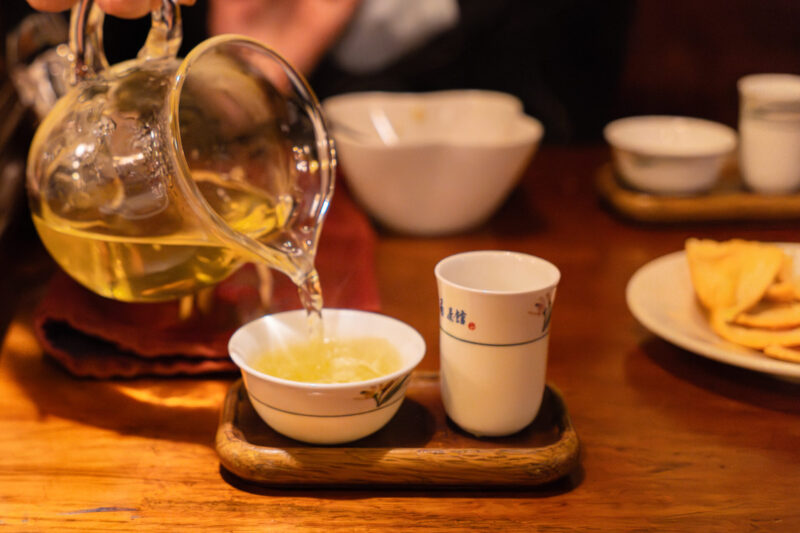
 Ordering pu-erh tea, chasing down steaming bamboo baskets one after another — char siu bao, har gow, siu mai, cheung fun, beef siu mai, ordered in quick succession.


None of it flashy, but that moment of freshness wrapped in steam and fragrance was the real treat. Inside, the mingled sound of chatter and trolley wheels felt like old Hong Kong flowing along unchanged. A place where tradition survives not as spectacle but as genuine daily life — an entirely fitting final meal for the trip.
- ADDRESS
160-164 Wellington St, Central, Hong Kong
About a 5-minute walk from Exit E2 of Sheung Wan MTR Station, or from Central Station
- OPEN
06:00-23:00
- COMMENT
- A storied teahouse with over a century of history — founded in 1889, it remains one of the rare few in Hong Kong still upholding the traditional trolley-service style of dim sum.
Airport Express to the Airport
Dim sum finished, boarding the Airport Express, finally toward the airport. Standing on the platform where “Hong Kong” is spelled out, the end of the trip starts to feel real.

Outside the window, clear skies and green cityscape roll steadily by.
One Last Attempt at Labubu, at the Airport POP MART
Arriving at the airport, the departure lobby is greeted by a large black Labubu monument, plaques of airport codes from around the world — HKG, JFK, PVG — scattered across it.

One final attempt, at the airport’s own POP MART.

In the end, the coveted Labubu proved simply too hard to find at the time, and it never did turn up. From start to finish, five days of testing my luck at the gacha game. Even that became its own kind of Hong Kong memory.
- ADDRESS
Terminal 1, Hong Kong International Airport, Chek Lap Kok, Hong Kong
Located both inside and outside the restricted departure lobby area of Terminal 1, Hong Kong International Airport
- OPEN
07:00-23:00
Typhoons, endless slopes, the Monster Building — and with that, the dense, energetic days in Hong Kong came to a close.
Epilogue | From a Bowl of Congee to the Best Table in the World
Two nights, three days, chasing the gastronomy of Hong Kong.
The Chairman, of Asia’s 50 Best Restaurants — a restaurant that stares directly at the essence of Cantonese cuisine, quietly drawing out the voice of its ingredients through aging and fermentation, standing as one of Hong Kong’s defining tables. In the 2026 rankings released afterward, The Chairman would return to first place for the first time in five years, with Hong Kong’s Wing taking second — a Hong Kong one-two finish. The certainty felt in that meal turned out not to be imagined at all; it felt, later, like getting the answer key confirmed.
And then there was Neighborhood, tucked into a back alley off Hollywood Road — cooking with real breathing room, built on a French foundation woven lightly through with Mediterranean and Asian touches. Casual and unrestrained, yet the precision behind the food was unmistakable.
These two names on the world stage aren’t the full measure of this city’s culinary strength. Yat Lok’s roast goose, Mak’s Noodle’s shrimp wonton noodles, Sang Kee’s kap tai congee, Lin Heung’s trolley-served dim sum — a bowl from a century-old establishment carried the same quiet pride. World-class dishes and back-alley bowls, side by side — that range, I think, is exactly what gives Hong Kong’s food culture its real depth.
The cityscape, still carrying traces of British rule, wears the growing signs of “mainlandization” while somehow holding onto its chaotic, energetic present-day face. A landscape defined by slopes and stairways, the density of its housing blocks, the sheer number of people passing by — a city that drains energy just from walking through it. And precisely because of that, the memory of every dish found in its back alleys stayed all the more vivid.
Which city next, and what dish will be waiting there?
- TAGS