CONTENTS
About GohGan
Concept
Set on the ground floor of “010 BUILDING” in Sumiyoshi, Fukuoka, GohGan bills itself as “Asian French” — French cuisine built around Indian influences at its core.
The restaurant emerged as a collaboration between Goh, one of Fukuoka’s most celebrated French restaurants, and Gaggan, the world-renowned Indian restaurant — a joint venture designed to make genre-defying cooking accessible in a more casual setting.
The cooking is grounded in French technique, fused with Indian spice and ingredients and cooking methods drawn from across Asia. The concept centers on cooking meant to be experienced with all five senses — fragrance, texture, and presentation all treated as equally essential.
Both course and à la carte menus are available, giving the restaurant real gastronomic depth while keeping the experience freer and more casual. It’s a restaurant drawing real attention as a new expression of fine dining, broadcast from Fukuoka out to the world.
About the Chefs
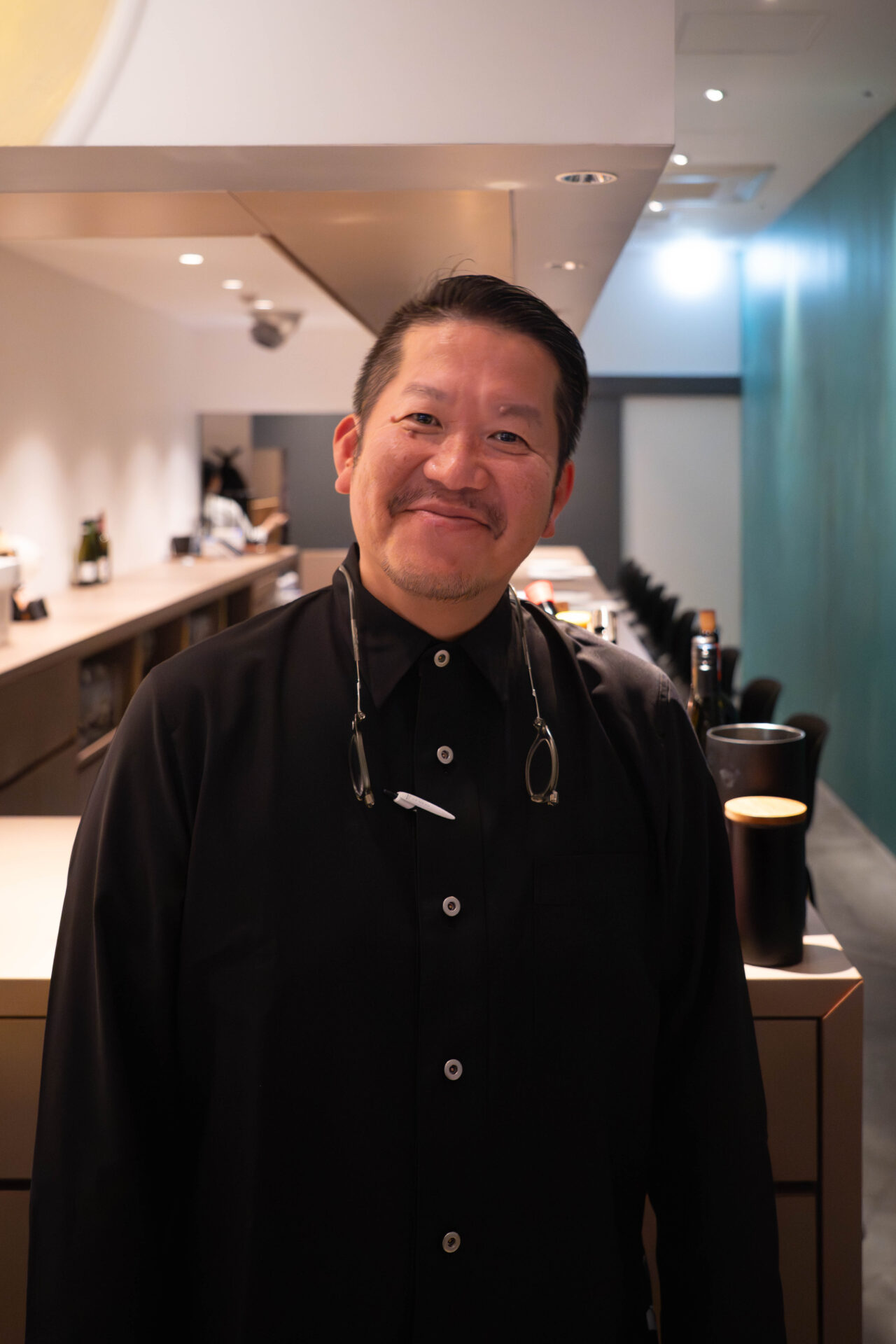
The restaurant is led by two chefs: Goh Fukuyama and Gaggan Anand.
Fukuyama, a French chef born in Fukuoka, opened his own restaurant, La Maison de la Nature Goh, in 2002. Recognized both in Japan and internationally with a Michelin star and a spot on Asia’s 50 Best Restaurants, he’s widely regarded as one of Kyushu’s defining chefs.
His counterpart, Gaggan Anand, is the world-renowned chef behind Gaggan in Bangkok, which claimed the No. 1 spot on Asia’s 50 Best Restaurants four times.
Fukuyama’s originality, built on a French foundation, meets Gaggan’s philosophy of free-thinking, spice-driven cooking that has captivated diners around the world — and where those two sensibilities intersect, GohGan produces a genuinely new form of cooking that reaches beyond any single genre.
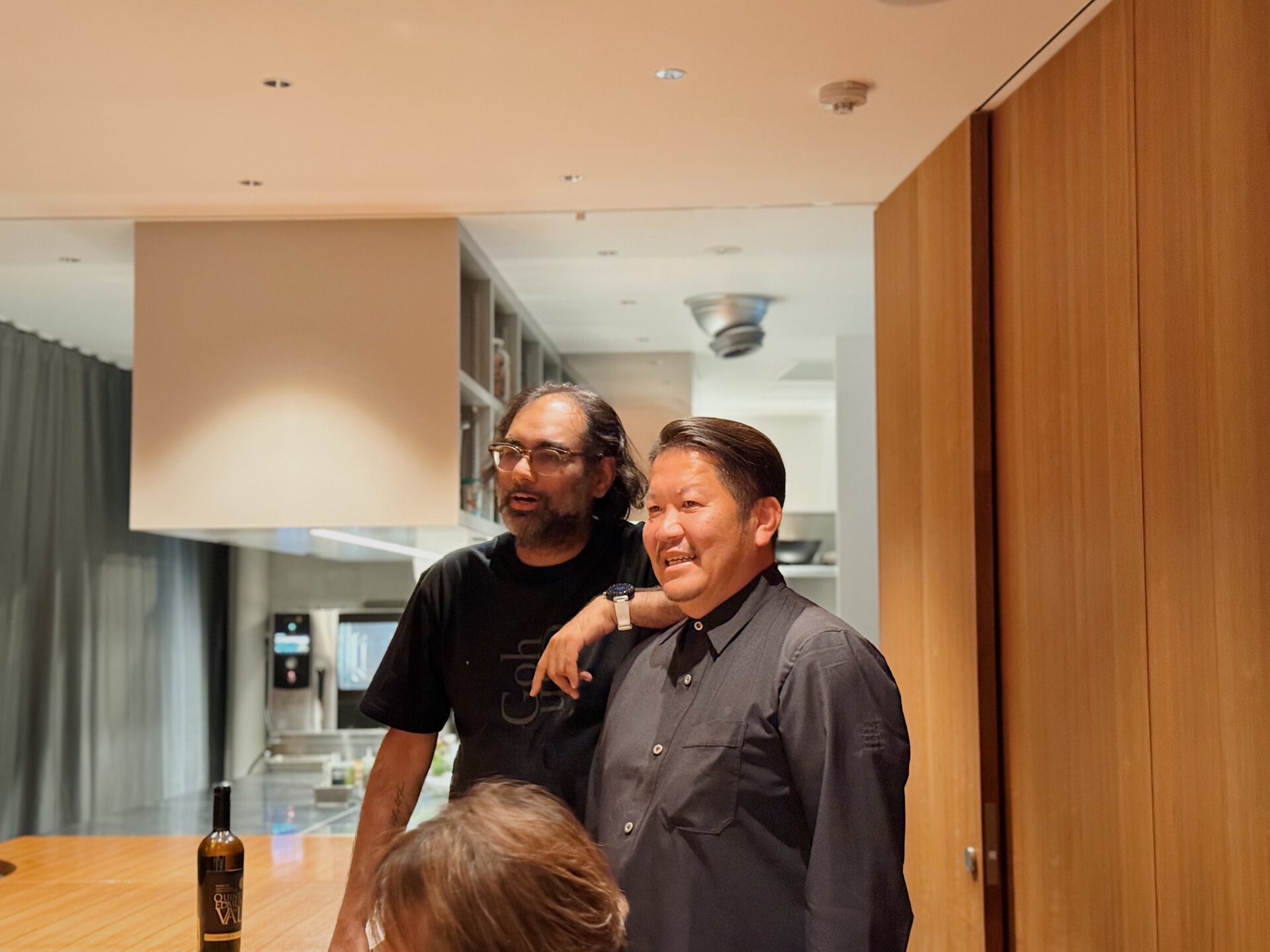 *Photo from a 2023 collaboration event
Recognition & Critical Reputation
As GohGan itself only opened at the end of 2022, it’s a relatively young restaurant, and it has not yet directly received major accolades such as a Michelin star or an Asia’s 50 Best Restaurants ranking under its own name.
That said, the restaurant draws enormous attention purely on the strength of its two co-owner chefs’ track records.
La Maison de la Nature Goh, Chef Fukuyama’s earlier restaurant, appeared on Asia’s 50 Best Restaurants a total of six times, establishing itself as a widely recognized name in Asia’s gastronomy scene.
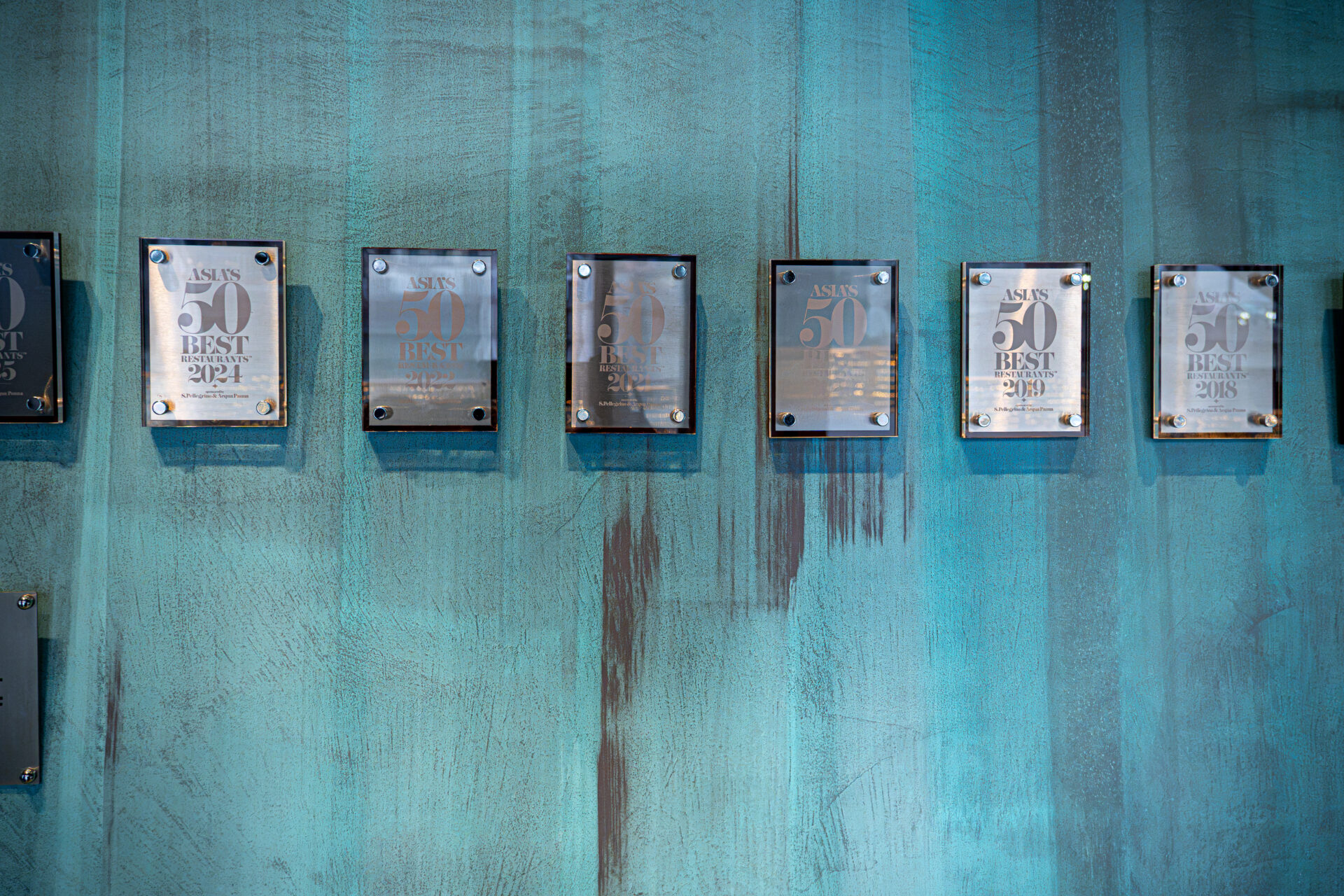
After closing that restaurant in 2022 and relaunching as Goh, the new restaurant ranked 45th on Asia’s 50 Best Restaurants in 2024 — the only restaurant from Kyushu selected that year.
Co-owner Gaggan Anand, meanwhile, is the internationally recognized chef behind Bangkok’s Gaggan, which held the No. 1 spot on Asia’s 50 Best Restaurants for four consecutive years.
GohGan itself has also been named to Tabelog’s “Top 100 Creative/Innovative Cuisine 2025” list, on Japan’s largest restaurant review platform — placing it among the country’s more highly regarded restaurants in its own right.
Given this background, GohGan stands out as a collaborative restaurant between two internationally recognized chefs, and is increasingly seen as one of the defining names in Fukuoka’s gastronomy scene.
Dining Prelude
Exterior & Entrance
GohGan occupies the ground floor of 010 BUILDING, a mixed-use development in Sumiyoshi, Fukuoka. The building’s glass façade is its most striking feature, giving the structure an open quality that lets glimpses of the interior filter softly out to the street.
The entrance avoids heavy decoration, favoring a simple, urban design. Through the large glass panels, the counter and dining atmosphere are visible from outside — despite being a genuine gastronomic restaurant, there’s an easy, unintimidating quality that invites people in naturally.
Even the restaurant’s signage is understated, favoring refinement over spectacle. The entrance captures both the local character of Sumiyoshi and the sense of occasion that comes with a restaurant helmed by world-renowned chefs.
The Dining Space
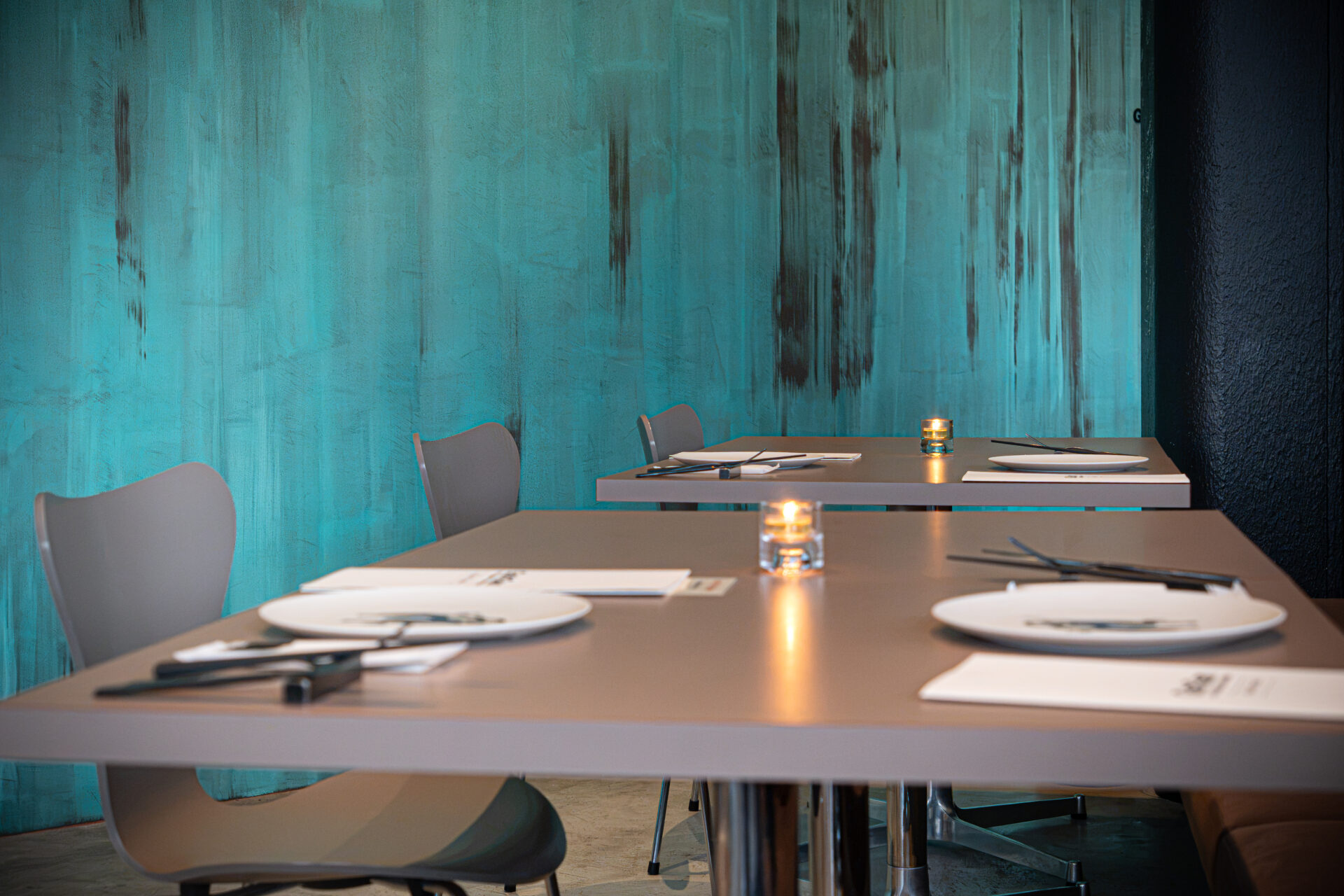
The interior is built around an open kitchen at its center, letting the chefs’ movements and the cooking process come naturally into view. Rather than the tension typical of a fine-dining restaurant, the atmosphere leans toward a lively, live sense of energy.
At the counter, dishes are served with the kitchen visible right up close, close enough to catch the final touches and plating as they happen. Table seating, meanwhile, is arranged with plenty of space, well suited to dining in groups.
The interior favors a modern design built on wood tones and calm colors, with lighting kept deliberately soft. Nothing about it feels overdone — the design naturally draws attention toward the food and conversation.
Despite being a restaurant led by world-renowned chefs, there’s a relaxed atmosphere that lets guests enjoy the food without excessive formality — a space clearly designed to balance genuine gastronomy with real casualness.
Menu Presentation
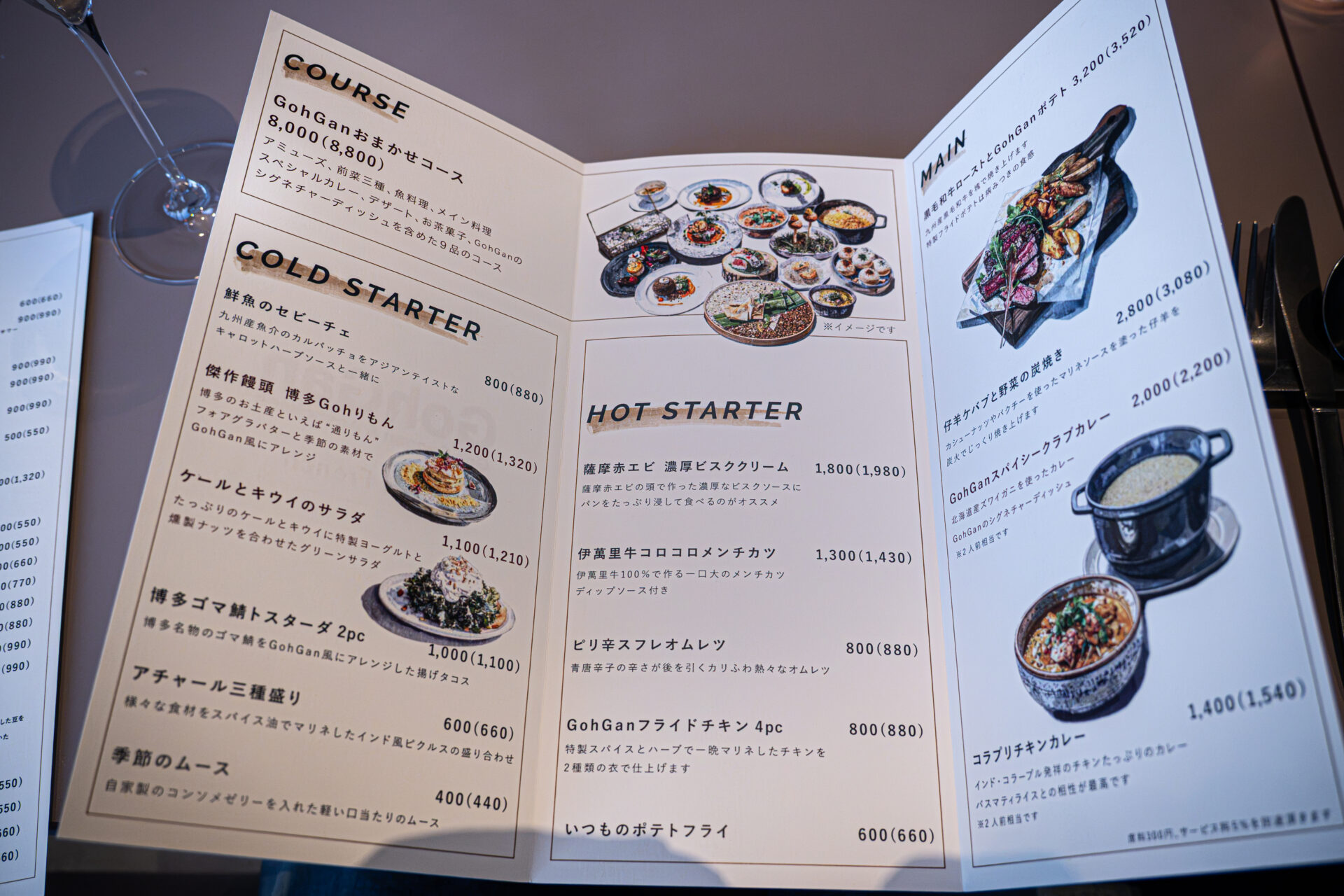
GohGan’s cooking centers on “Asian French” — French technique layered with Indian spice and Asian ingredients throughout. Rather than staying bound to classical French structure, the menu embraces real freedom, incorporating spice, fermentation, and acidity as it sees fit.
The menu offers both a course and à la carte options. Guests can settle in for a full course that showcases the kitchen’s gastronomic technique and ideas, or freely combine a handful of dishes in whatever way suits them.
The lineup runs from light starters and snack-like bites through to seafood, meat, and spice-forward dishes. The Indian influence shows not just in how spices are used, but in dishes built around the ideas of chaat and curry as well.
Fukuoka and Kyushu ingredients feature prominently throughout, and the combination of French technique, spice fragrance, and local produce results in a genuinely distinctive style that refuses to be pinned to any single genre.
Whether taken as a course or à la carte, dishes tend to arrive in relatively small portions, meant to be layered together across the meal. Despite carrying genuine gastronomic weight, the menu structure stays flexible and easy to enjoy freely.
The Tasting
Pani Puri
This visit went with the course rather than à la carte.
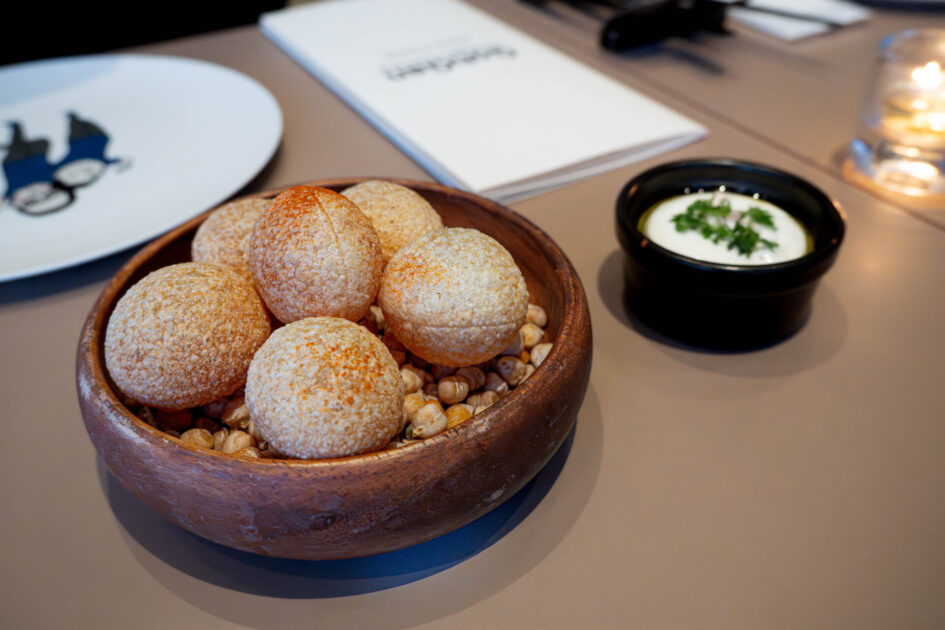
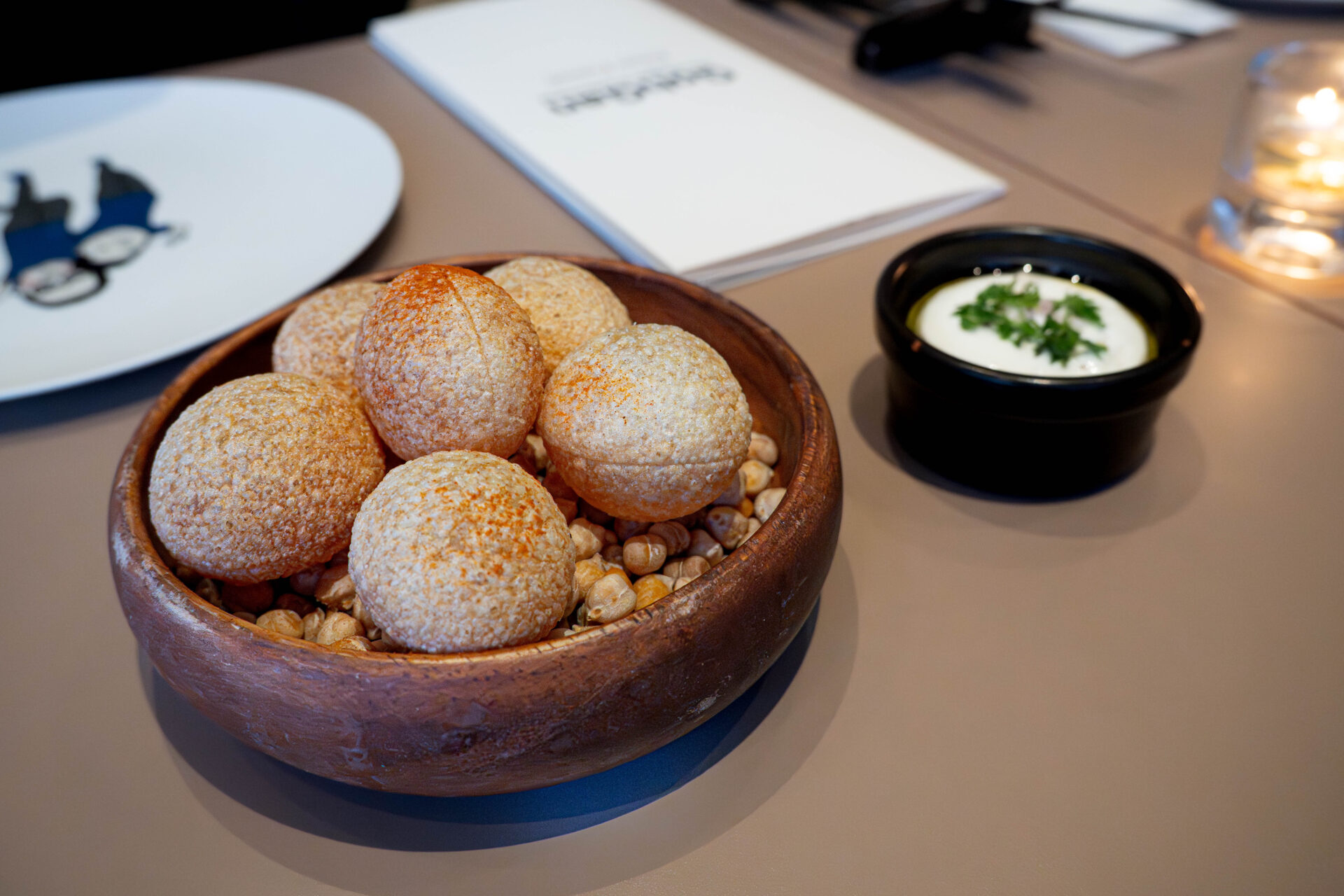
The course opened with pani puri, a well-known Indian street food.
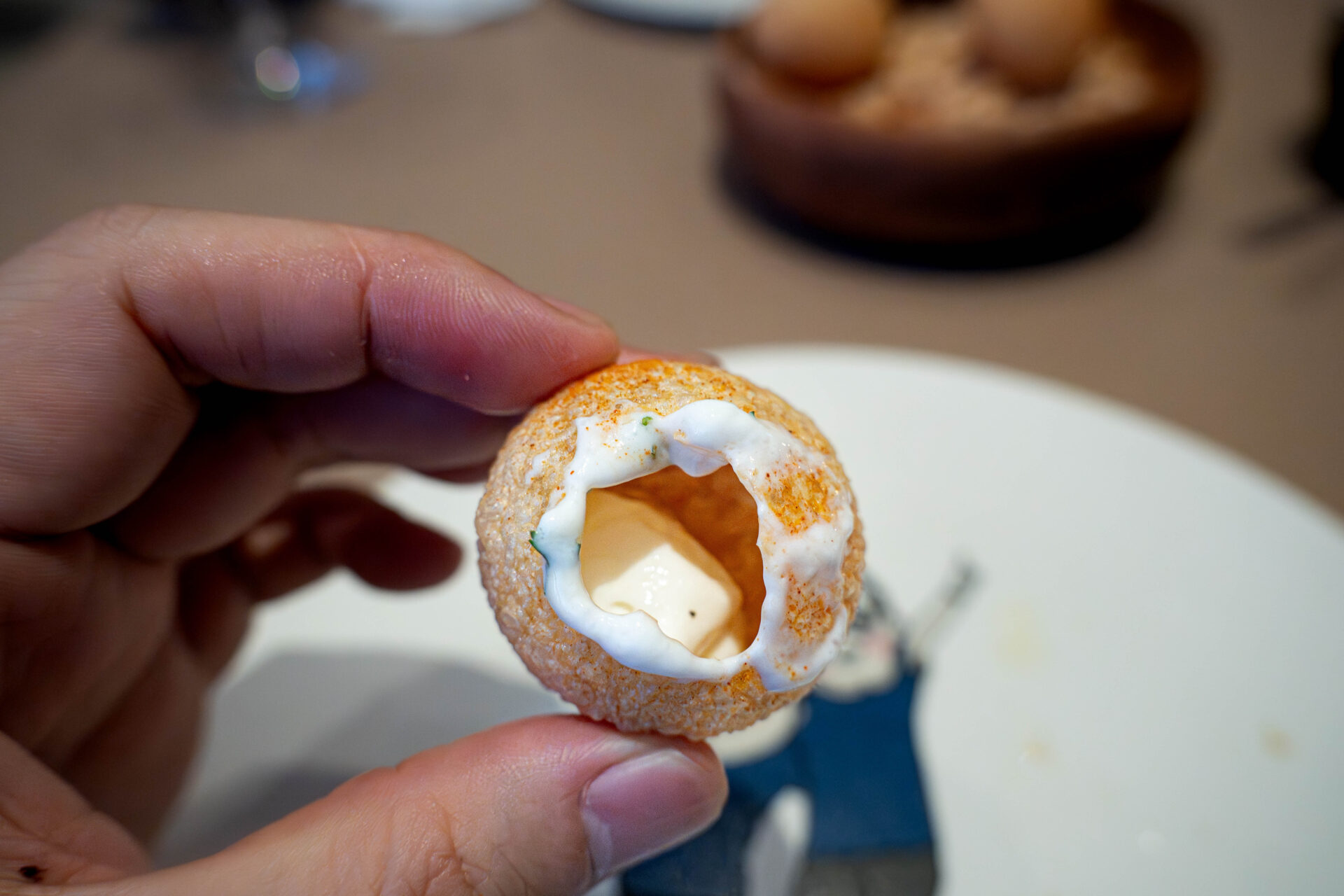
Small, round, puffed fried shells arrive plated, with a yogurt sauce alongside. The idea is to gently crack the shell open with the back of a spoon, pour in the sauce, and eat it right away.
The shell has a light, almost bursting texture, the sauce flooding into the hollow the moment it’s broken open. The yogurt’s gentle acidity comes with a faint hint of spice.
Bite-sized, but the lightness of texture and the nuance of spice both come through clearly. Bringing an Indian street food to open a French tasting menu is exactly the kind of move that defines this restaurant.
As the opening course, it naturally signals the direction the meal is headed.
Chicken Liver Pâté
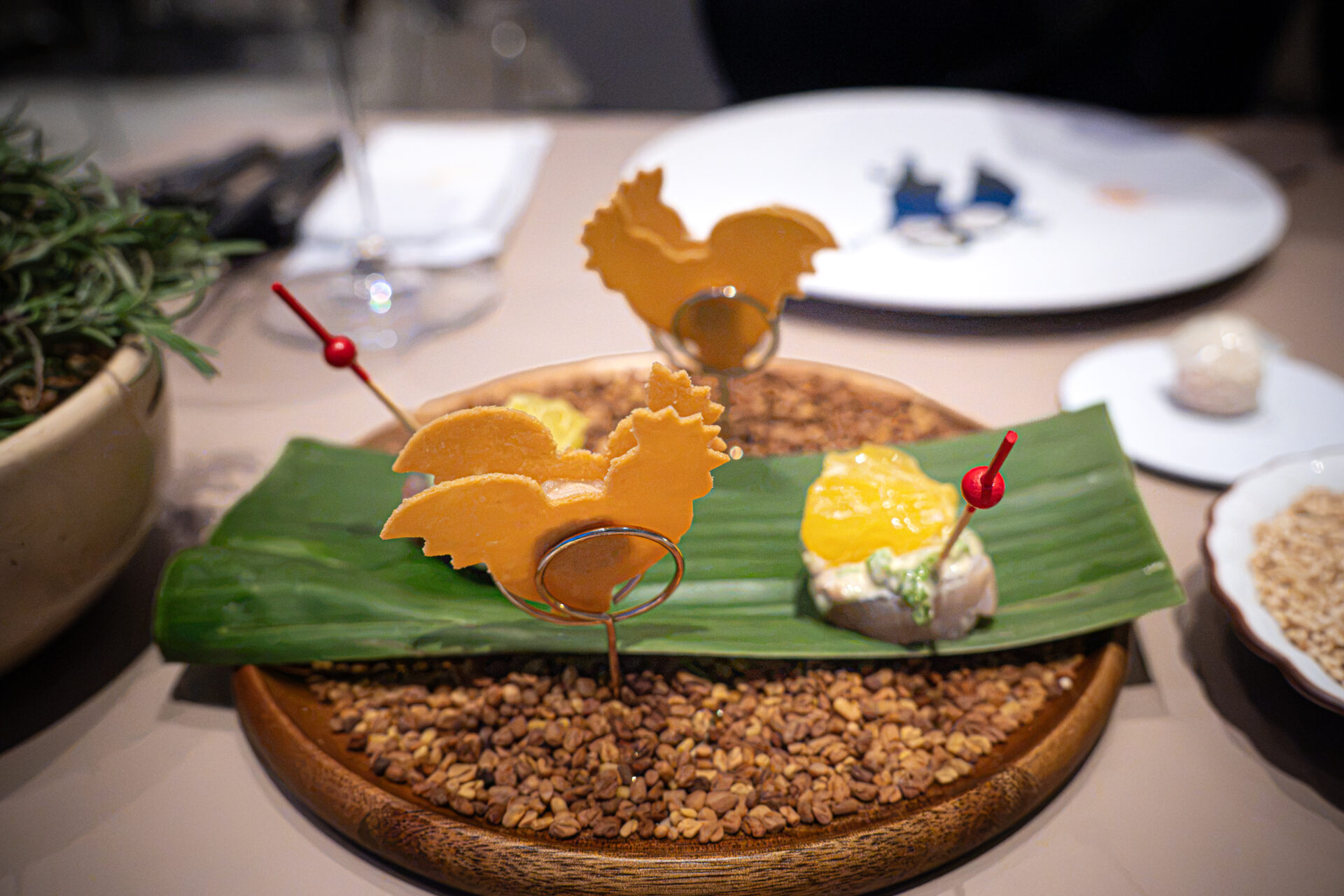
A piece of finger food sandwiching chicken liver pâté between two thin chips cut into the shape of a chicken.
The lightly fried chips carry a crisp texture, with a smooth liver pâté in between. The liver’s richness comes through without ever feeling heavy, sized perfectly for a single bite.
Playful in appearance, but the flavor makes the liver’s umami unmistakably clear — a light, easy way to open the early stretch of the course.
Sawara Sashimi
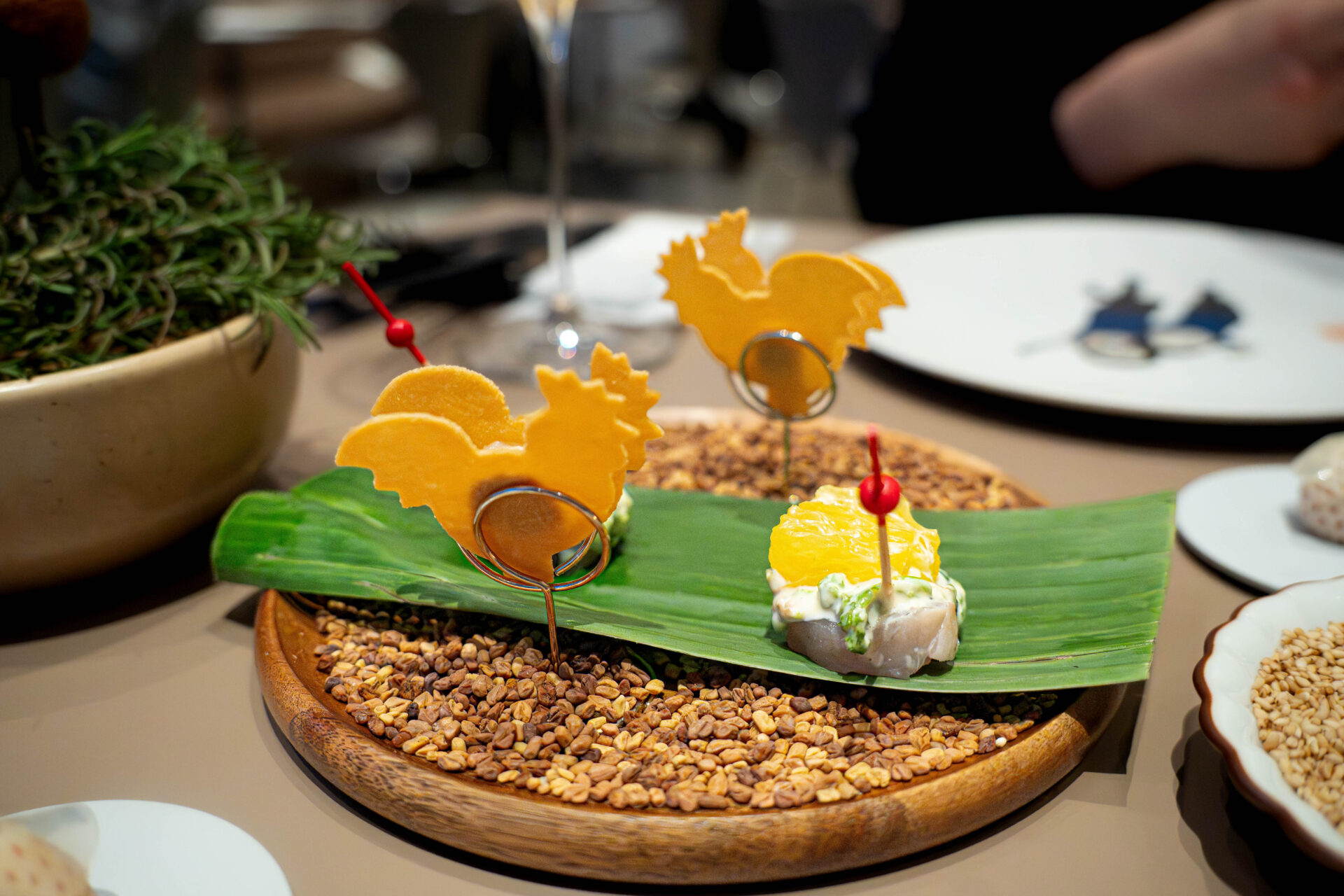
Sawara (Spanish mackerel) sashimi paired with anchovy mayonnaise and seri (Japanese parsley).
Hassaku citrus is added on top, its bright acidity and faint bitterness serving as an accent.
The sawara’s gentle fat meets the anchovy’s salinity and the mayonnaise’s richness, while the seri’s green fragrance and the hassaku’s citrus nuance layer in on top, keeping the whole dish light.
A simple ingredient — sashimi — paired with a French sauce and citrus acidity, making for a fittingly light dish this early in the course.
Persimmon Pork Dog
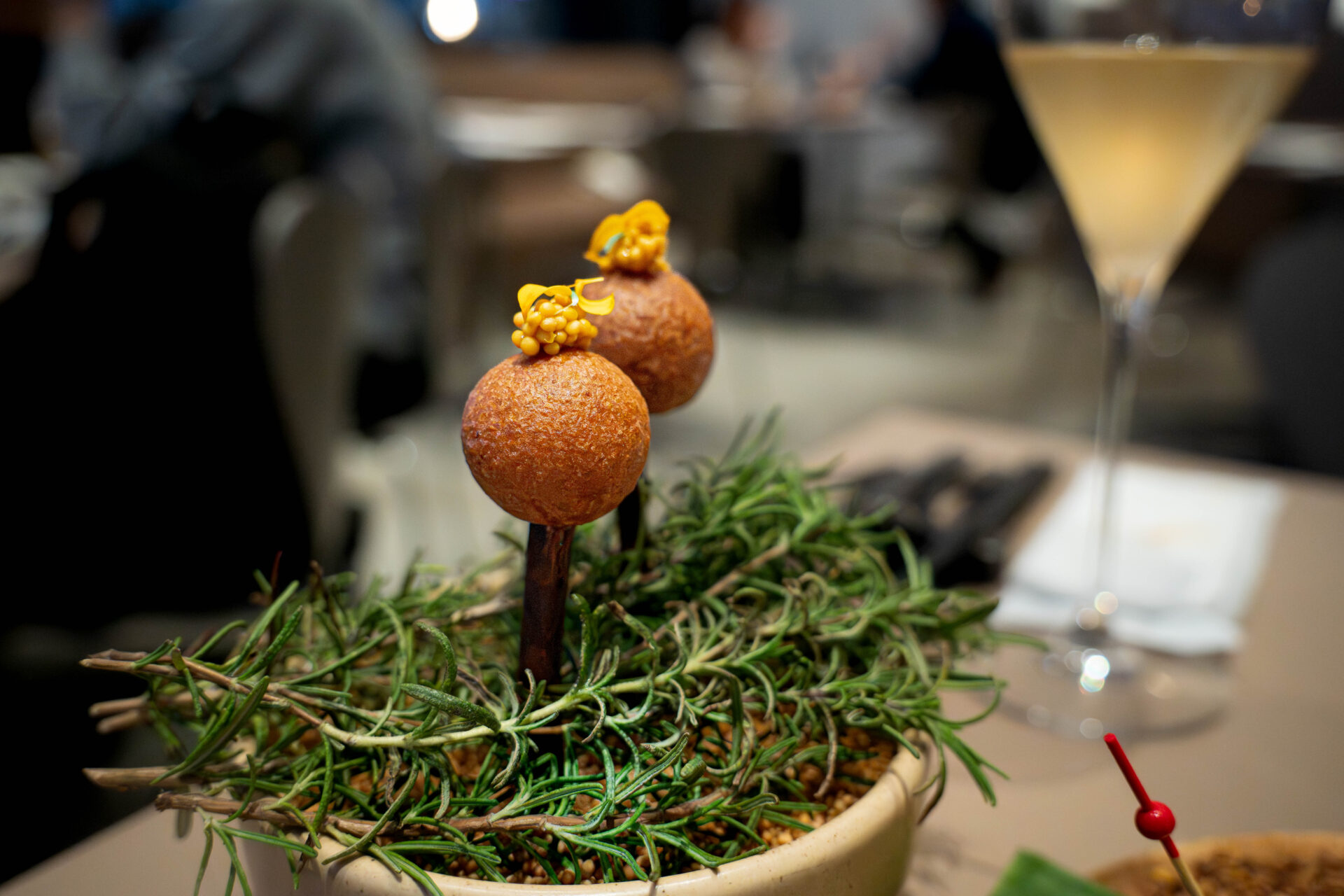
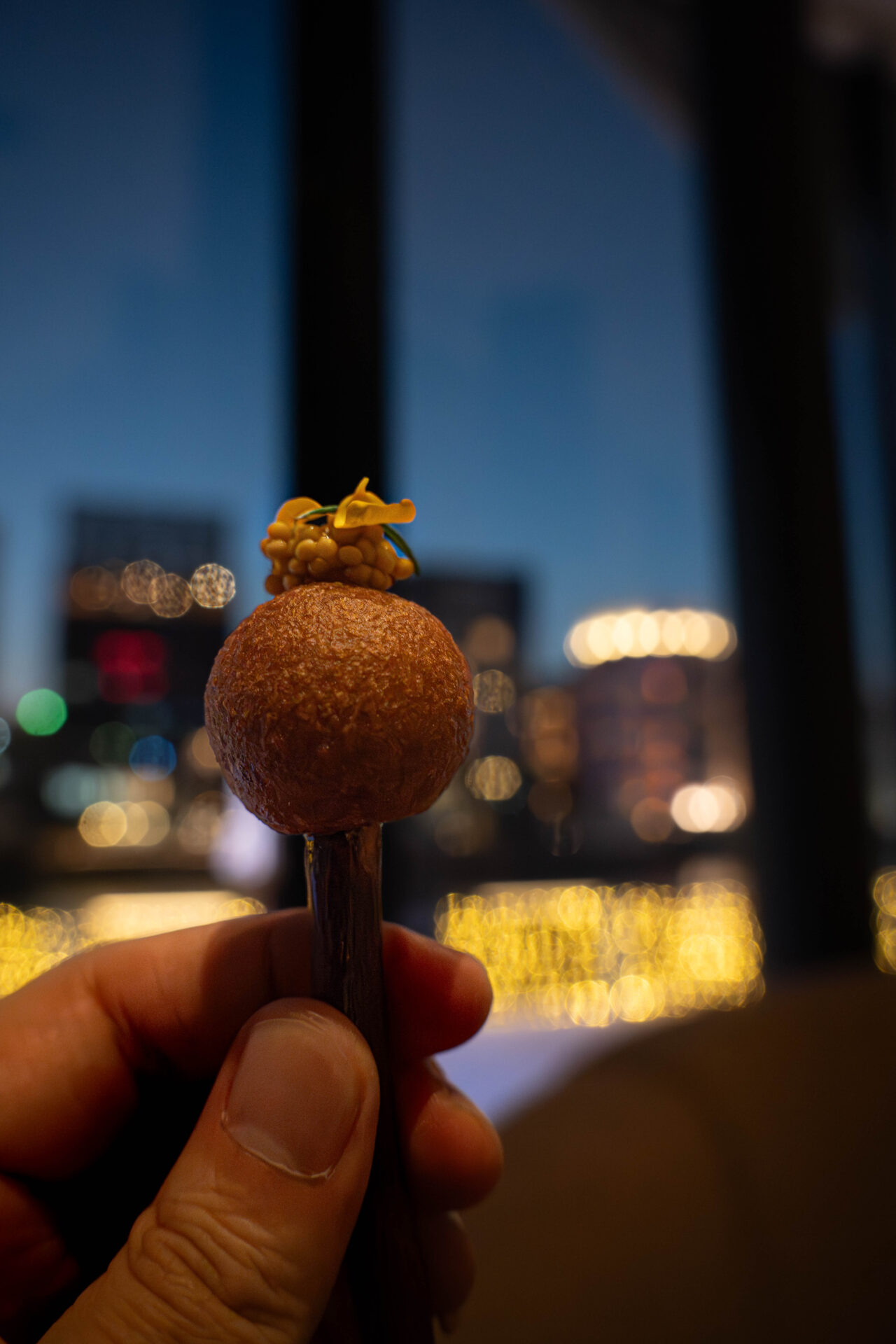
Arriving on a skewer in a round shape: the persimmon pork dog.
Made with pork raised by River Wild, a producer in Ukiha, Fukuoka. The pigs are fed local persimmons, resulting in meat known for its balance of fatty sweetness and rich umami.
That pork is worked into a corn-dog-style preparation. The batter fries up fragrant and crisp, releasing the pork’s full umami the moment you bite in.
Playful in appearance, but built around a genuinely local ingredient reworked into street-food form — exactly the kind of idea this restaurant is known for.
Amid the course’s brisk pace, this stood out as one of the more memorable pieces of finger food.
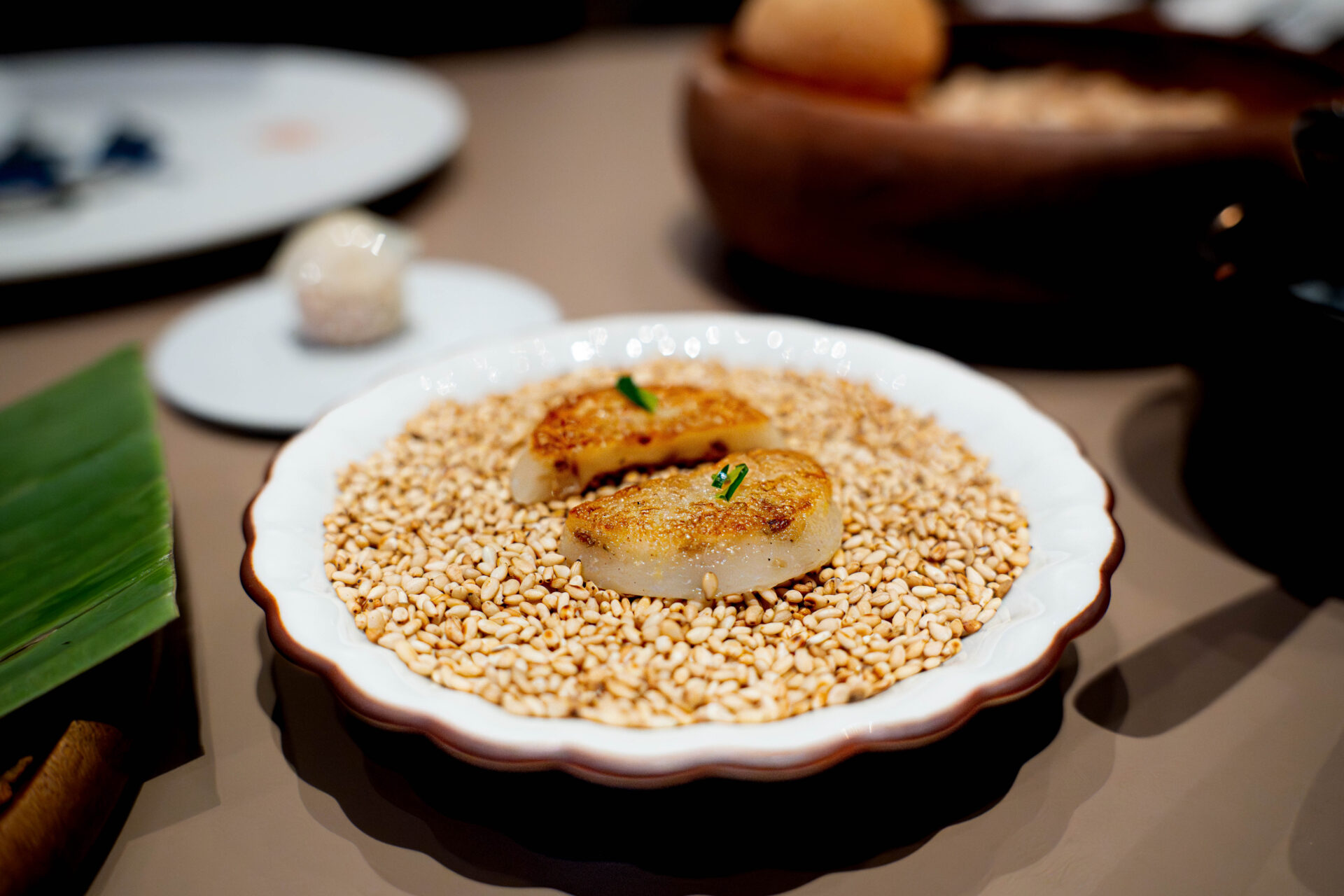
Pankee
Pankee, a dish from Gujarat in western India.
Rice-flour batter fermented with yogurt, then grilled to a fragrant char on the surface. The first bite reveals a chewy, almost mochi-like texture.
Spice is worked into the batter itself, with a green chili on the side sharpening the flavor further. The gentle acidity from fermentation meets the spice’s fragrance, giving this simple dish surprising depth.
A dish that draws on Indian fermentation while working in as a light, playful accent within the course.
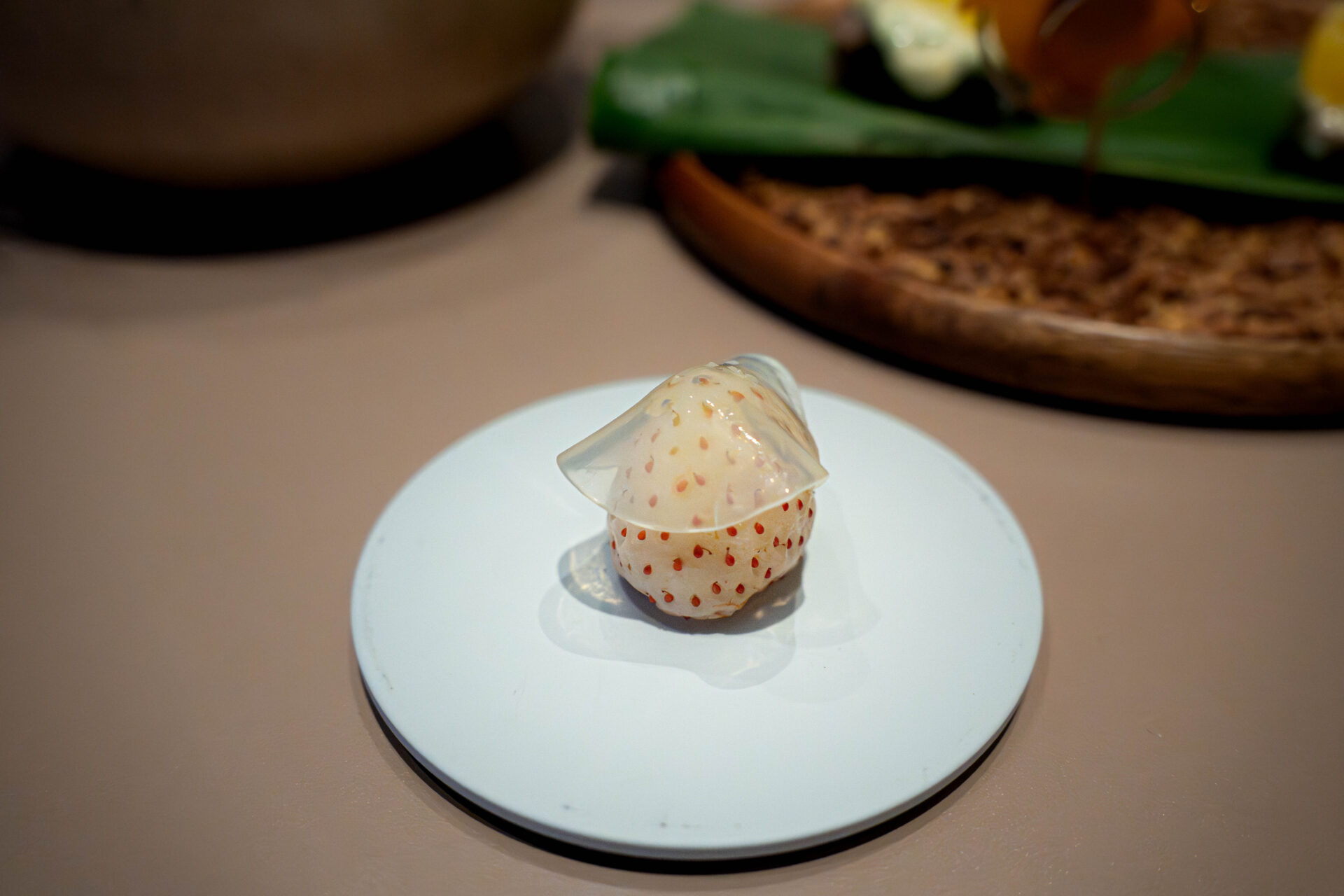
White Strawberry
Served on a small plate: a dish built around white strawberry.
A thin sheet of whey jelly sits over the strawberry, the whey’s gentle acidity meeting the fruit’s delicate sweetness.
The jelly is thin and soft, never getting in the way of the strawberry’s freshness and leaving a light finish. A small dish that resets the palate early in the course.
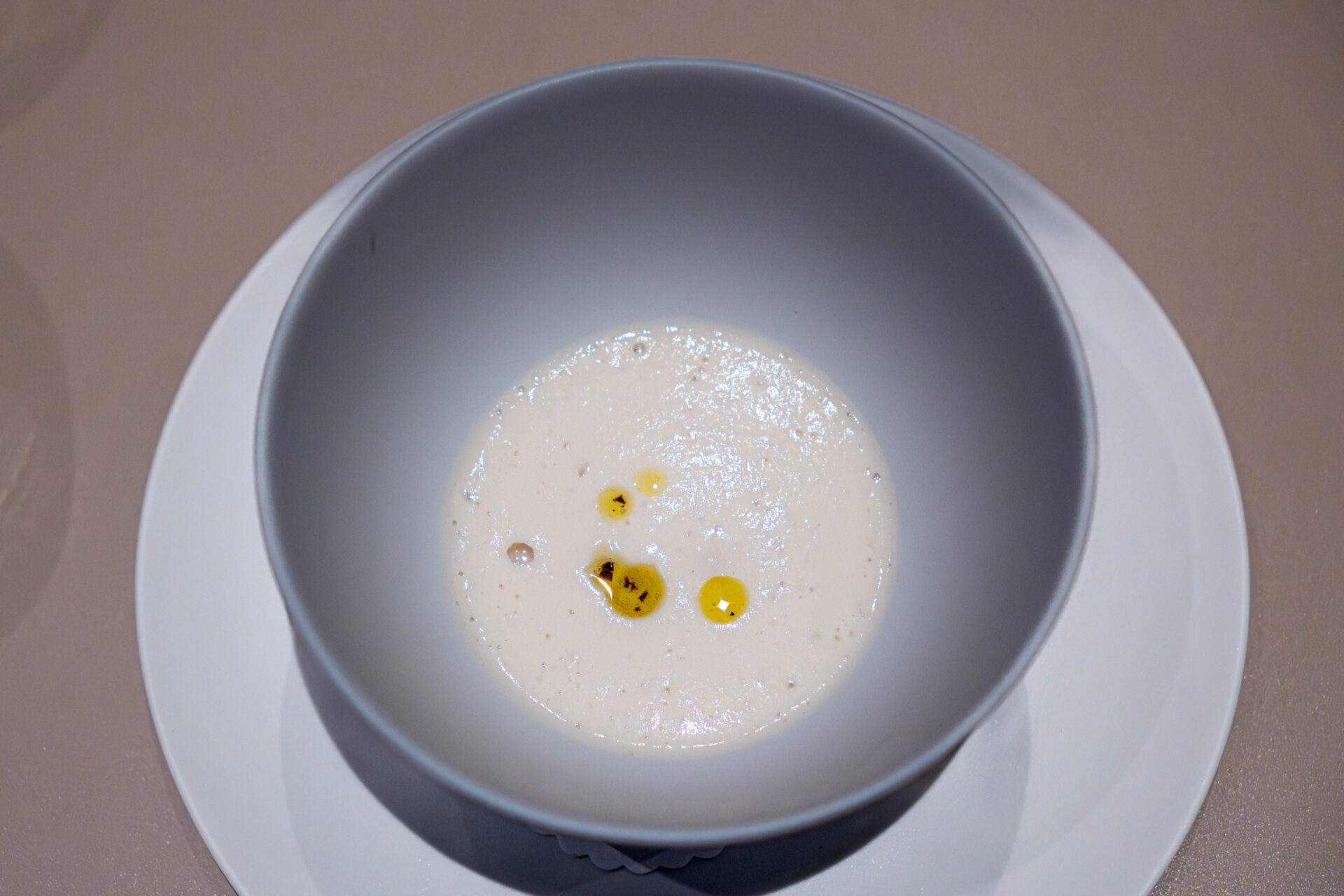
Jerusalem Artichoke Mousse
Next came a Jerusalem artichoke mousse.
Built on the artichoke’s gentle sweetness, layered with blue cheese’s richness, finished with a few drops of truffle oil. Light and airy in texture.
The artichoke’s faint earthiness meets the blue cheese’s salt and umami, with the truffle’s fragrance opening up at the very end.
Nothing overly assertive, the dish stays light throughout — a small plate built around seasonal ingredients, tucked in between courses.
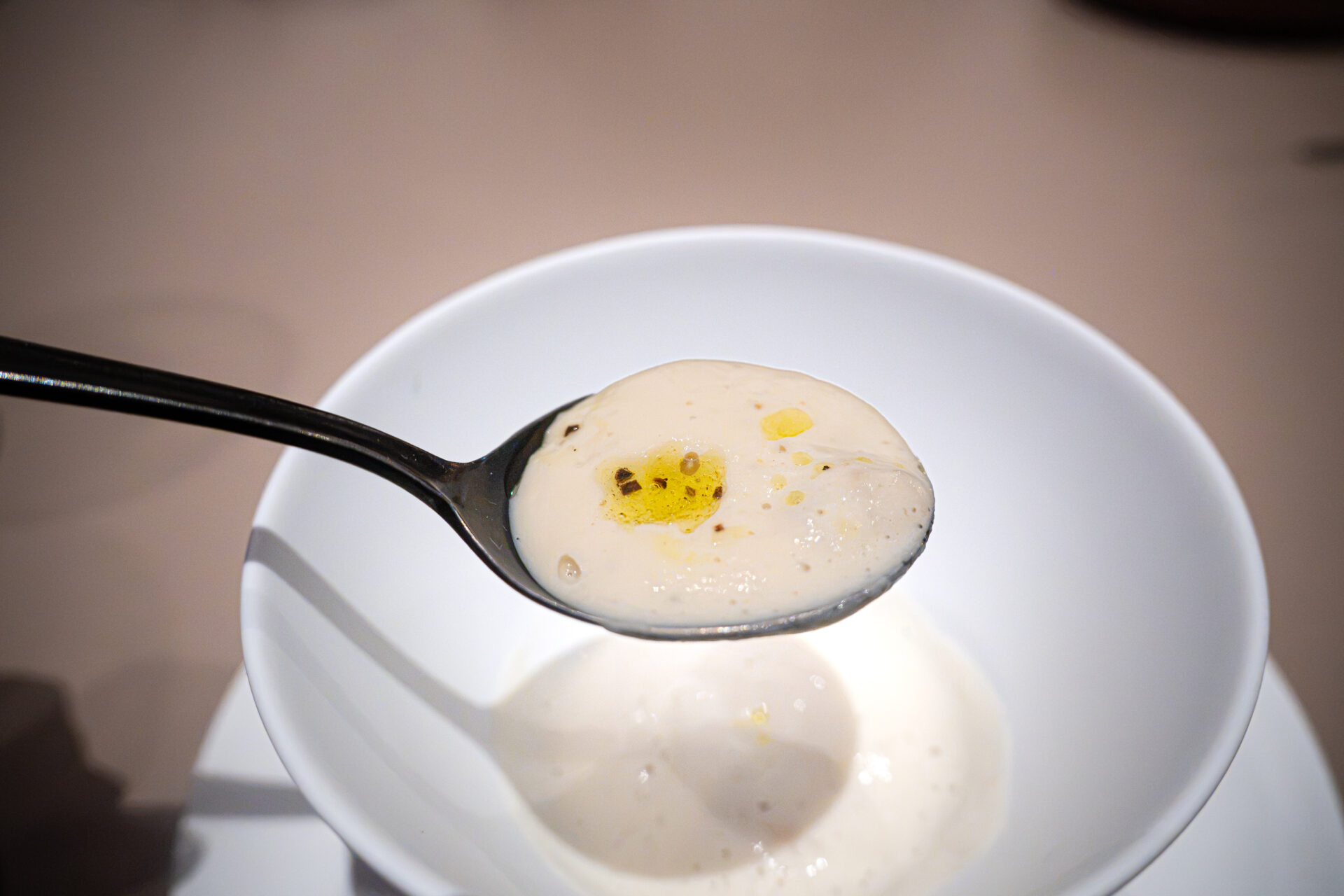
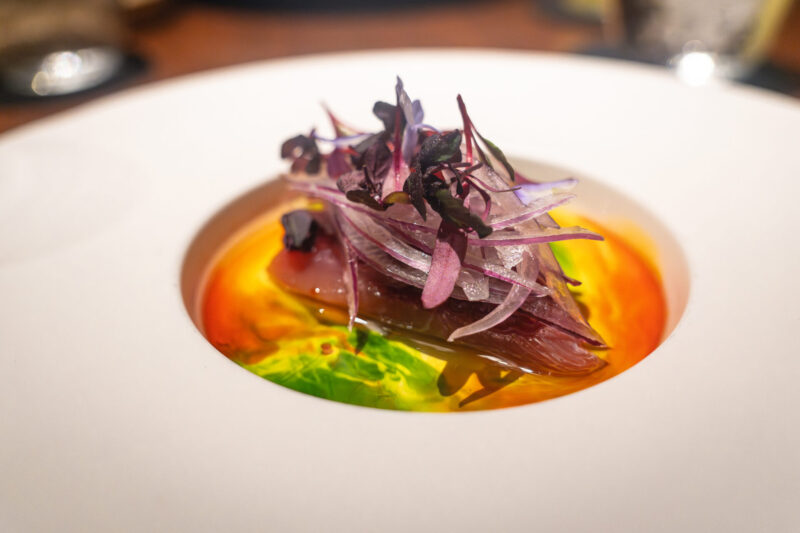
Bijin Buri (Yellowtail)
A dish built around Bijin Buri, yellowtail from Oita Prefecture.
Raised on a feed of sake lees, the fish is known for its rich fat and clean finish. The flesh comes out tender, almost translucent.
Thin slices of yellowtail are layered mille-feuille-style with daikon greens. Herbs and mustard seed are scattered on top, adding both fragrance and texture.
The yellowtail’s fat meets the daikon greens’ faint bitterness and the herbs’ fragrance, keeping the overall impression light — a simply constructed appetizer that lets the ingredients speak for themselves.
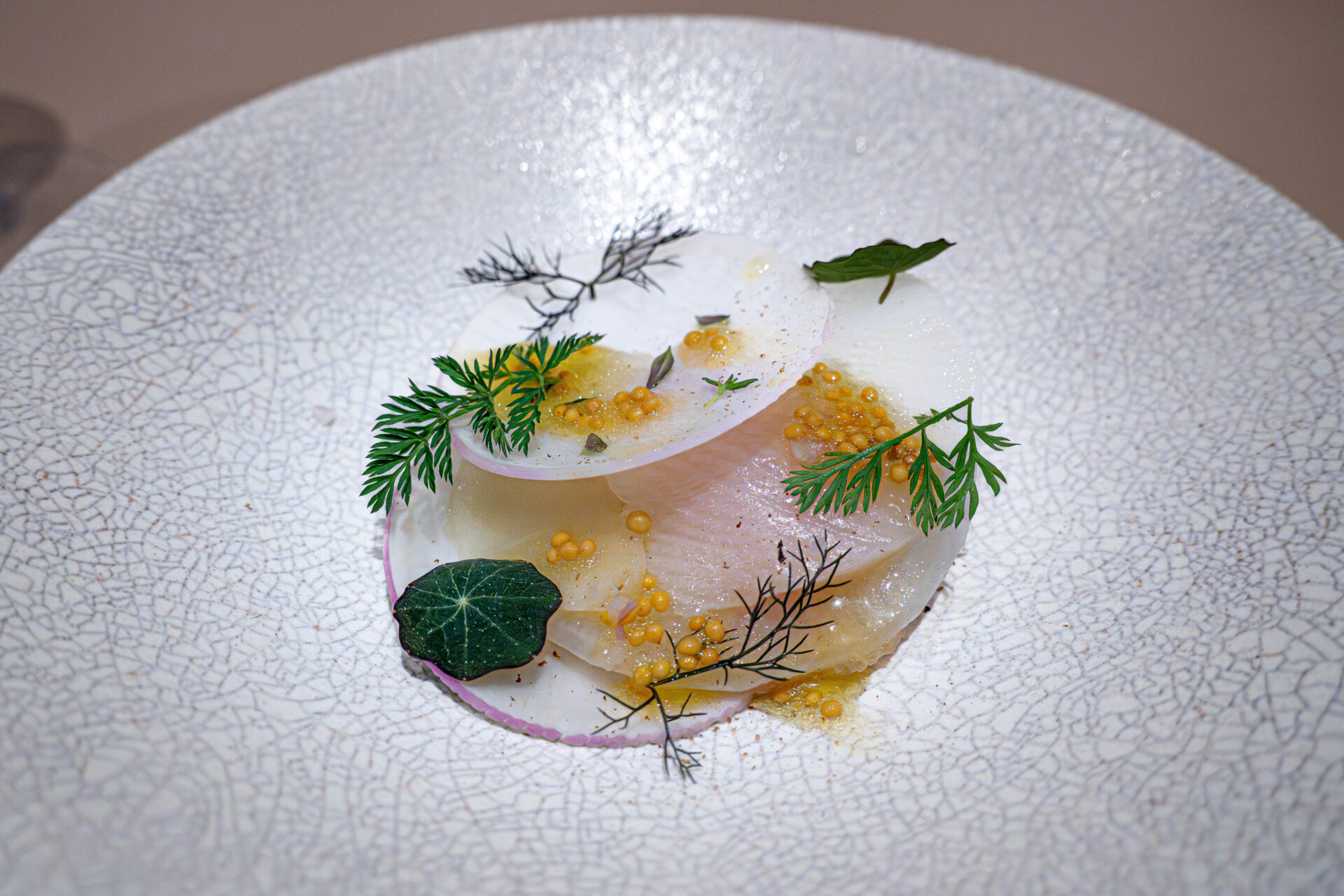
Masterpiece Manju Hakata: “Goh-rimon”
A dish reworking Hakata Torimon, Meigetsudo’s famous Fukuoka confection. Its name: “Masterpiece Manju Hakata: Goh-rimon.”
Between the soft, moist dough sits a sandwich of foie gras cream and tamarind jam. The torimon’s gentle sweetness meets the foie gras’s richness and the tamarind’s acidity.
On the side, a kumquat sauce and a kumquat compote scented with Earl Grey. Bright citrus acidity and tea fragrance round out and lighten the whole dish.
Built on a classic Fukuoka confection but layered with French sensibility and spice — a genuinely playful dish, characteristic of GohGan.
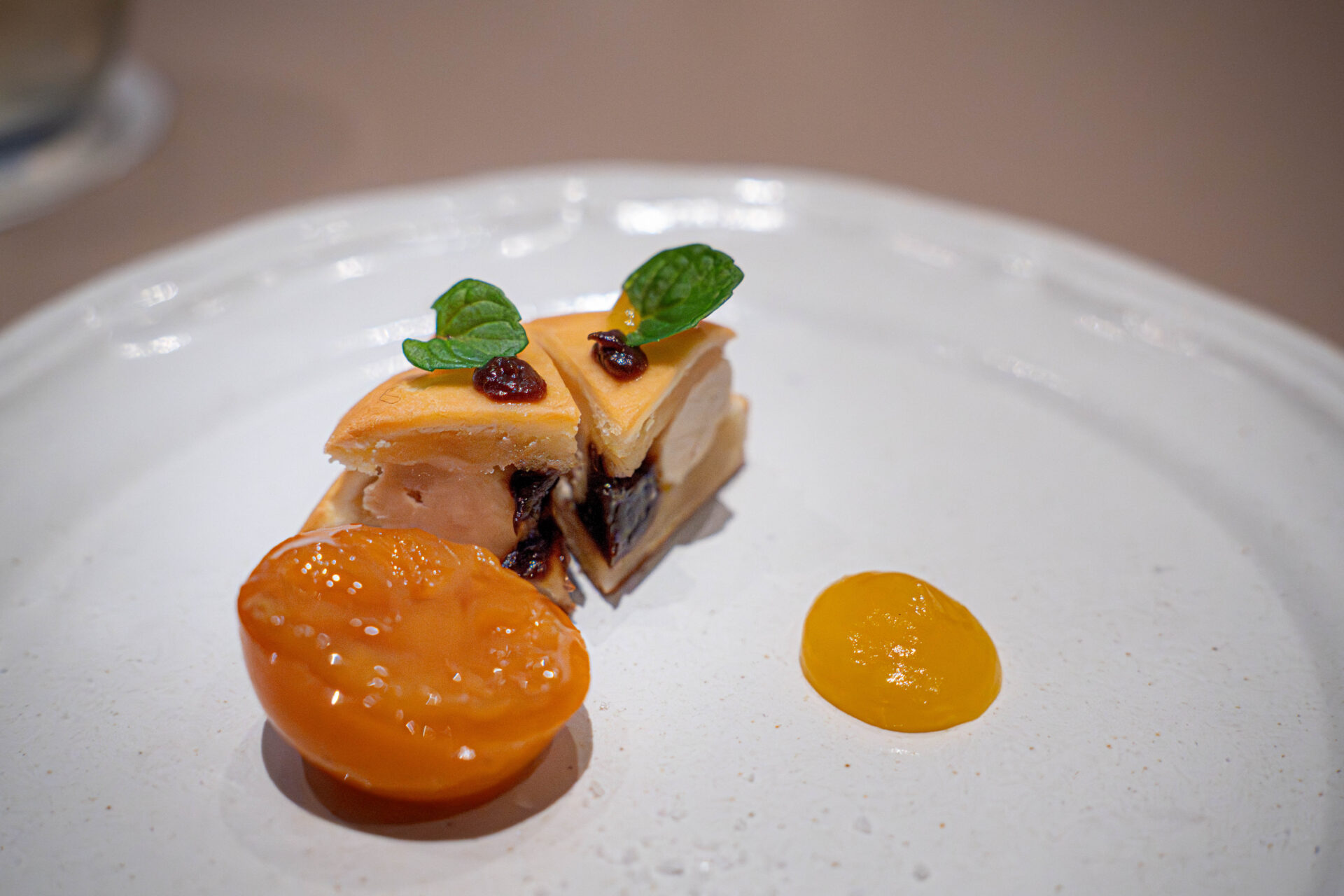
Kamae Flounder and Yellow Carrot
A dish built around flounder from Kamae, Oita.
The flounder is steamed through, topped with thinly cut yellow carrot.
Careful moisture control leaves the fish moist yet firm in texture.
The sauce is white-wine based — a light preparation that lets the flounder’s sweetness come through.
Hakata Wagyu Sirloin
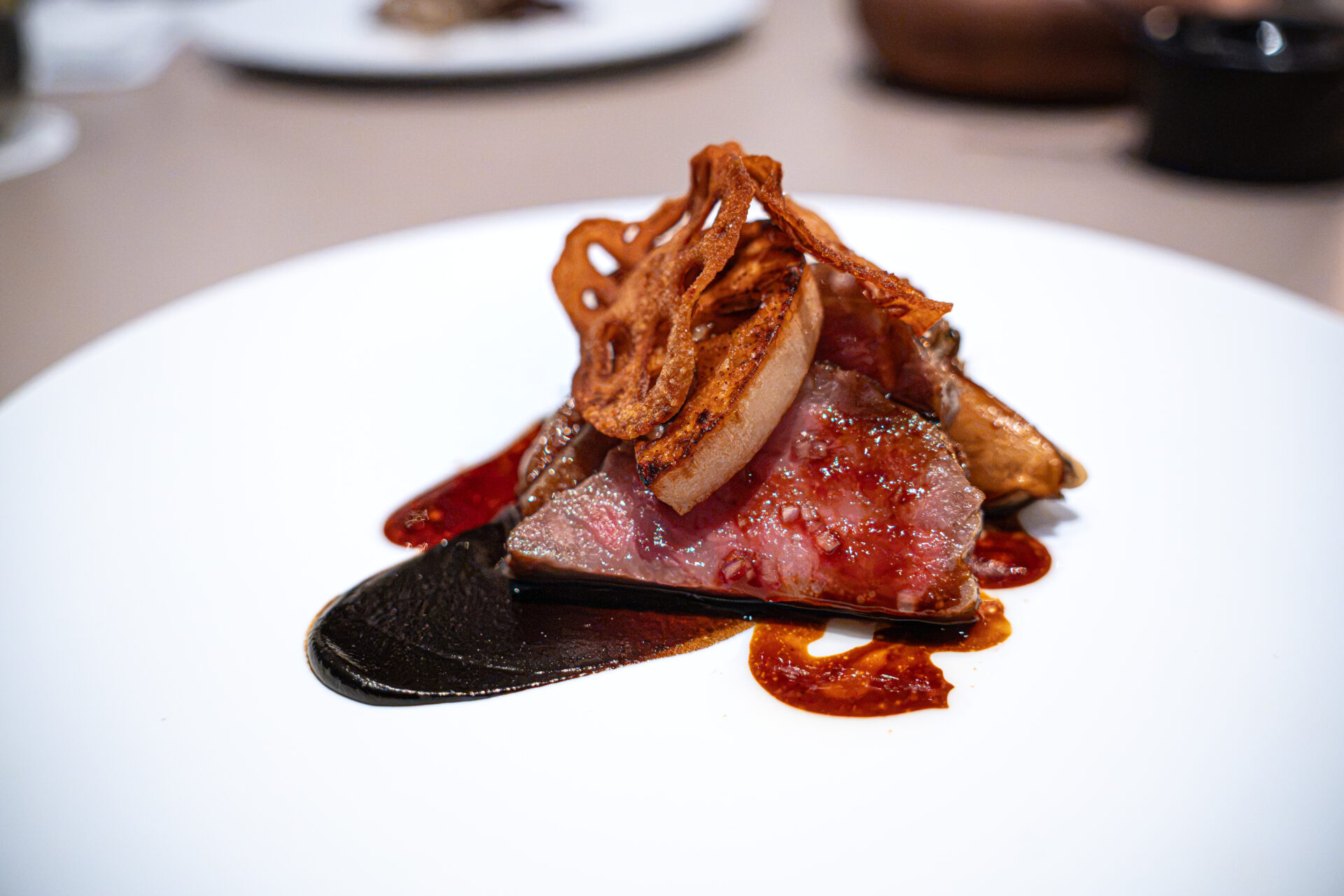
The main course: Hakata wagyu sirloin.
Cooked to a moist medium, the balance between the lean meat’s umami and the fat’s sweetness comes through clearly. Sautéed maitake mushroom sits beneath, its fragrant char supporting the meat’s richness.
The sauce is a black garlic mayonnaise, its distinctive depth and sweetness adding real dimension to the meat.
On top, Wakimizu lotus root from Chikuzen, Fukuoka, served two ways — as chips and boiled. The fragrance and clean bite add a light contrast to the meat course.
Beef Shigure Okaki
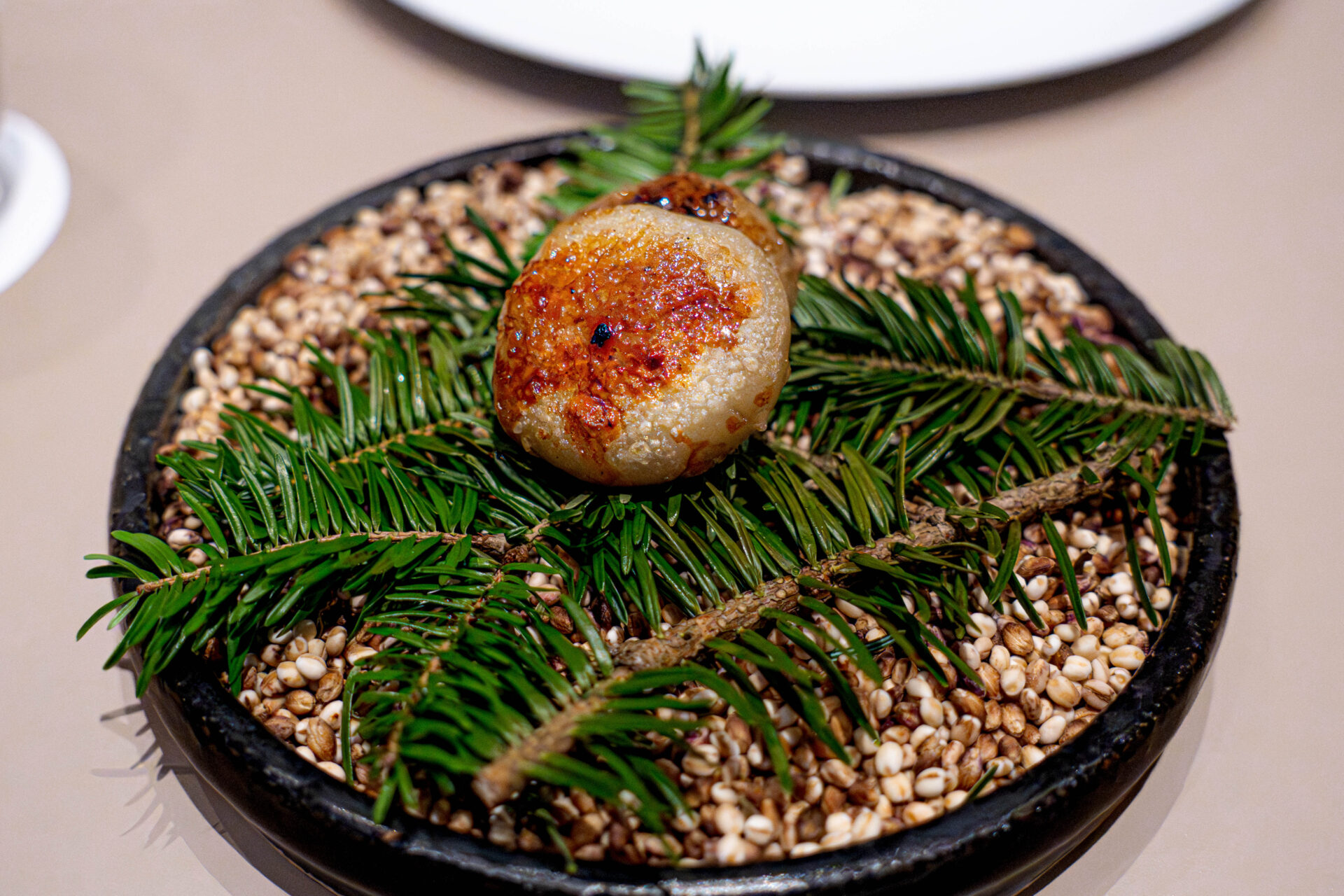
Served alongside the meat course: beef shigure okaki.
A bite-sized rice cracker made from glutinous rice, wrapped around sweet-savory simmered beef shigure-ni. Fragrant on the outside, releasing the beef’s umami within.
A playful dish, but one that also serves to carry the main course’s lingering flavor forward.
Spicy Crab Curry
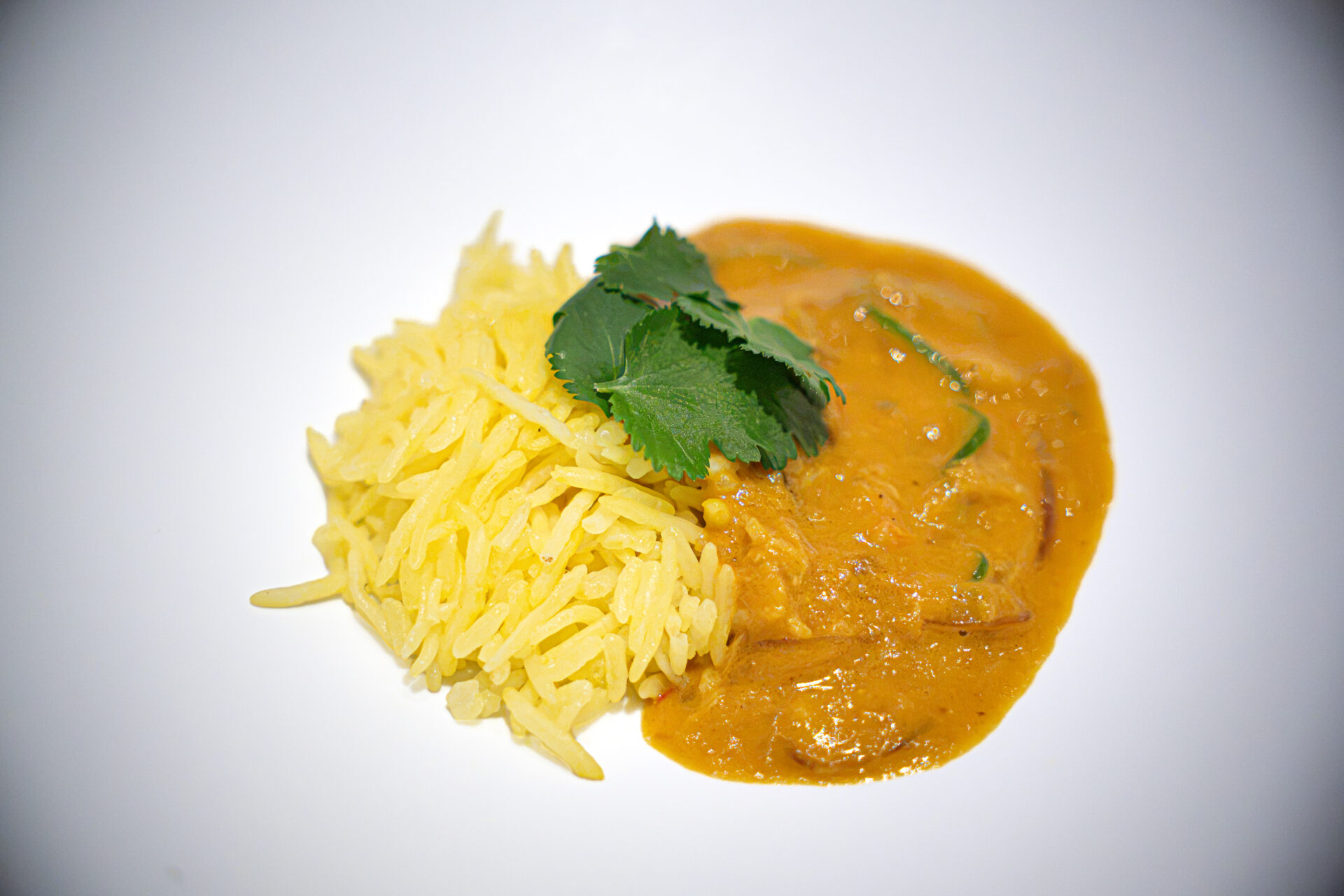
Closing the savory courses: one of GohGan’s signature dishes, spicy crab curry.
Made with Hokkaido snow crab. The picked crab meat is worked into a curry built on a proprietary spice blend and coconut cream.
Spicy in aroma, but coconut’s gentle richness wraps around the whole dish, leaving a surprisingly mild flavor overall. The crab’s umami comes through clearly.
Paired with basmati rice, cooked in a Staub pot — light and fluffy, pairing well with the spiced curry.
Arriving at the close of the course, this dish stands as a fitting emblem of GohGan’s cooking — French technique meeting the flavors of India and Thailand, Gaggan’s home base.
Dessert & Finale
Mont Blanc
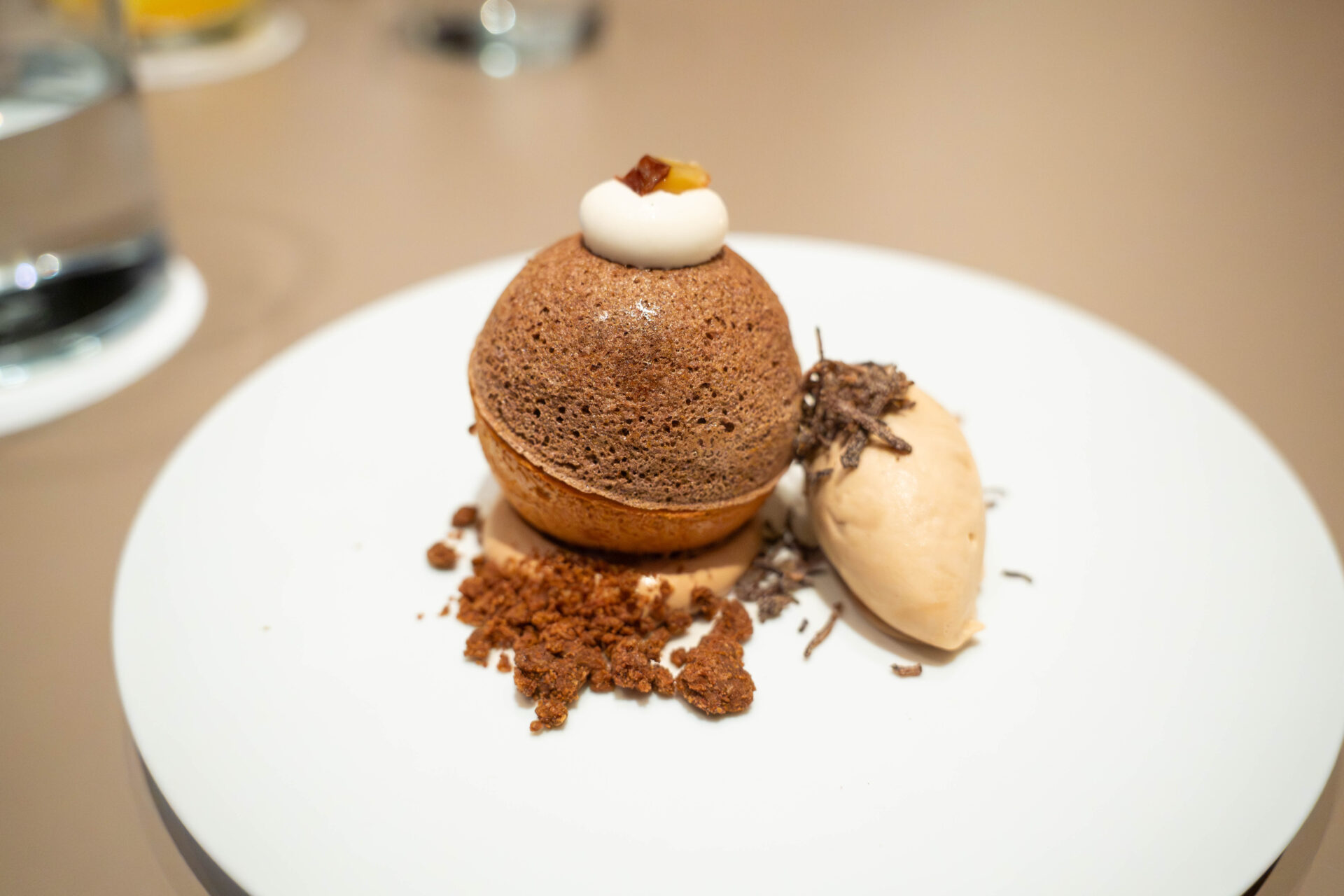
Dessert is GohGan’s signature spherical Mont Blanc.
Inside the dome-shaped exterior sits a marron cream and candied chestnut made with chestnuts from Ukiha. Once served, the sphere is broken open with a spoon and eaten together with the cream inside.
The light outer shell gives way to a smooth marron cream within, its rich, gentle sweetness spreading out.
Ice cream and crumble on the side add textural and temperature contrast — a fittingly light dessert to close out the course, leaving a clean finish.
Petit Fours
The course closes with small confections.
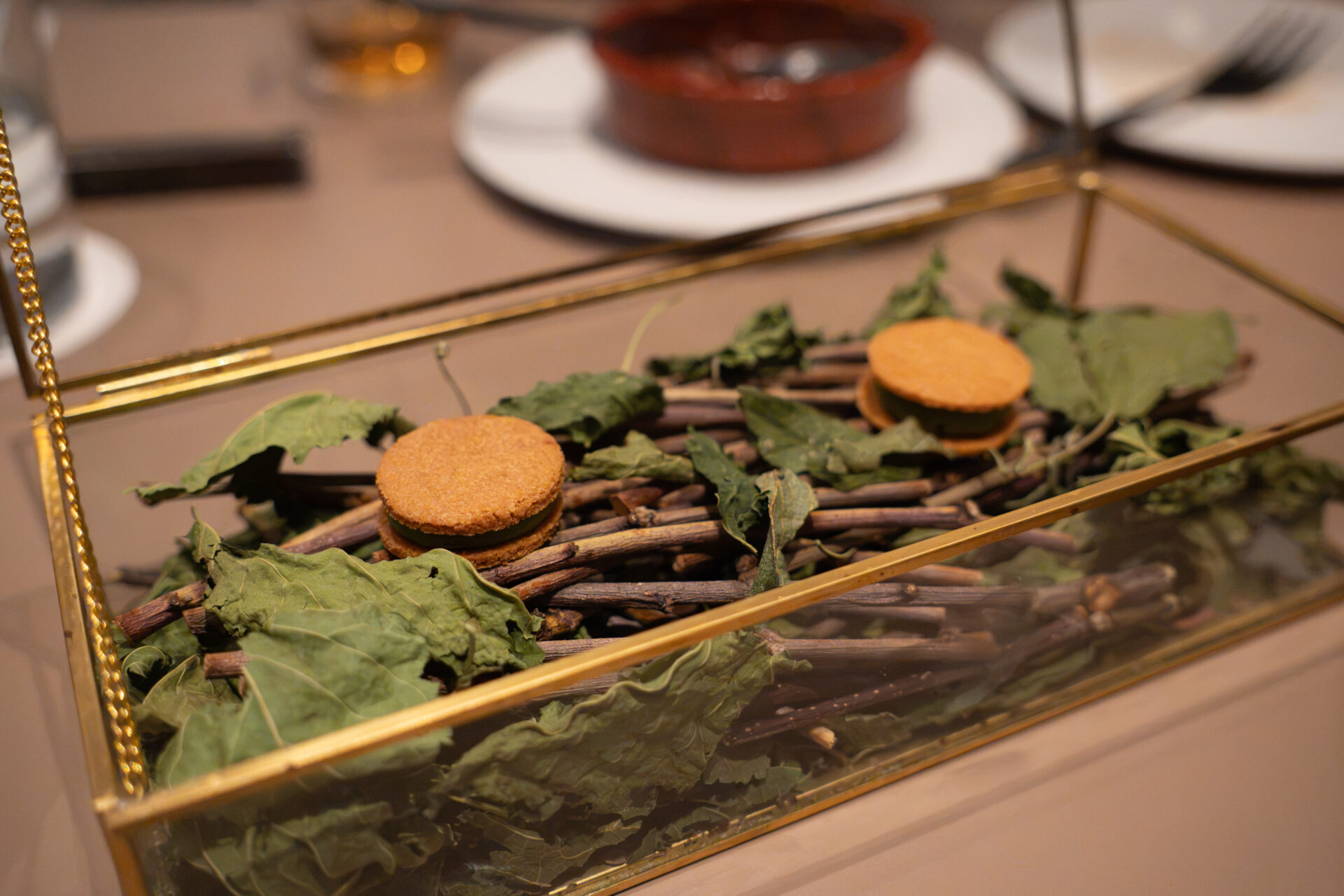
Arranged in a glass case are crisp cookie sandwiches.
Filled with cream, a gentle sweetness that closes out the course’s lingering flavors. A presentation that keeps things enjoyable right to the very end.
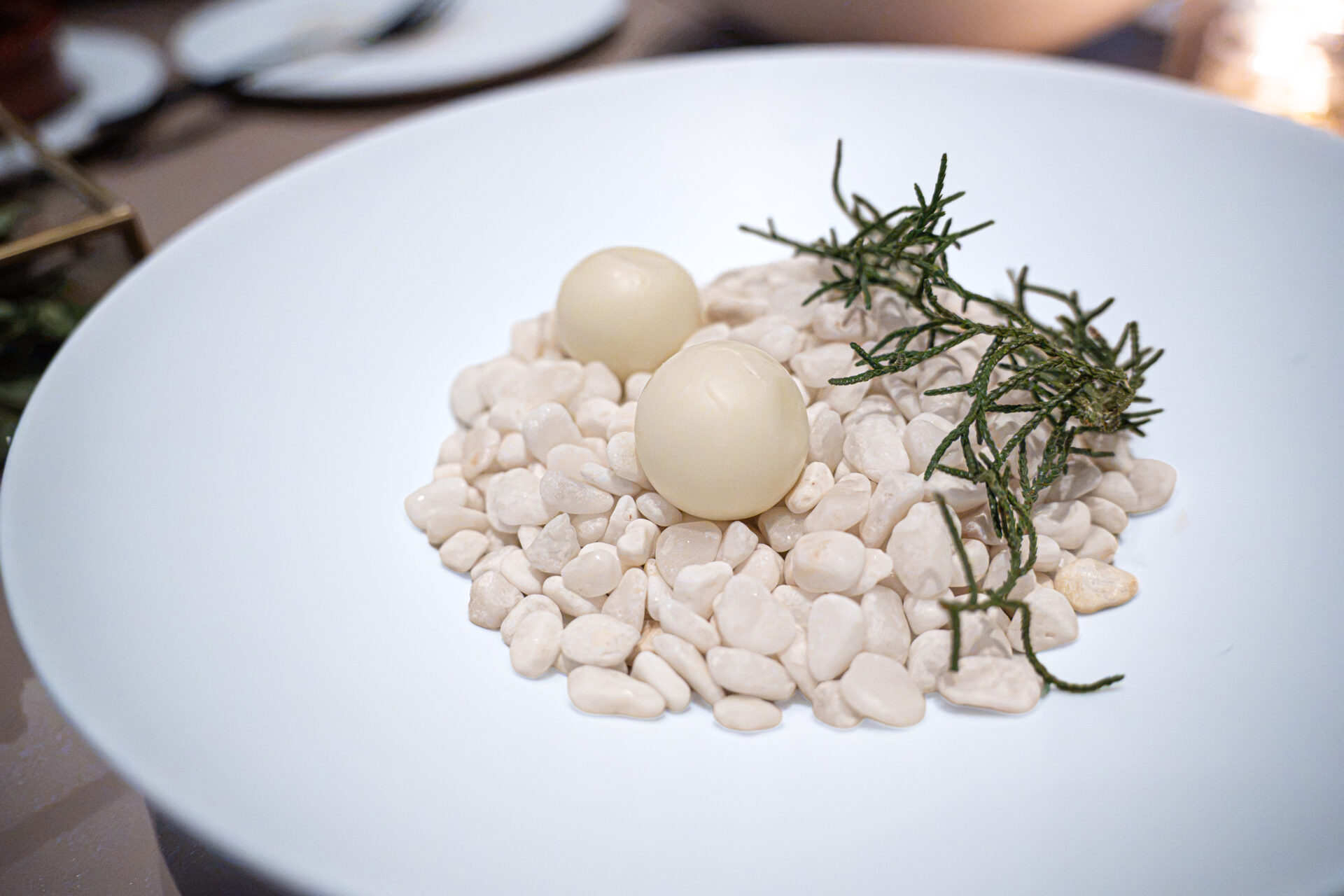
A second confection follows, served in a dish reminiscent of white pebbles — small, round, bite-sized treats offered as petits fours to finish the meal.
A small sweet to enjoy at leisure alongside coffee or tea, bringing the meal to its close.
Final Thoughts
GohGan’s course layers Indian spice and fermentation onto a French technical foundation. Opening with pani puri and moving through finger food, fish, meat, and finally the signature spicy crab curry, the meal’s flow refuses to stay bound to any single genre.
What stands out is how thoroughly Kyushu ingredients — flounder from Kamae in Oita, Hakata wagyu, lotus root from Chikuzen — are worked into dishes built on spice, citrus, and fermentation. Dishes like the “Goh-rimon,” reworking Fukuoka’s classic Hakata Torimon, bring genuine local culture into the cooking with real playfulness.
Above all, the closing spicy crab curry stands as this restaurant’s defining dish — spice’s fragrance, coconut’s gentle richness, and the snow crab’s umami coming together to leave real satisfaction at the meal’s close.
Throughout, GohGan’s identity comes through clearly: fusing French and Indian culinary traditions without strain, expressed with real playfulness. Despite its gastronomic weight, the restaurant never feels overly formal — a place that makes the sheer pleasure of eating unmistakably clear.
Reservations & Access
GohGan is located on the ground floor of 010 BUILDING in Sumiyoshi, Hakata Ward, Fukuoka City. Reservations can be made by phone or online — restaurant details are available on the official website, with bookings also possible through Ikyu.com. Phone: 092-281-0555.
Access: about a 5-minute walk from Kushida-jinja-mae Station on the Fukuoka City Subway Nanakuma Line. Located in 010 BUILDING along the Naka River, the restaurant offers both indoor seating and a riverside terrace.
According to the official website, current hours are lunch on Saturdays, Sundays, and public holidays from 12:00–3:00 PM, and dinner from 5:00–10:00 PM. Closed Mondays, with holidays shifted to the following day when they fall on a Monday. Note that some booking sites list dinner hours varying by day of the week, so confirming the latest information at time of reservation is recommended.
| Item | Details |
|---|---|
| Name | GohGan |
| Address | 010 BUILDING 1F, 1-4-17 Sumiyoshi, Hakata-ku, Fukuoka City, Fukuoka Prefecture |
| Access | About a 5-minute walk from Kushida-jinja-mae Station (Nanakuma Subway Line) |
| Phone | 092-281-0555 |
| Lunch | Sat, Sun & public holidays, 12:00 PM–3:00 PM |
| Dinner | 5:00 PM–10:00 PM (varies by day) |
| Closed | Mondays (shifted to the following day on public holidays) |
| Reservations | By phone or online |
| Official website | GohGan official website |
| Online booking | Ikyu.com | GohGan reservation page |
| Building website | 010 BUILDING |
*As hours and closing days are subject to change, checking the official website or booking page for the latest information before your visit is recommended.
- TAGS
We’ll create a journey tailored to your interests.