CONTENTS
About Hiruzen Eel Specialty Restaurant “Ryo”
Concept
“Eel Specialty Restaurant Ryo” sits quietly in a small hamlet in Chuwa Village, tucked among the mountains of Hiruzen Highland in Okayama.
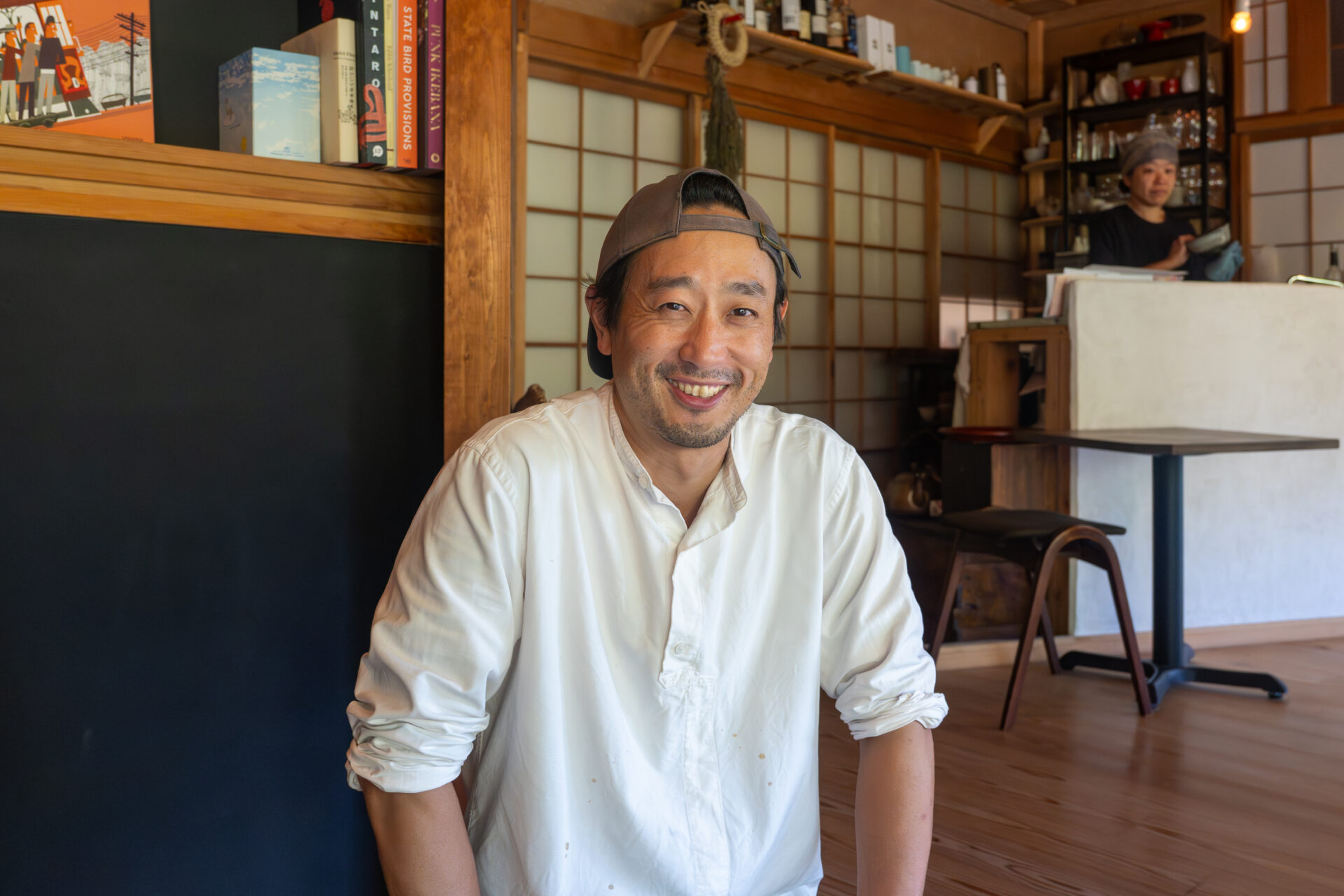
The owner, who ran an eel restaurant in Nakameguro, Tokyo that earned a Michelin star two years running, relocated here in the spring of 2020 to rediscover his cooking amid nature.
He uses 28°C hot-spring water that wells up right next to the property to rest the eels and in food preparation.
From splitting and skewering to steaming and grilling over local charcoal, every step of the process is done by his own hands.
In each of these steps lives a kind of “spaciousness of time” that could never be found in the city.
The eel served here is no mere kabayaki (grilled eel).
Throughout the course—from appetizers to soups—the umami and aroma of eel are built up in three dimensions, layering flavors that resonate with the atmosphere of the place itself.
Rather than flashy presentation or technique, the aim is to let the power of this land’s water, air, fire, and ingredients speak directly on the plate.
The philosophy that “nature as it is, is the most beautiful” flows quietly through both the cooking and the space.
A place that depicts a new form of eel cuisine, together with the presence of the satoyama (rural mountain landscape).
That is the underlying philosophy at the heart of Hiruzen’s “Ryo.”
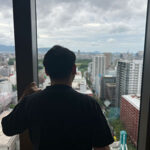
Ryo Murata — Head Chef
Born in Tokyo.
After a career in music, he entered the culinary world and opened an eel specialty restaurant in Nakameguro in 2013.
Within just a few years he earned a Michelin star, bringing fresh energy to the world of eel cuisine.
He later put a close to his success in the city and, wanting to “unite life and cooking as one,” moved to Hiruzen.
Surrounded by naturally cultivated vegetables, pure spring water, and mountain air, he continues to explore a new “shape of eel cuisine” together with his wife, Tomoko.
His cooking carries not only a love of eel, but also an eye turned toward the “place” itself.
Using hot-spring water to rest the eel, reading the aroma and humidity of the charcoal—all of it is a way of listening to the voice of the ingredients and the land.
True to his words, “without pretense, honestly, doing what can only be done here, right now,” he spares no effort, refining flavor at the intersection of sensibility and reason.
Meeting him in person, he comes across less as a stereotypical craftsman and more as gentle and easygoing.
There’s no strain in the way he presents a dish, no hesitation in the way he speaks.
What he seeks may not be the “ideal eel dish,” but rather “a single plate of eel in harmony with nature.”
Ryo Murata, a chef who lives alongside the scenery of Hiruzen.
His presence speaks to the charm of this land even more than his cooking does.
Restaurant Reputation

Dining Prelude
Exterior & Entrance
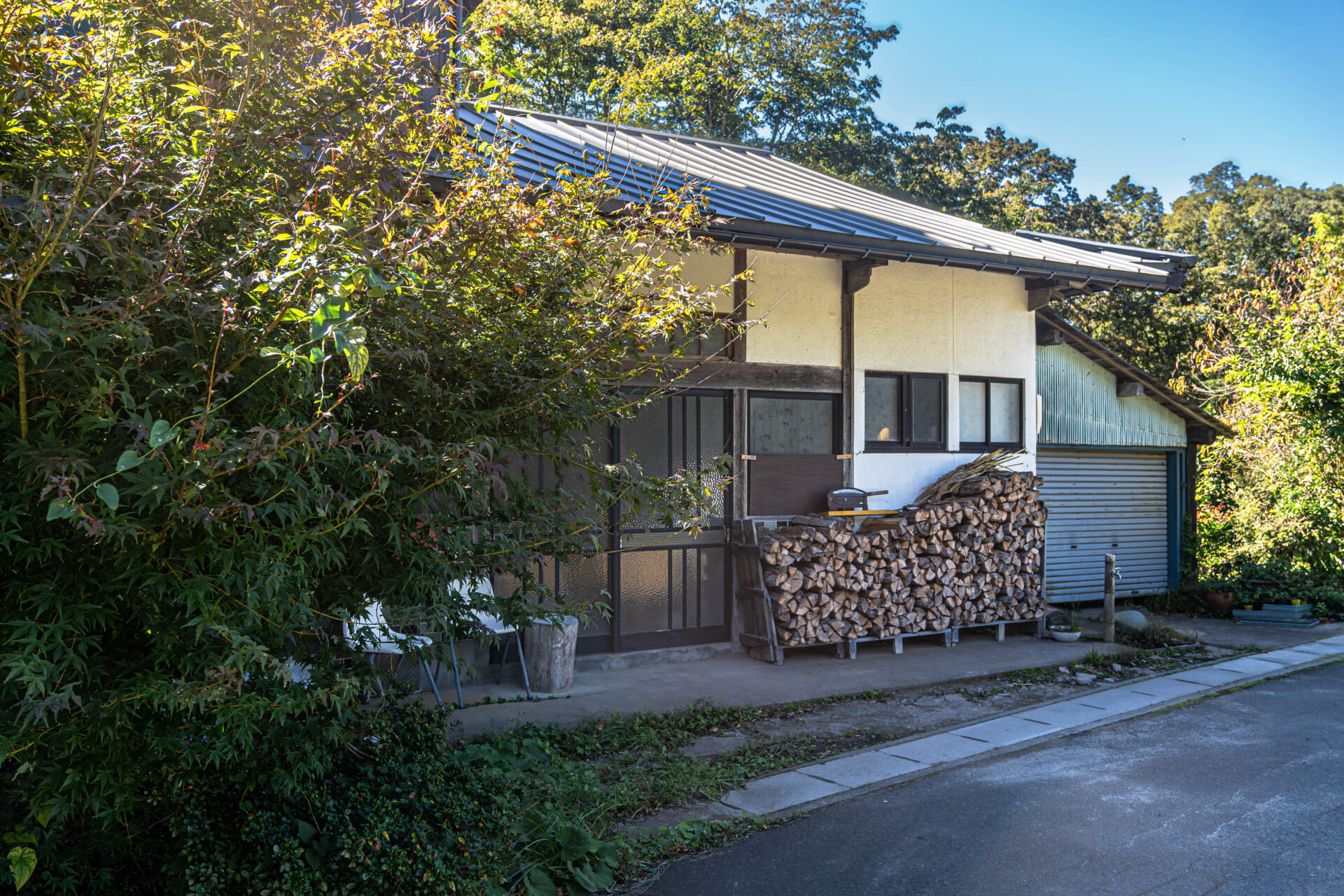
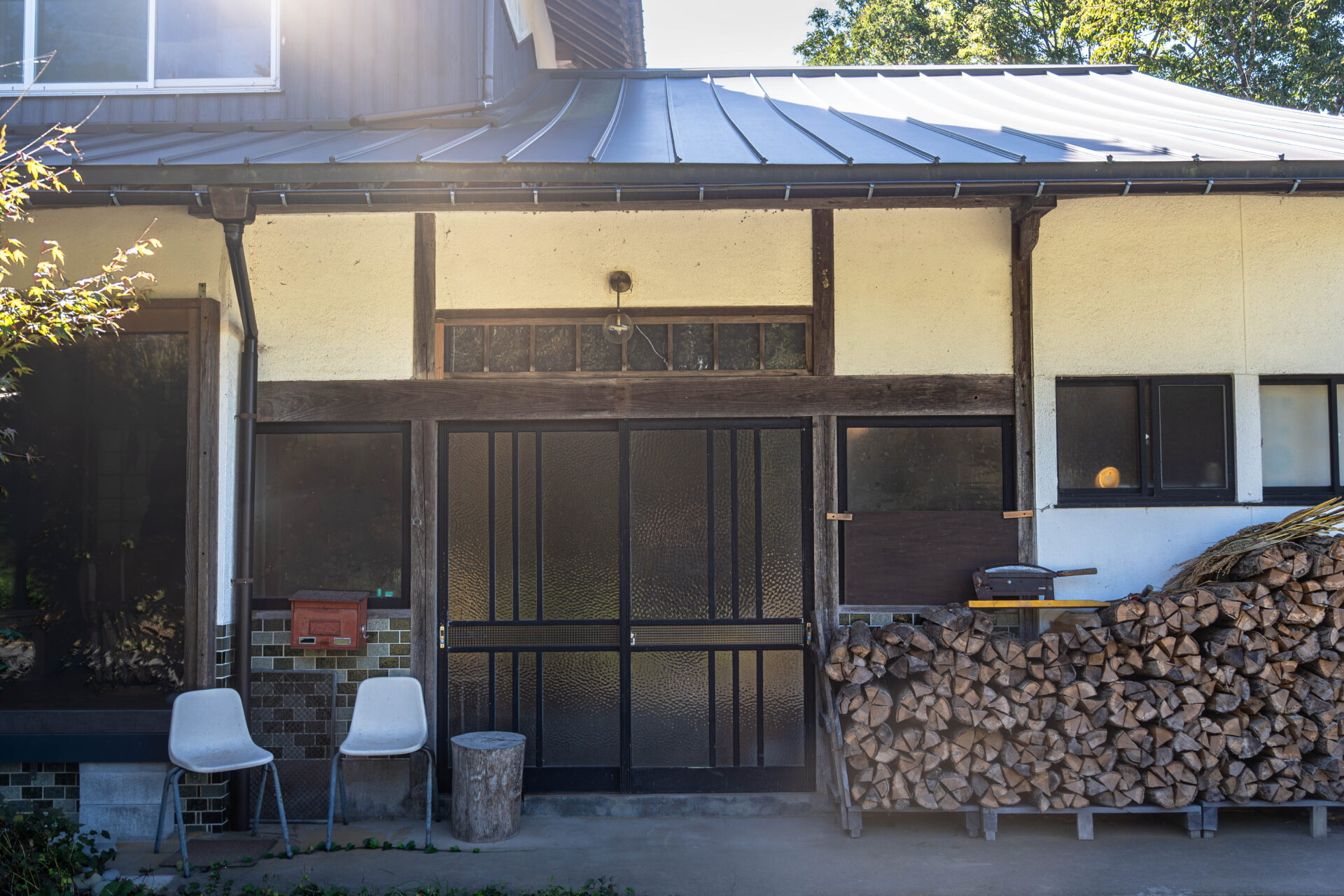
“Ryo” is not located in a developed tourist area, but sits quietly in the mountain hamlet of Chuwa Village. Even when you rely on Google Maps and arrive near the restaurant, its plain, house-like appearance makes you wonder, “Is this really the place?”—and that is one of the restaurant’s defining traits. In fact, it’s easy to understand why many first-time visitors are surprised, saying, “I couldn’t believe how deep in the mountains it was.”
The building is a wooden house. In the front garden grow plants such as butterbur, sansho pepper, and butterfly iris, giving a sense of the seasonal color typical of a satoyama village. That modest, unassuming exterior seems to be exactly what sets up the surprise and anticipation visitors feel upon arriving at “a special place.”
The window frames facing the road are neatly kept, forming a large glass door—a striking detail. At the entrance sits an object made of round stones gathered from the coast of Tottori, a small touch that lets visitors sense the restaurant’s world the moment they arrive, rather than treating the entryway as a mere passage.
As the reservation time approaches, a wonderful aroma drifts out from inside the restaurant, heightening anticipation. Stepping inside reveals a comfort that’s hard to imagine from the exterior, and many visitors describe feelings of nostalgia, like “it reminds me of my grandmother’s house.” The rustic simplicity of the exterior, the small thoughtful touch at the entrance, and the nostalgic yet refined space that opens up the moment you step in—that contrast is likely what leaves such a strong impression on visitors to “Ryo.”
About the Dining Space
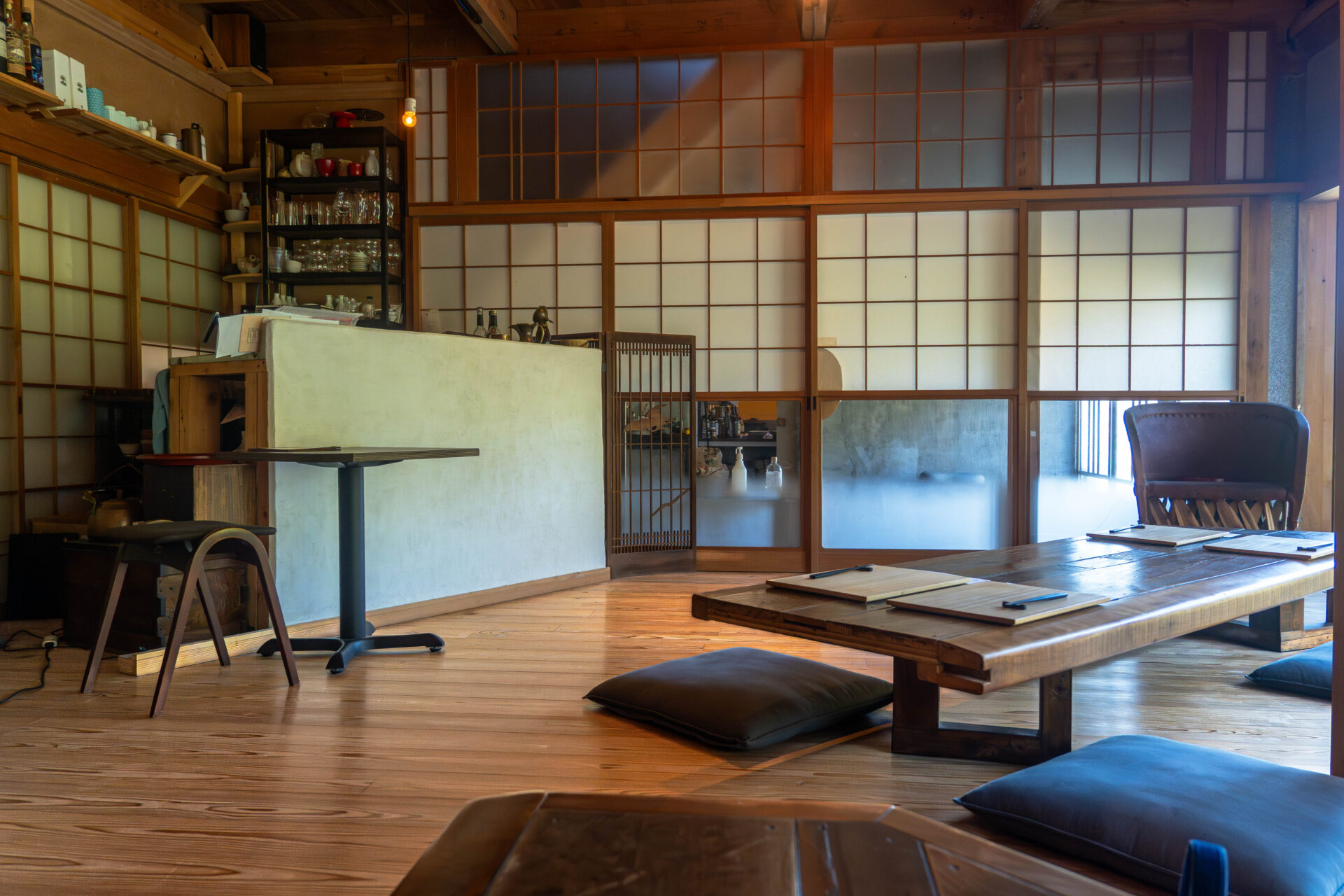
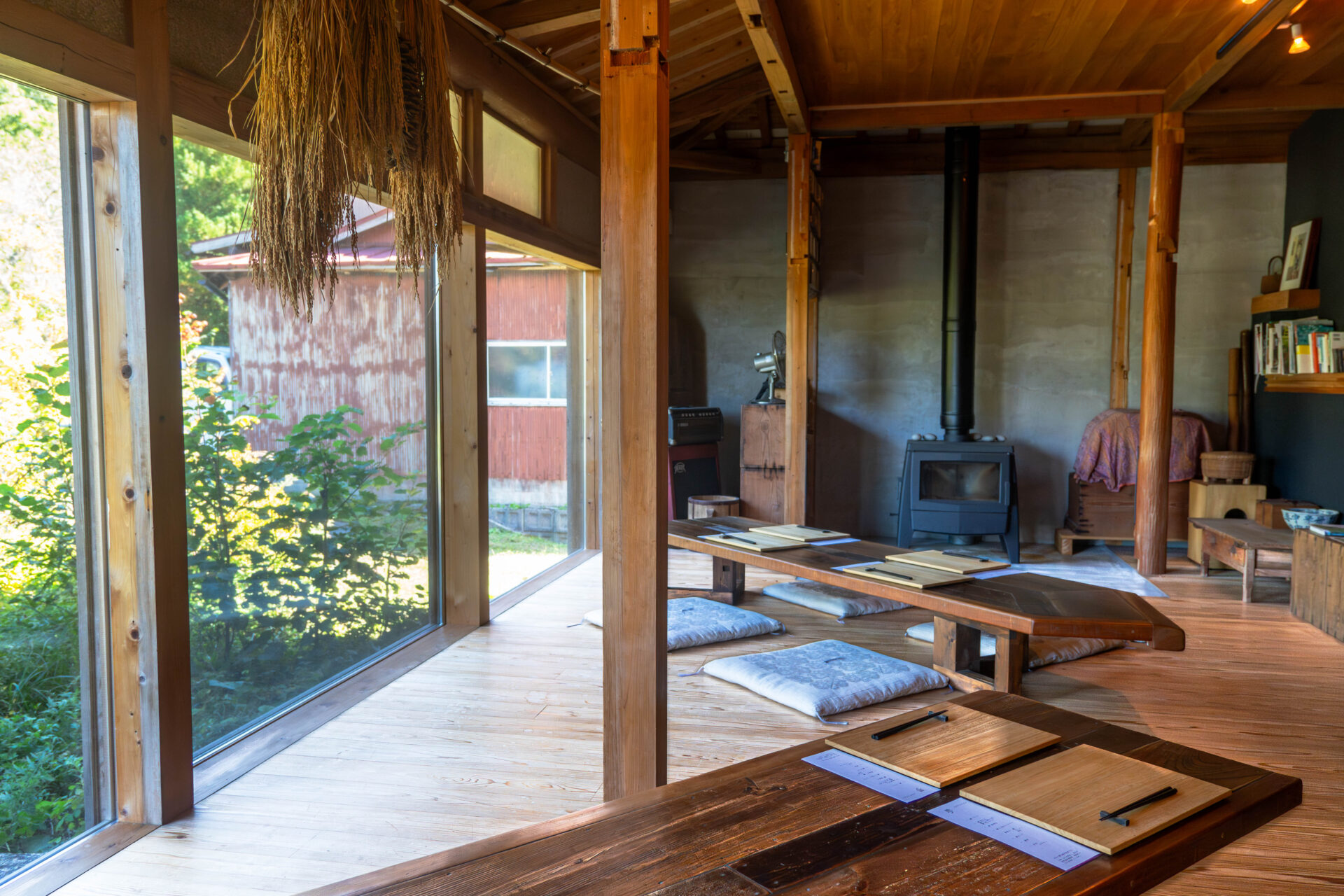
The interior has a compact layout with two large tables, eight seats in total. The tables sit by the windows, so the seasonal scenery outside becomes part of the dining room itself. Guests wait for their meal seated on floor cushions—a style that departs from the urban kappo restaurant and instead offers a relaxed dining experience unique to a satoyama setting.
The dining room makes the most of the character of the old farmhouse, renovated by the owner himself. Elderly locals can be seen walking by in farm clothes outside the window, making the dining space feel continuous with the rural life outside. Stepping up onto the raised wooden floor, you find a low table that was once the counter top from the Nakameguro days in Tokyo, now reborn in a new form. Large windows open wide, giving the whole room the comfortable feel of an engawa veranda, with a view beyond of the rice paddies the owner and his wife cultivate themselves.
Meals begin all at once at 12:00, with all guests starting their meal at the same time. During the course, staff make a round to greet each table after the meal, offering an intimate, homely style of service made possible by the small scale of the restaurant. With only eight seats, this dining space—combining the rice-paddy view right outside, the warmth of the old farmhouse, and attentive hospitality—is one of the restaurant’s great charms.
Menu Presentation
The cuisine at “Ryo” isn’t meant to conclude with kabayaki or unaju alone, as at a typical eel restaurant—instead it’s built as a full course that expresses a single eel through a variety of techniques.
The lunch course uses about 1.5 domestic eels per person, moving through small dishes, sake-grilled eel, fried dishes, soup, and eel rice bowl to a sweet finish, letting guests experience the appeal of eel from many angles over the course of the meal. Carefully building around the character of each part of the fish and differences in how the heat is applied, each dish conveys the depth found in a single ingredient—eel.
Early in the course come dishes incorporating seasonal ingredients as well as sake accompaniments made from the liver, fins, and bones, expressing the chef’s philosophy of using the entire eel without waste. This is followed by sake-grilled eel, fried dishes, and a clear soup that draws out the eel’s umami, each highlighting a different change in flavor through its own cooking method.
The course finishes with an eel rice bowl featuring kabayaki grilled fragrantly over charcoal as the star. After showing many different faces throughout the course, the eel is finally enjoyed in its most classic form, leading to a satisfying lingering finish.
Another defining feature is that the menu is flexibly rearranged according to the season and what’s available. Great care is taken to offer the best possible content for that particular day, incorporating whatever ingredients are in season.
By expressing a single eel through a wide range of techniques—grilling, frying, simmering, and drawing out stock—nothing of the ingredient’s appeal goes to waste. That is the form of eel cuisine that “Ryo” aims for.
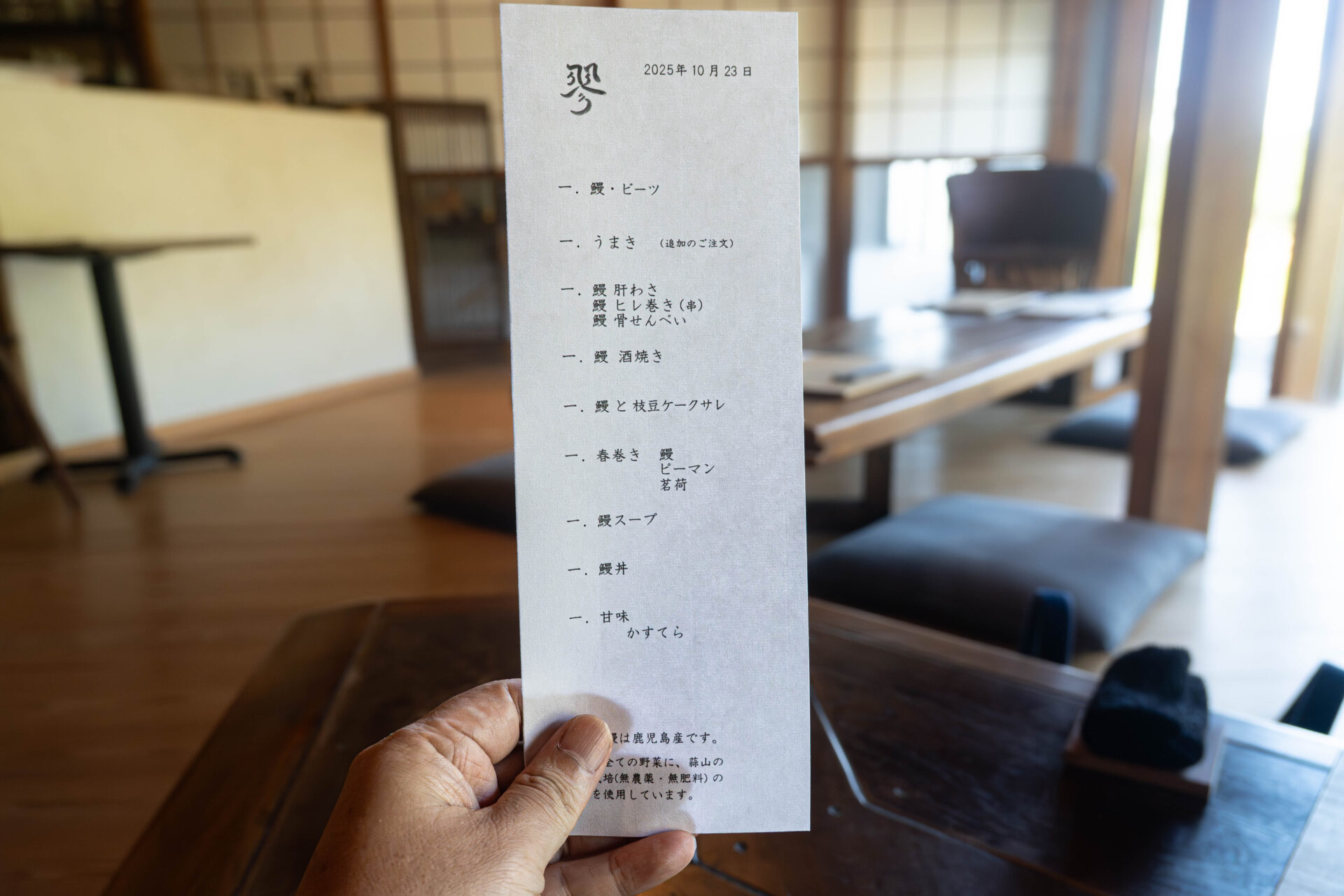
The course on this particular day consisted of nine dishes in total: Eel and Beets / Umaki (add-on) / Eel Liver with Wasabi, Fin Rolls, and Bone Crackers / Sake-Grilled Eel / Eel and Edamame Cake Salée / Spring Rolls (Eel, Green Pepper, Myoga Ginger) / Eel Soup / Eel Rice Bowl / and a Sweet — Castella Cake. The eel is sourced from Kagoshima, and all the vegetables are naturally cultivated (no pesticides, no fertilizer) in Hiruzen.
The Dishes We Actually Tasted
“Eel and Beets”
Opening the course is a shirayaki (plain-grilled, unsauced) dish combining eel and beets. The eel used this day was sourced from an eel farm in Kagoshima. Immediately after being sourced, it is kept alive in a river fed by Hiruzen’s natural hot springs before use—a thorough attention to detail.
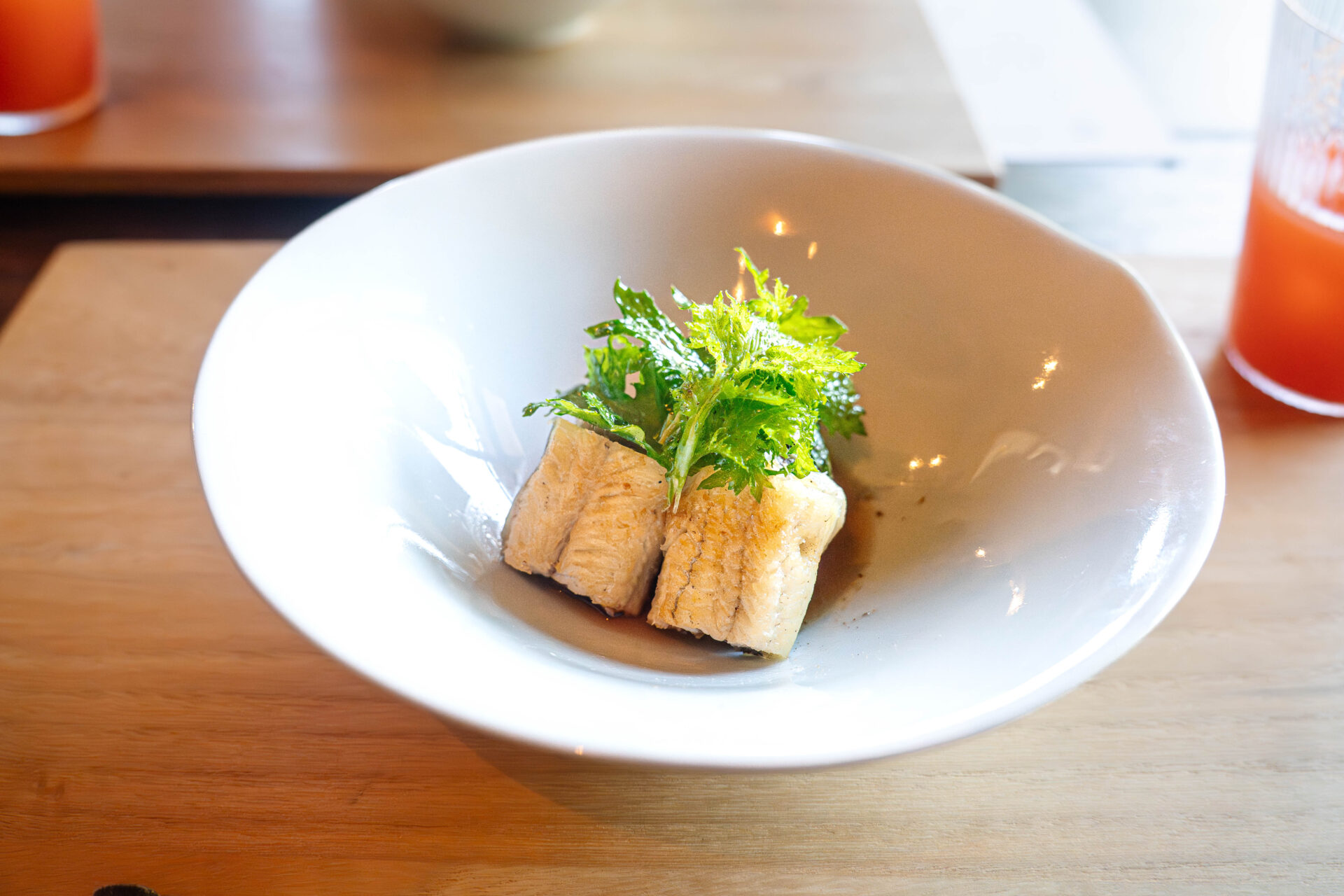
The cooking method is shirayaki. While the fat is thoroughly rendered, the finished result is remarkably delicate and beautiful, with a fragrant grilled color on the skin. An exquisite grilling technique that deliberately introduces slight unevenness in the heat further draws out the eel’s natural umami.
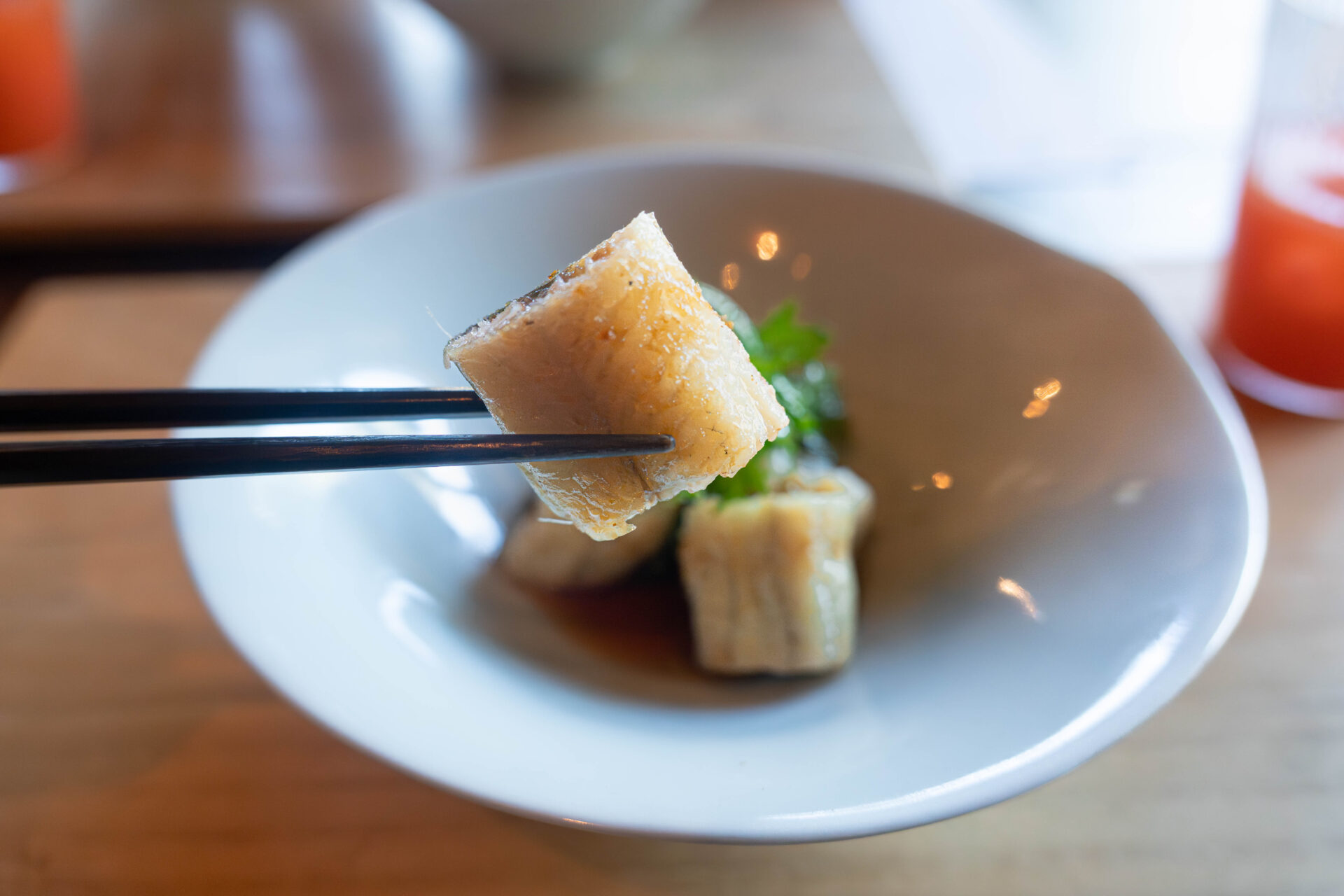
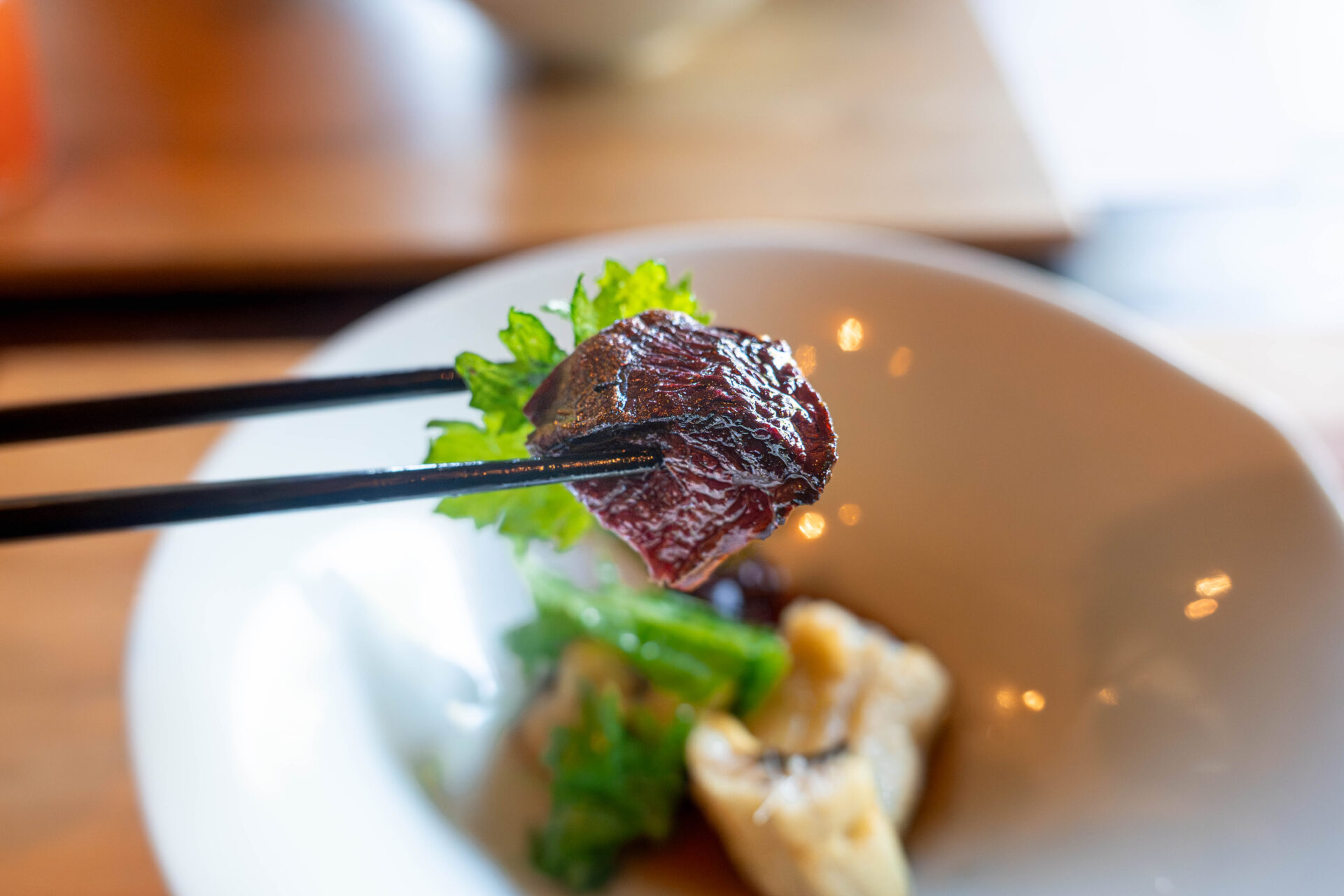
The accompanying beets are slow-roasted at a low temperature for about an hour, giving them a moist texture and gentle sweetness that complements the eel’s fragrance. Mustard greens from Santa Farm add a touch of color and a peppery freshness, tying the whole dish together. A dish where the care and skill invested in the ingredients come through clearly—a fitting opening to the course.
“Umaki” (Additional Order)
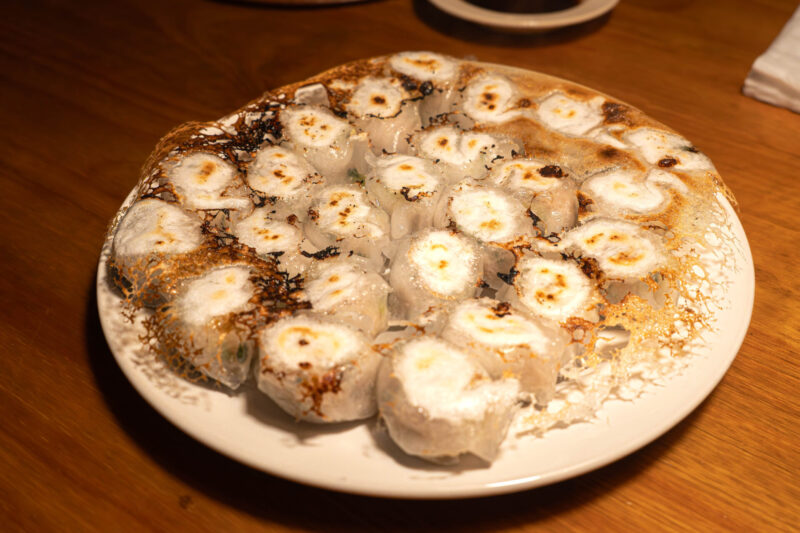
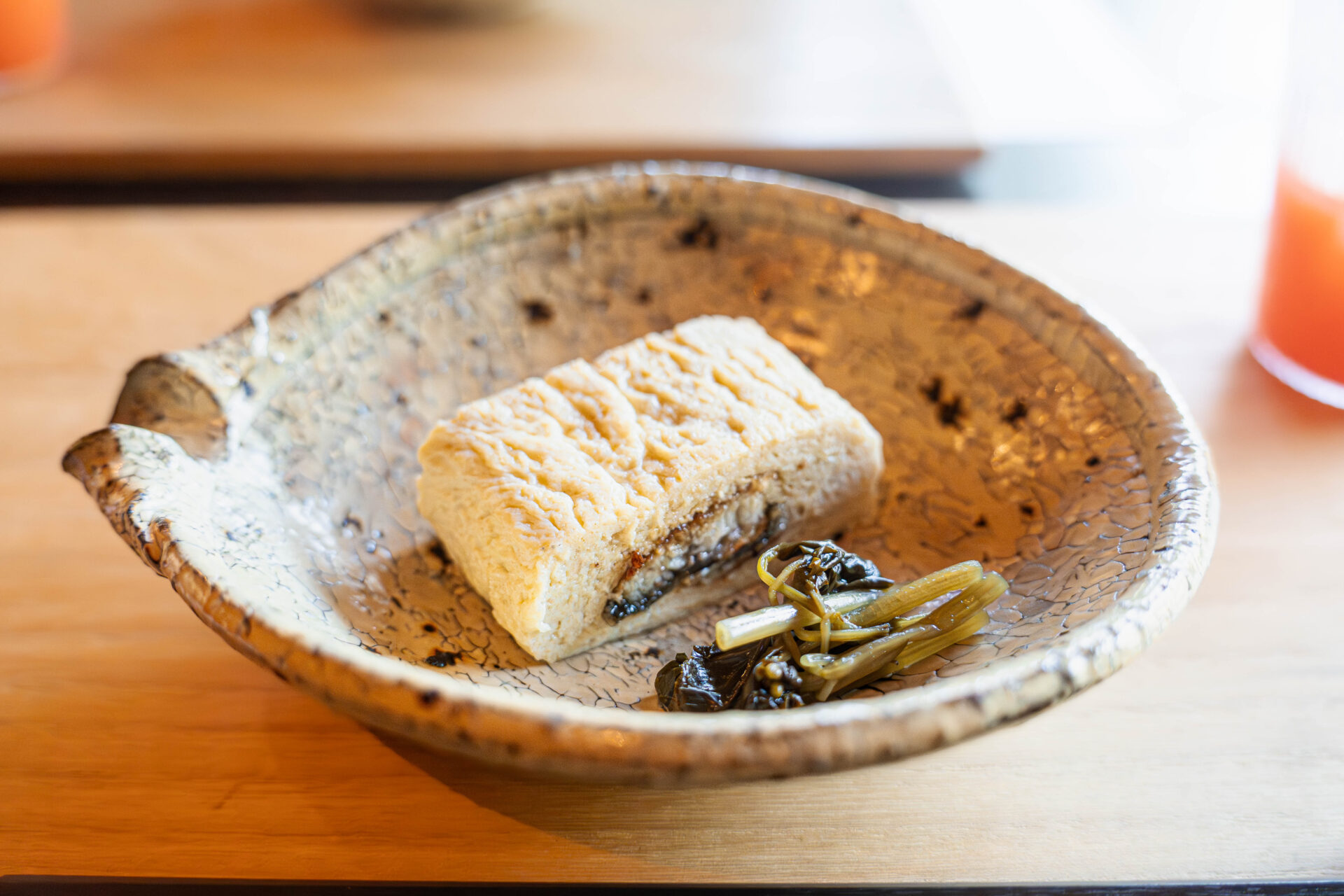
“Umaki” can be ordered as an add-on at the time of reservation. It’s served in a richly crackle-glazed dish with striking character.
The dashi-infused rolled omelet is generously soaked with dashi, with eel wrapped securely inside. The beautiful contrast between the soft yellow of the egg and the grilled color of the eel visible within makes for a lovely presentation, and each bite brings together the aroma of dashi and the umami of the eel.
Alongside it are wasabi leaves that grow wild in a nearby river. The vivid green of the leaves and the freshness of the stems add a peppery, refreshing accent to the gentle sweetness of the egg and the flavor of the dashi. It’s a dish that reflects Hiruzen’s own approach of making direct use of what nature offers locally.
“Eel Liver with Wasabi, Eel Fin Rolls (Skewered), Eel Bone Crackers”
Served in an antique blue-and-white dish, these three sake accompaniments make full use of the eel, leaving nothing to waste.
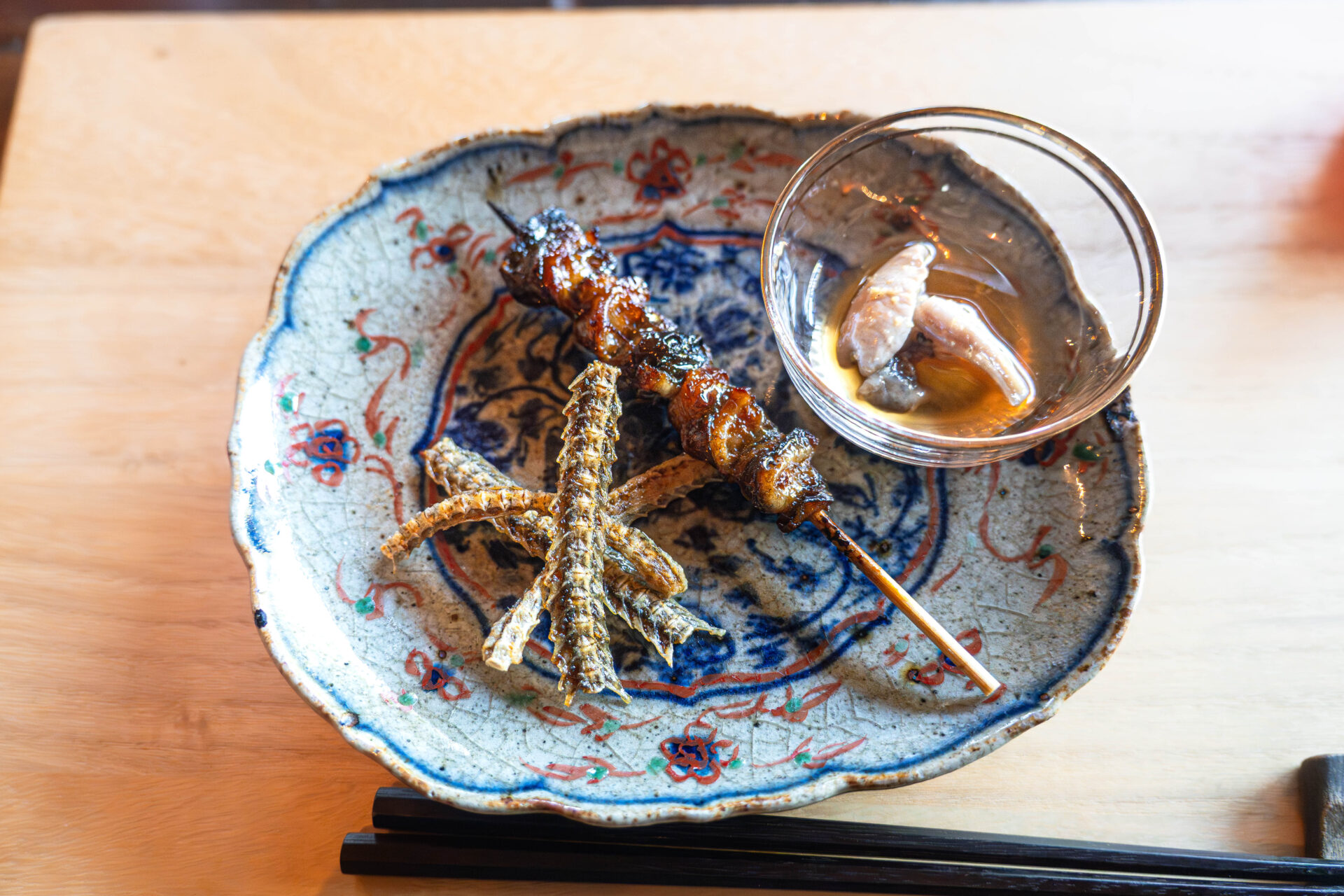
Eel liver with wasabi is a dish of blanched liver submerged in a wasabi-soy dashi. The plump texture pairs with the refreshing spice of the wasabi-infused soy dashi, resulting in a clean flavor free of any off-putting smell.
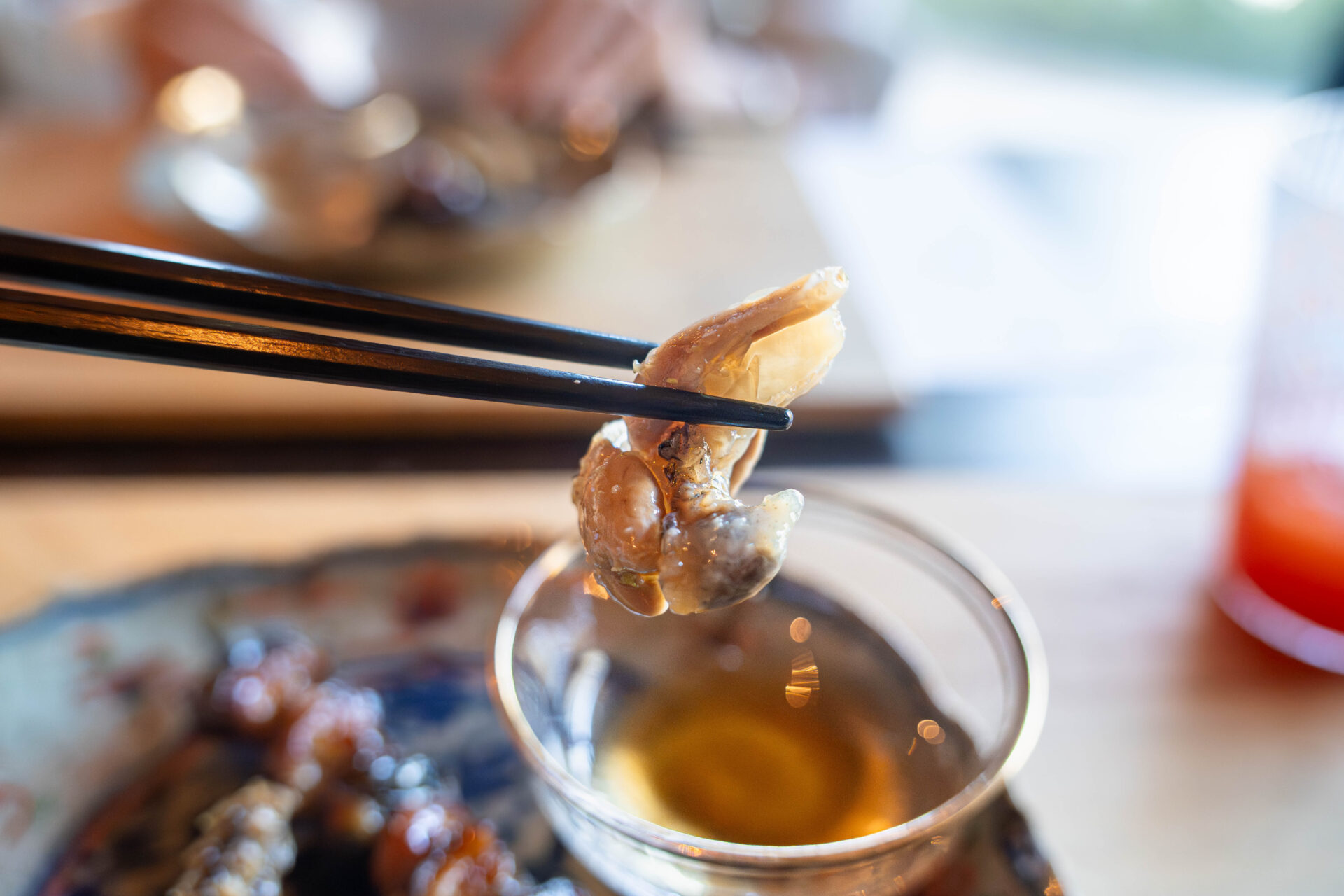
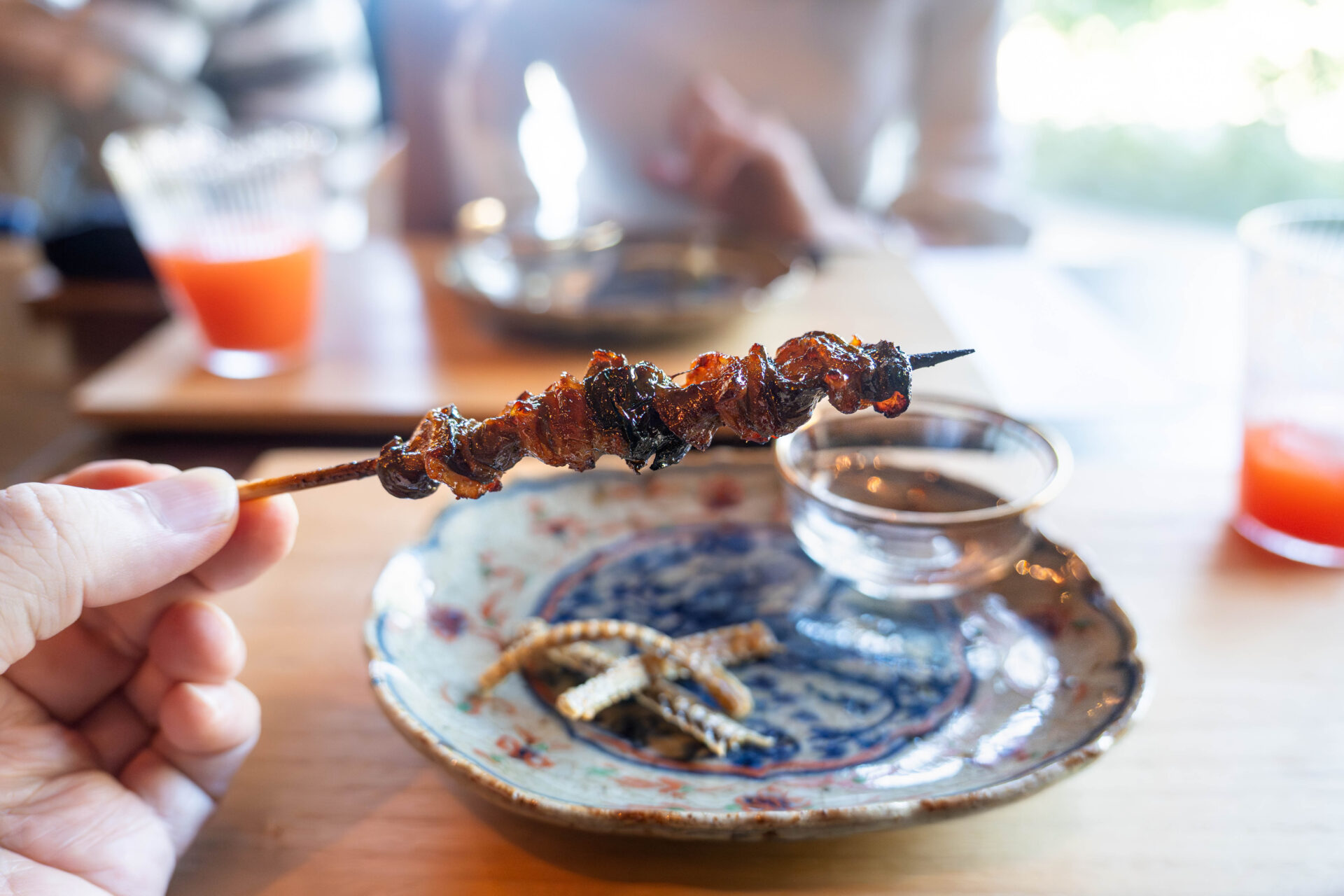
Eel fin rolls (skewered) are fins wrapped and grilled on a skewer. Repeated basting with sauce gives them a glossy char, and the crisp, fragrant finish stands out. The balance between fat and flesh is exquisite, releasing a juicy umami with every bite.
Eel bone crackers are fried bones finished off like a light, crunchy snack. Biting into them produces an impressively crisp, snappy sound, showing off a playful side within the sake accompaniments.
By applying a different cooking method to each of the liver, fins, and bones—parts that are normally overlooked—the composition lets diners enjoy every part of a single eel. With three dishes offering different textures and temperatures side by side, this course brings a small sense of surprise and rhythm.
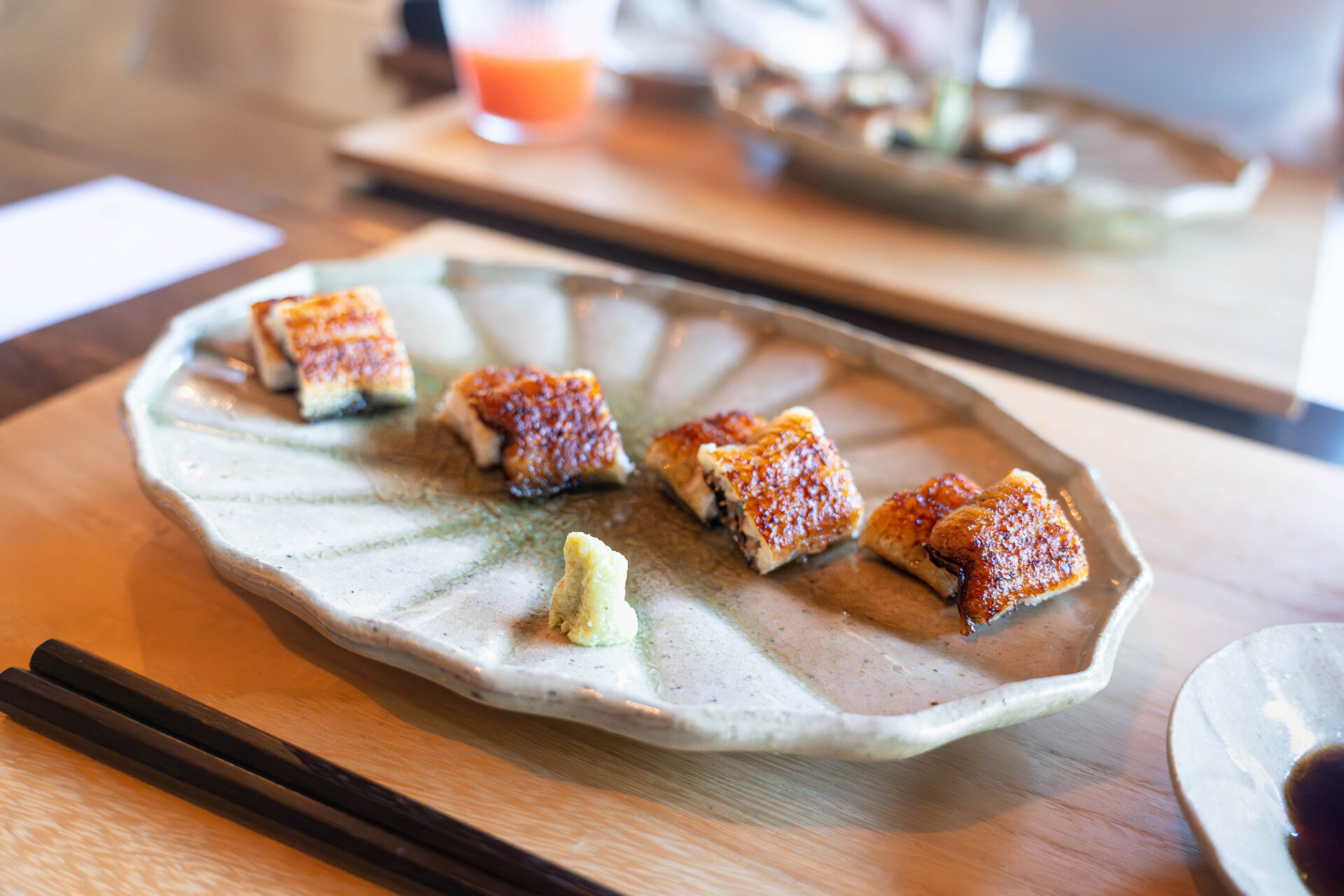
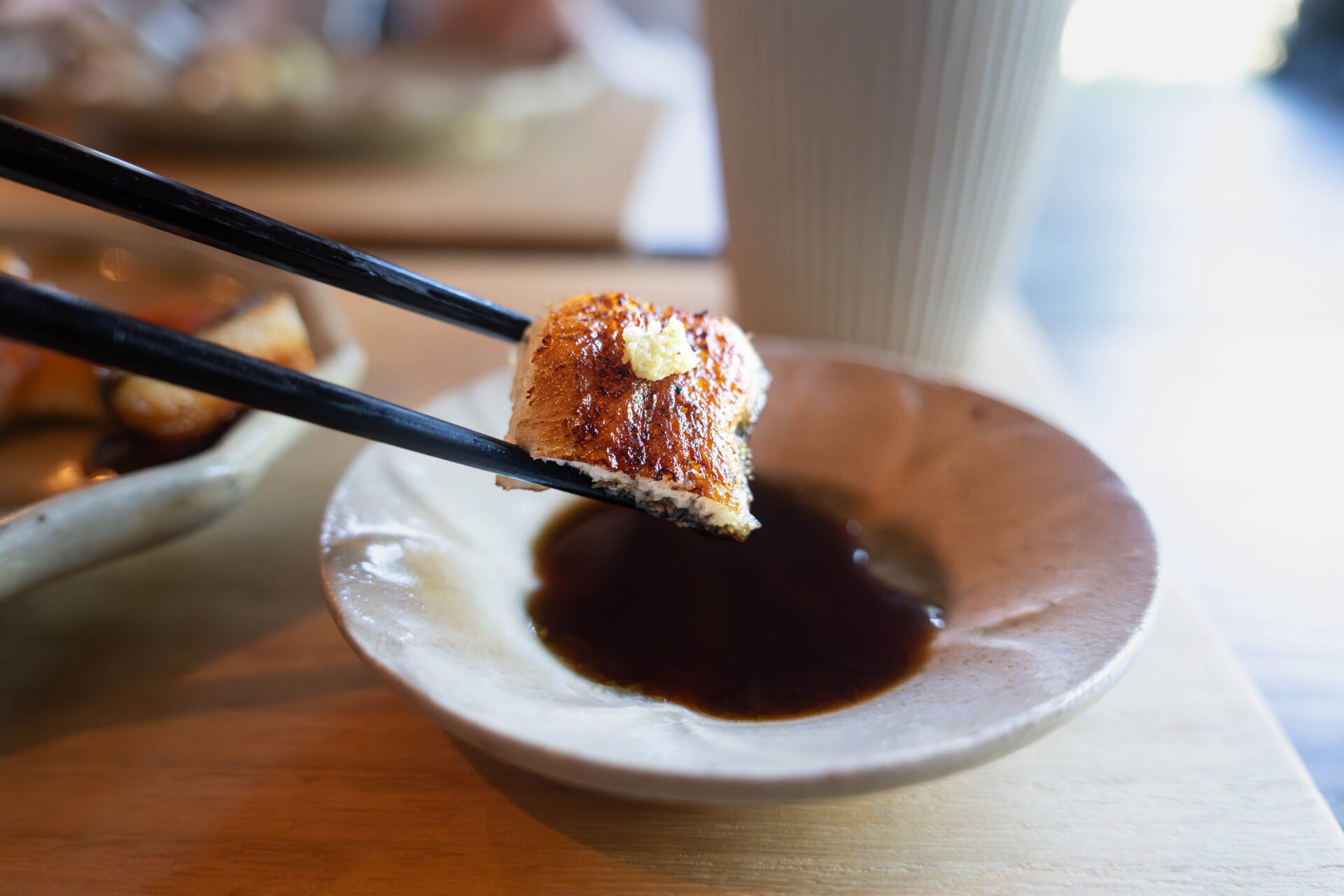
“Sake-Grilled Eel”
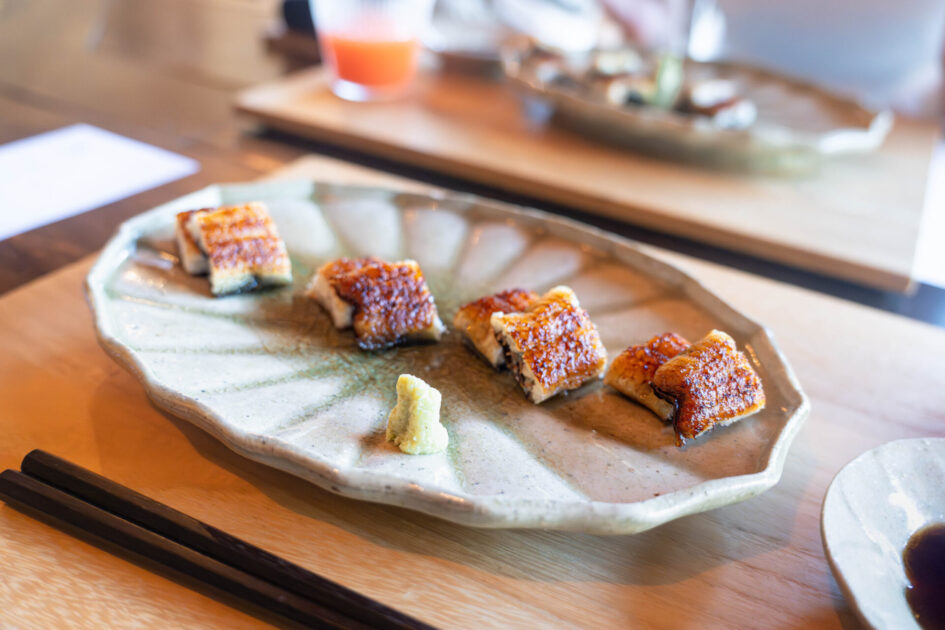
Four beautifully arranged pieces of eel sit on a white flat plate. “Sake-grilling”—grilling while basting with pure rice sake—is one of the techniques that symbolizes this restaurant. The surface has a firm, fragrant grilled color, and the crisp texture of the skin contrasts strikingly with the plump white flesh visible beneath.
It’s served with wasabi. First, guests are meant to enjoy it plain, savoring the direct umami and sweet fat of the grilled eel. The second way to enjoy it is dipped in wasabi-soy sauce. This restaurant’s soy-based sauce is outstanding, pairing wonderfully with the sake-grilled eel. The richness and depth of the soy sauce layer over the fragrant grilled flavor, while the sharp freshness of the wasabi lightens and balances the richness of the fat. Being able to enjoy the dish in these two ways—plain and dipped in sauce—was a major part of this dish’s appeal.
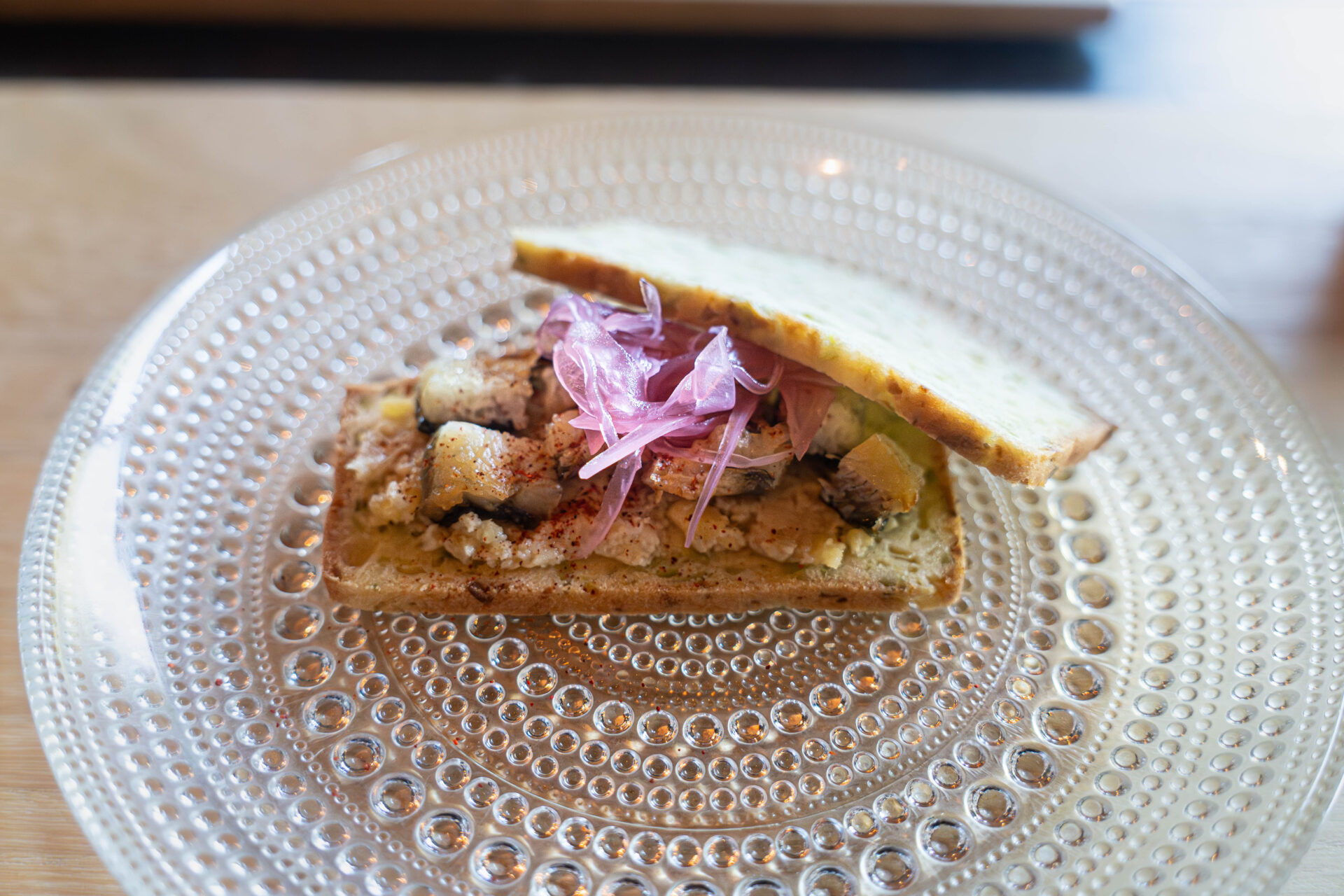
“Eel and Edamame Cake Salée”
Served on a polka-dot glass plate, this dish carries a particularly Western, playful flair within the course.
The base is a cake salée baked with edamame worked into the batter. Within the moist dough, the green of the edamame is scattered as an accent. The very idea of pairing cake salée—a French savory cake—with eel, a Japanese ingredient, speaks to this restaurant’s originality.
On top sits crisply grilled eel along with a paste made from sweet potato and sesame. Amid the soft textures of the moist cake, the smooth, creamy paste, and the accent of red onion, it’s the crisp, fragrant eel that stands out as the one contrasting texture. That single point of textural difference brought sharp definition to the entire dish.
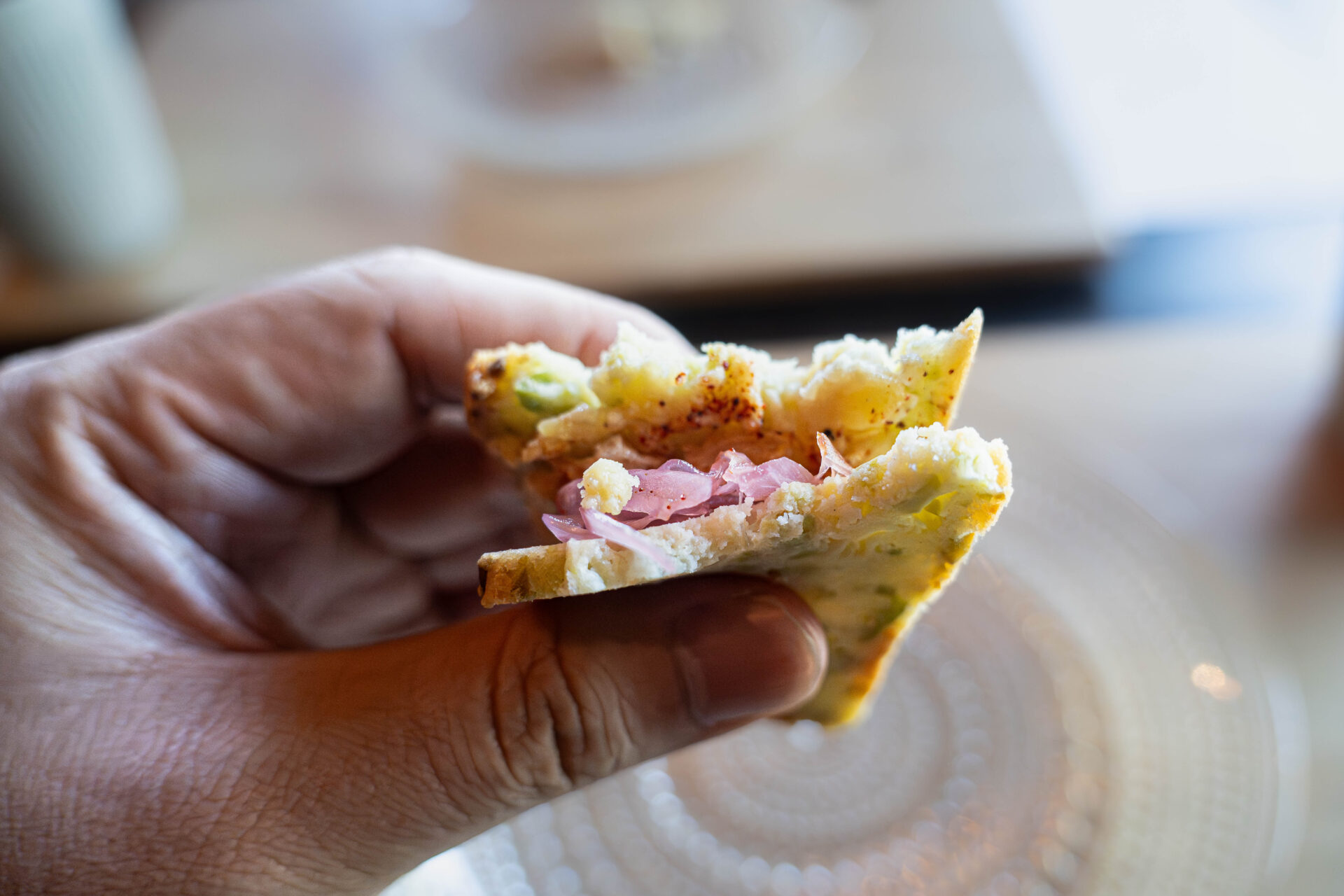
It’s also notable for being served cut in half, meant to be eaten by hand. The layers of eel, paste, and red onion visible in the cross-section give it the look of a small sandwich—a playful, sensibility-filled dish that seamlessly blends Japanese and Western elements.
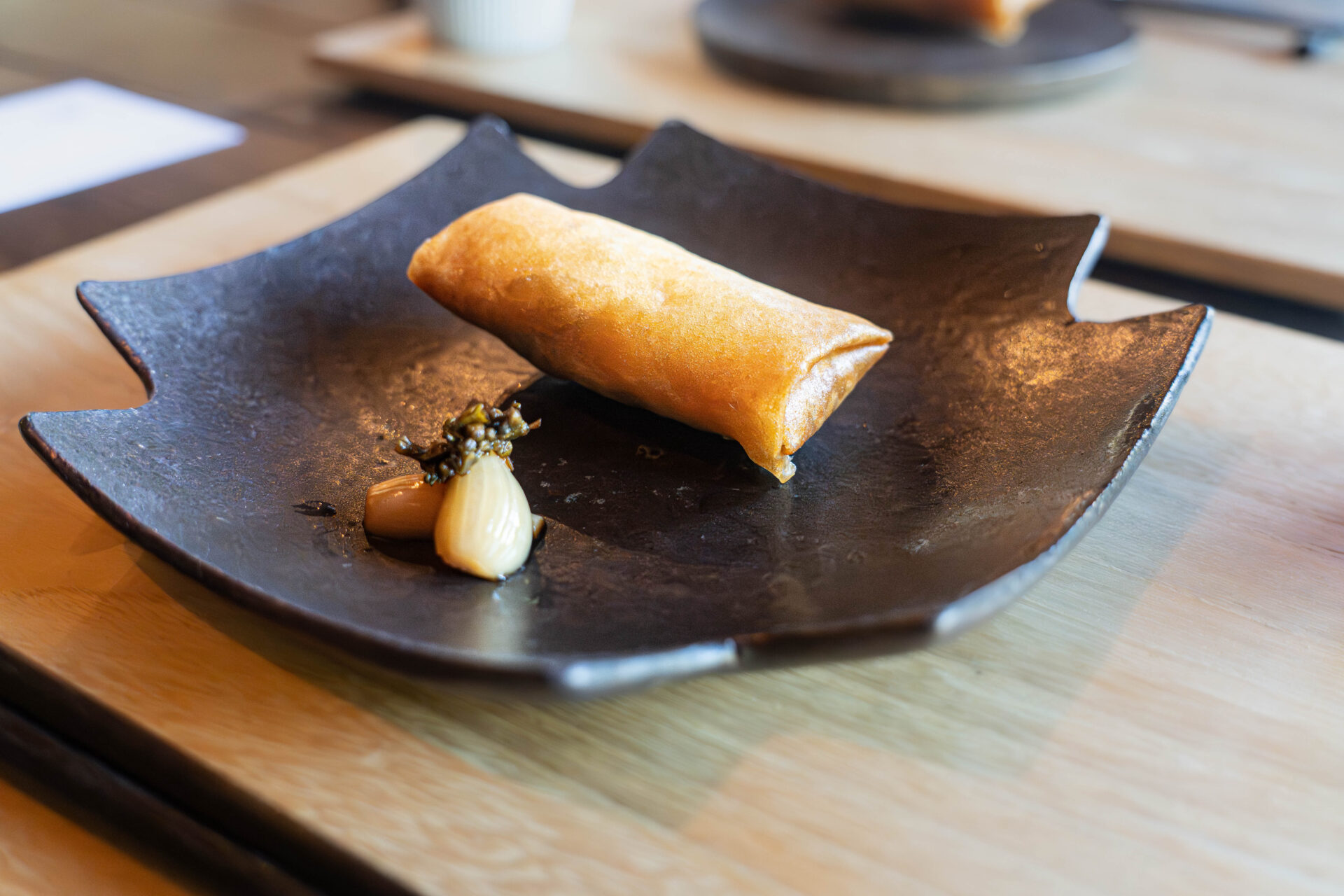
“Spring Rolls (Eel / Green Pepper / Myoga Ginger)”
Served on a striking black dish that could almost be mistaken for a star shape, these spring rolls stand out visually within the course.
Fried to a golden brown, the spring rolls are wrapped in a crisp, glossy skin that whets the appetite. In cross-section, eel, green pepper, and myoga ginger appear layered together. The skin has a light, crunchy texture, and biting into it releases the fragrant aroma of the eel’s skin along with the refreshing scent of green pepper. This combination of two aromas pairs surprisingly well, and the bitterness and freshness of the green pepper layered over the eel’s rich fat produces a depth of flavor that goes beyond a simple fried dish.
Served alongside is rakkyo (pickled scallion) aged for two years. Its long maturation has softened the edges of its acidity, giving it a mellow tartness and deep richness that gently accents the oiliness and fragrance of the spring rolls with a lingering finish.
“Eel Soup”
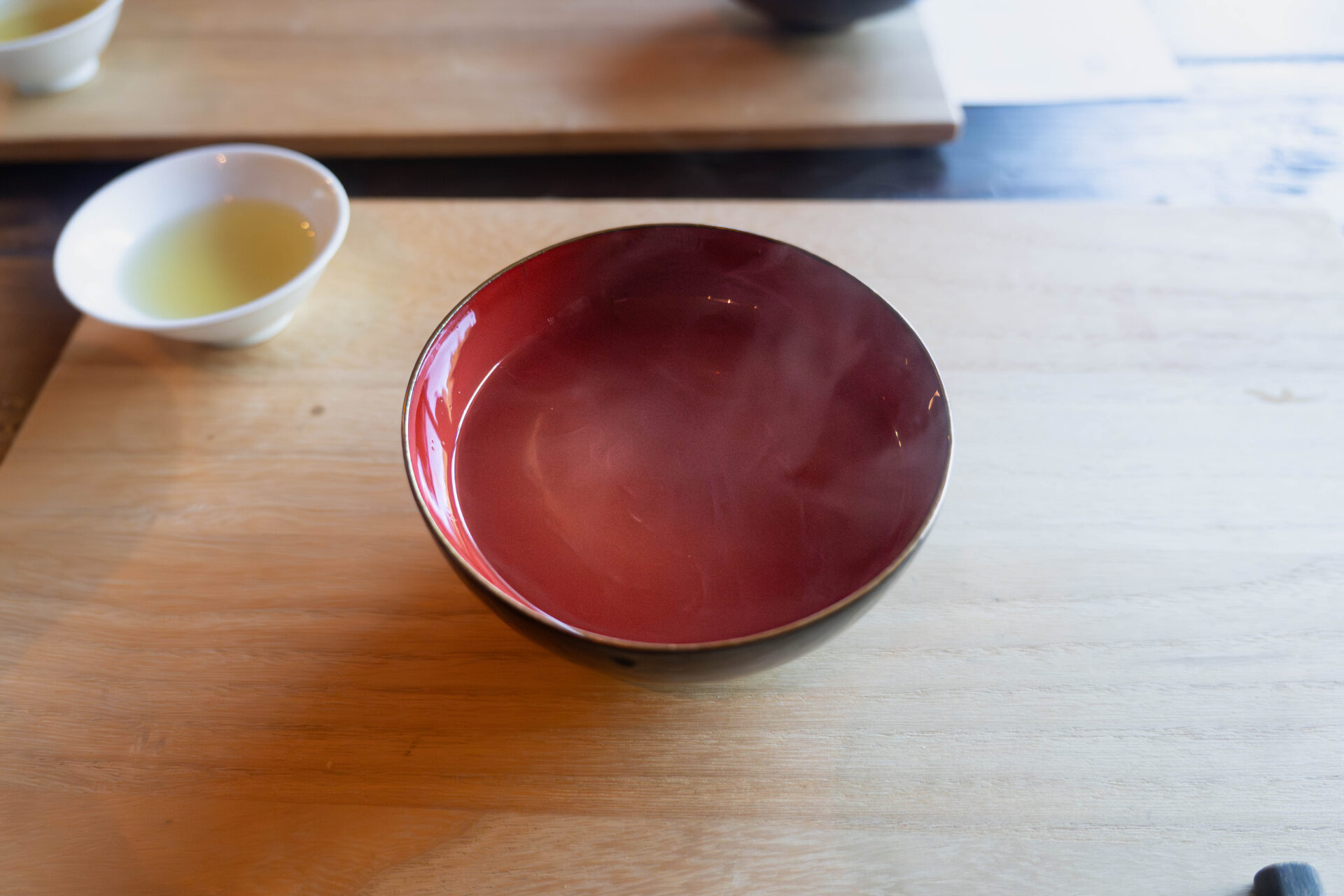
Eel soup is poured into a glossy vermillion-lacquered bowl. The deep red of the interior shimmers beautifully in the light, and the elegant presence of the lacquerware quietly signals that the course has reached its second half.
This soup is seasoned with kombu dashi, and while the eel’s umami remains the star, the gentle umami and aroma of the kombu sharpen the overall outline of the flavor. After the rich, dense flavors of the preceding sake accompaniments, fried dishes, and grilled dishes, this clear broth serves as a pause that resets the palate, building anticipation for the eel rice bowl to come—a dish that also plays the role of an “interval” within the course.
“Eel Rice Bowl”
The eel rice bowl, taking center stage as the main event of the course, arrives in a dignified, richly glazed dish. Inside the bowl, fragrantly grilled eel is layered thickly, its glossy, shining sauce vivid to the eye.
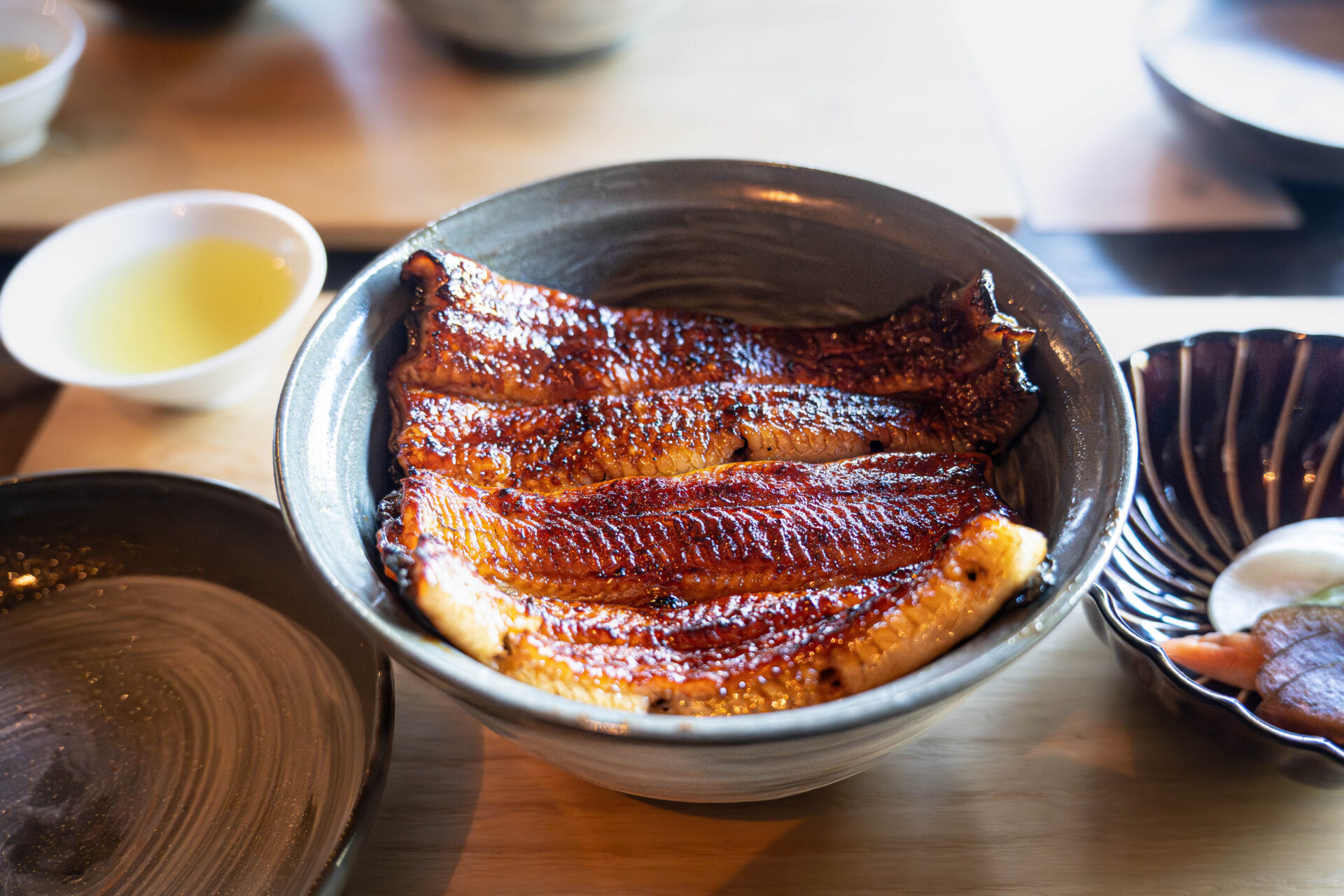
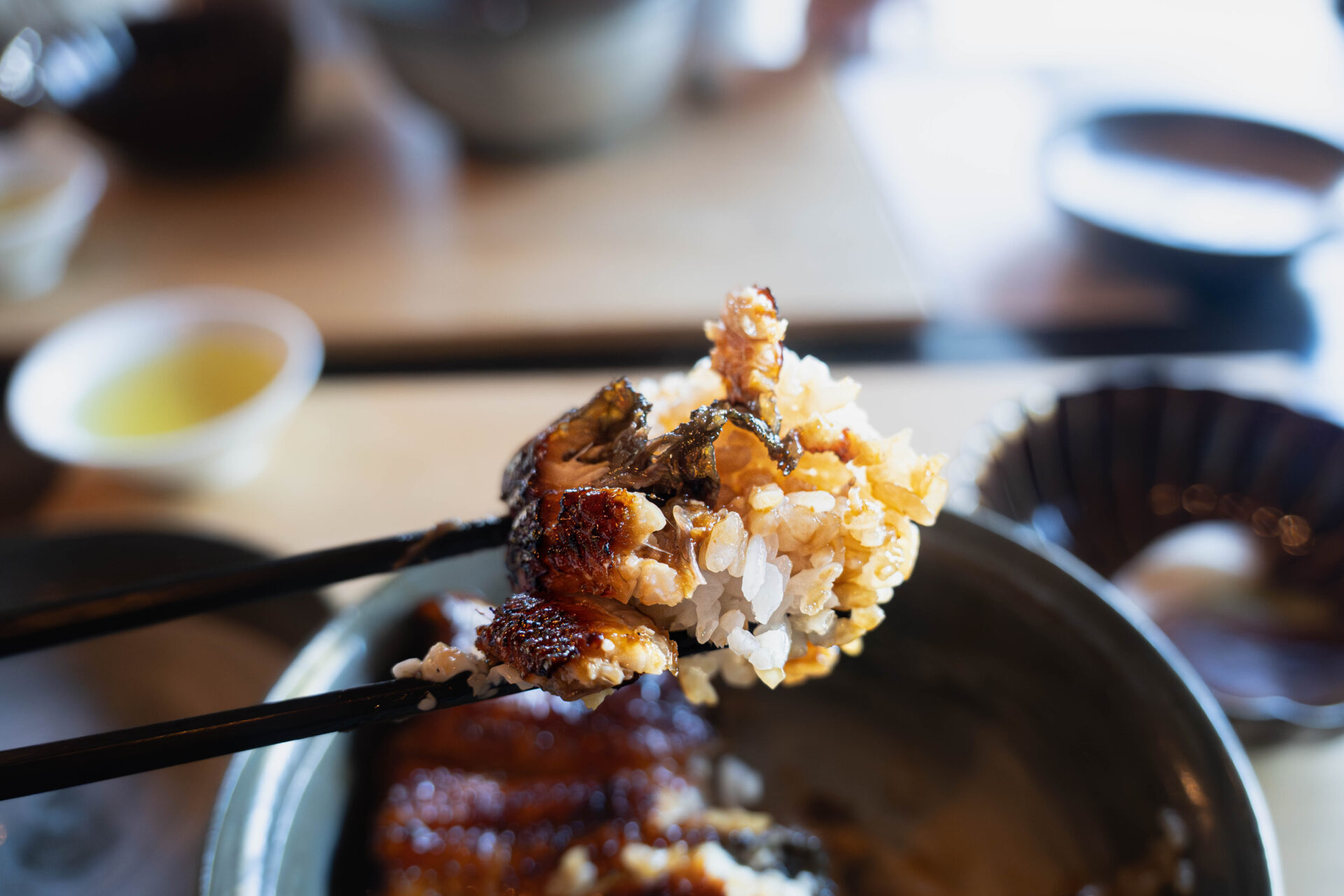
The rice forming the base of the bowl is Sasanishiki, grown by the owners themselves in the rice paddy directly in front of the restaurant. Cultivated without fertilizer or pesticides, every step—from hand-planting to sun-drying—is carried out with painstaking care, an extraordinary level of dedication. The commitment extends beyond simply sourcing and grilling excellent eel—it reaches all the way to the rice that receives it, an attitude condensed into this single bowl.
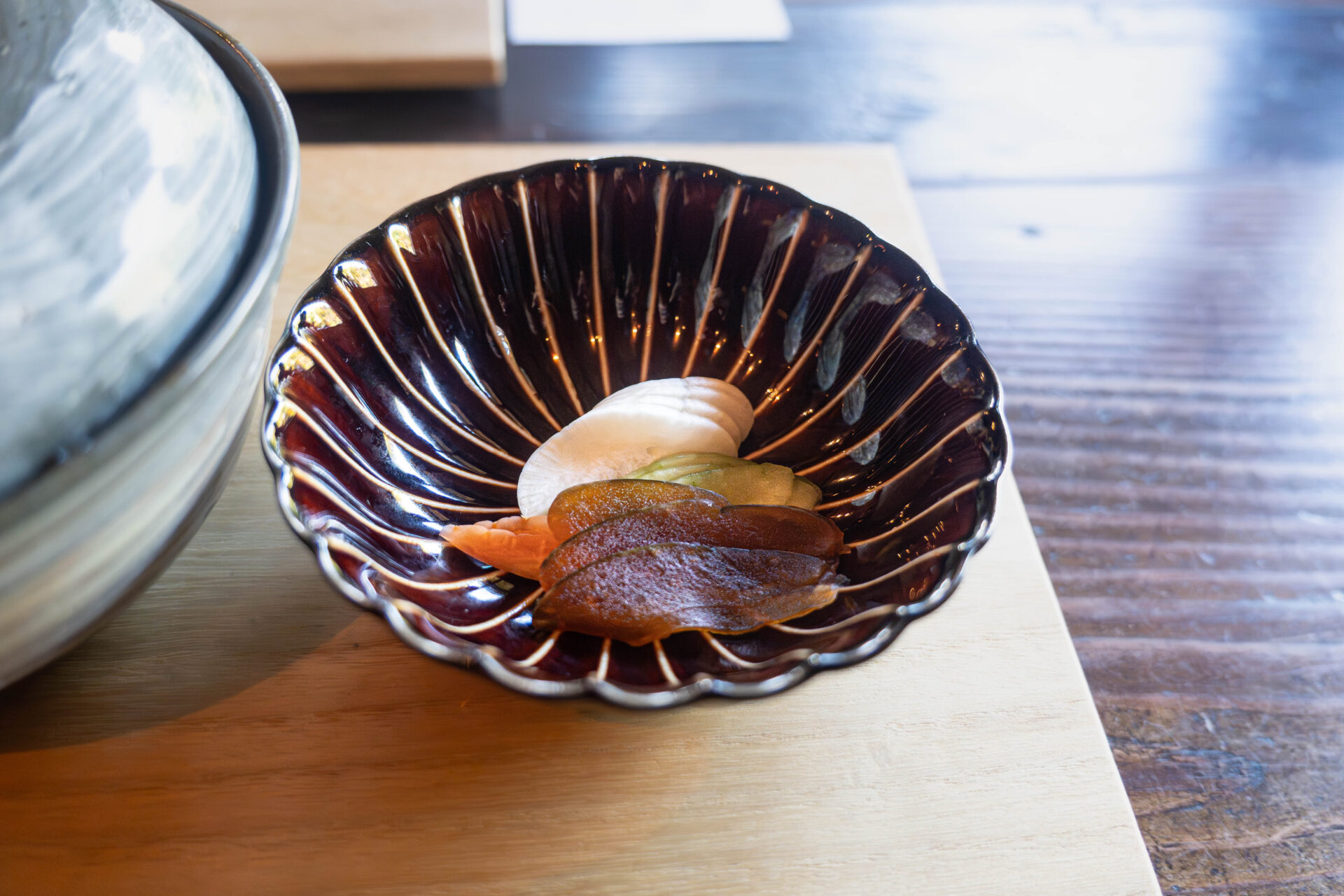
The narazuke pickles served alongside are said to be grown by hand, starting from removing the seeds themselves, a testament to the attention given even to the smallest supporting elements of the eel rice bowl. It was a dish worthy of the course’s climax—deepened by the attitude of completing everything by hand, from growing the rice to cooking the eel.
Dessert & Finale
“Sweet: Castella Cake”
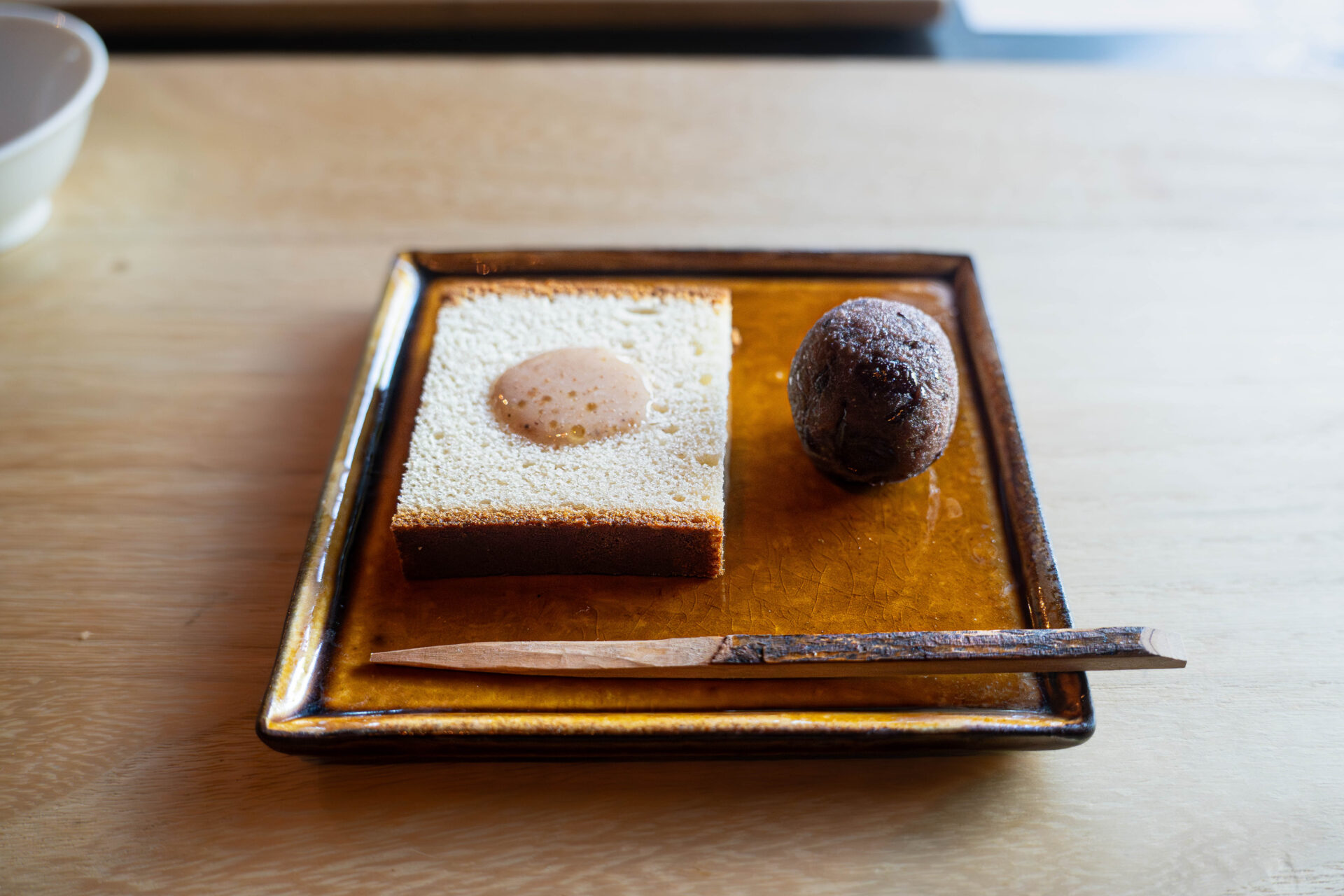
The sweet that closes out the course is served in a beautifully glossy, muted square dish. It comes with a fork fashioned to look like a natural tree branch, a fitting touch for the final course.
The castella cake is baked using eggs from the nearby Papalagi Farm. Its cross-section is moist and fine-grained, topped with a light, whipped sauce. This sauce is based on Hiruzen Kougei’s natural koji amazake, adding a gentle fermented sweetness and aroma to the cake. Alongside it is a red bean paste made from Hirugei’s own and their own home-grown azuki beans, both naturally cultivated.
The sweetness is kept restrained while still delivering a clear sense of it, designed to connect with and extend the lingering impression of the eel rice bowl served just before. This dish carries one more distinctive feature: within a course where every dish features eel, this dessert is the sole exception, containing none at all. Made entirely from the bounty of Hiruzen’s naturally cultivated ingredients, it quietly brought the entire course to a close.
Summary and Impressions
Starting with the delicate shirayaki of “Eel and Beets,” followed by the add-on “umaki,” the three sake accompaniments showcasing the eel’s liver, fins, and bones through different cooking methods, and then “sake-grilled eel”—the dish symbolic of this restaurant—the restaurant’s philosophy of savoring a single eel from every possible angle came through clearly even this early in the meal.
The “eel and edamame cake salée” and “spring rolls” that followed were creative dishes that leapt well beyond the boundaries of traditional eel cuisine. Even while borrowing Western elements and the form of a fried dish, the fragrance and core umami of the eel remained firmly intact—a composition where playfulness and technique coexisted. After the palate was reset with the “eel soup,” the course reached its high point with the main “eel rice bowl.” Home-grown Sasanishiki rice, homemade narazuke pickles—the attention paid to every element surrounding the eel, not just the eel itself, was condensed into this one bowl.
And finally, the “castella cake.” Within a course where eel appears in every dish, this being the only sweet without eel, quietly closing things out purely with the bounty of Hiruzen’s natural cultivation, showed a certain artistry in how the course was structured.
It’s striking how the course maintains interest across nearly two hours by varying the part of the eel, the cooking method, the temperature, and the texture from dish to dish. The balance between dishes that refine traditional eel cooking and dishes with a high degree of creativity was also excellent, letting diners feel the depth hidden behind the title of “eel specialty restaurant” with every dish.
What left the strongest impression, beyond the dedication to the eel itself, was the thoroughness with which nearly every ingredient—from growing the rice, to cultivating the vegetables, to preparing the narazuke pickles—is raised by their own hands. This was a truly one-of-a-kind eel experience, born from the meeting of skill honed to earn a Michelin star in Tokyo, the bounty of the Hiruzen land, and the handiwork of the chef and his wife.
Reservation & Access Information
How to Reserve
“Ryo” is fully reservation-based, and since it cannot be reached directly by public transportation, arriving by car is a prerequisite. Reservations are handled by email rather than phone. To book, send an email to ryo.reserve@gmail.com clearly stating: ① Full name ② Desired date ③ Number of guests (adults/children) ④ Phone number. At the bottom of the restaurant’s official website homepage, an “Latest News” section publishes available business days and seating availability roughly a month in advance, so it’s best to check there first before reaching out.
For groups of four or more, the restaurant’s operating schedule can sometimes be adjusted, so it’s best to inquire directly by email for details. As this is a popular restaurant, some visitors report having “made an online reservation two months in advance,” so booking early is advisable.
Because replies sometimes do not arrive, guests are asked to always include a phone number, and it’s recommended to allow “ryo.reserve@gmail.com” through your email filters before reaching out. Care is also needed regarding the cancellation policy: guests are asked to avoid cancelling within a week of the reservation, and cancellations made the day before or later may incur a cancellation fee of 50% to 100% of the course price on the day itself.
Access Information
“Ryo” is located at 1705-6 Hiruzen Shimowa, Maniwa City, Okayama Prefecture, in a mountain hamlet within the Chuwa district of Maniwa City, to the east of the well-known Hiruzen Highland summer resort area. It’s characterized by its quiet setting away from the tourist areas, with many first-time visitors surprised to find it “so deep in the mountains.”
As noted above, since the restaurant cannot be reached directly by public transportation, arriving by car is essential. Hiruzen Highland is also known as a scenic driving area, and some guests enjoy the surrounding views, such as Tsuguro Highland, on their way to the restaurant. The phone number is not made public, so if you get lost en route there is no way to call for directions—it’s important to confirm the exact location on the website beforehand.
Business Hours
Business hours begin all at once at 12:00, fully reservation-based. Regular closing days are irregular, so business days and shipping dates for mail-order kabayaki eel should always be checked on the website. Meals begin all at once at 12:00, with the course served over roughly two hours.
The restaurant observes a winter closure period, typically from mid-February to mid-March. During this period, email inquiries and mail-order purchases remain available. Since seating availability fluctuates in detail day to day, the general approach is to decide on a preferred date while regularly checking the “Latest News” section on the website, which shows availability roughly a month ahead.
The restaurant’s approach—an all-at-once start, fully reservation-based system, and irregular closing days—seems to reflect its own business philosophy of letting guests engage fully with the food within a small eight-seat space.
Hiruzen Eel Specialty Restaurant Ryo — Visitor Guide
| Item | Details |
|---|---|
| Address | 1705-6 Hiruzen Shimowa, Maniwa City, Okayama Prefecture |
| Area | East of Hiruzen Highland, in a mountain hamlet in the Chuwa district of Maniwa City |
| Phone Number | None (phone inquiries not accepted) |
| Access | Car only (no public transportation reaches the restaurant directly) |
| Business Hours | All-at-once start at 12:00 (course lasts about 2 hours) |
| Format | Fully reservation-based, lunch course only |
| Regular Closing Days | Irregular (check business days on the website each time) |
| Winter Closure | Typically mid-February through mid-March (email inquiries and mail-order remain available) |
| How to Reserve | Email only: ryo.reserve@gmail.com |
| Information to Include | ① Full name ② Desired date ③ Number of guests (adults/children) ④ Phone number |
| Checking Availability | The “Latest News” section at the bottom of the official website’s homepage (published roughly a month in advance) |
| Groups of 4 or More | Business schedule may be adjustable in some cases (please consult by email) |
| Cancellation Policy | Please avoid cancelling within a week of your reservation. Cancellations made the day before or later may incur a fee of 50% to 100% of the course price on the day itself |
| Recommendations | Since replies sometimes don’t arrive, always include a phone number. It’s also recommended to allow “ryo.reserve@gmail.com” through your email filters |
- TAGS
 Plan Your Journey
We’ll create a journey tailored to your interests.