CONTENTS
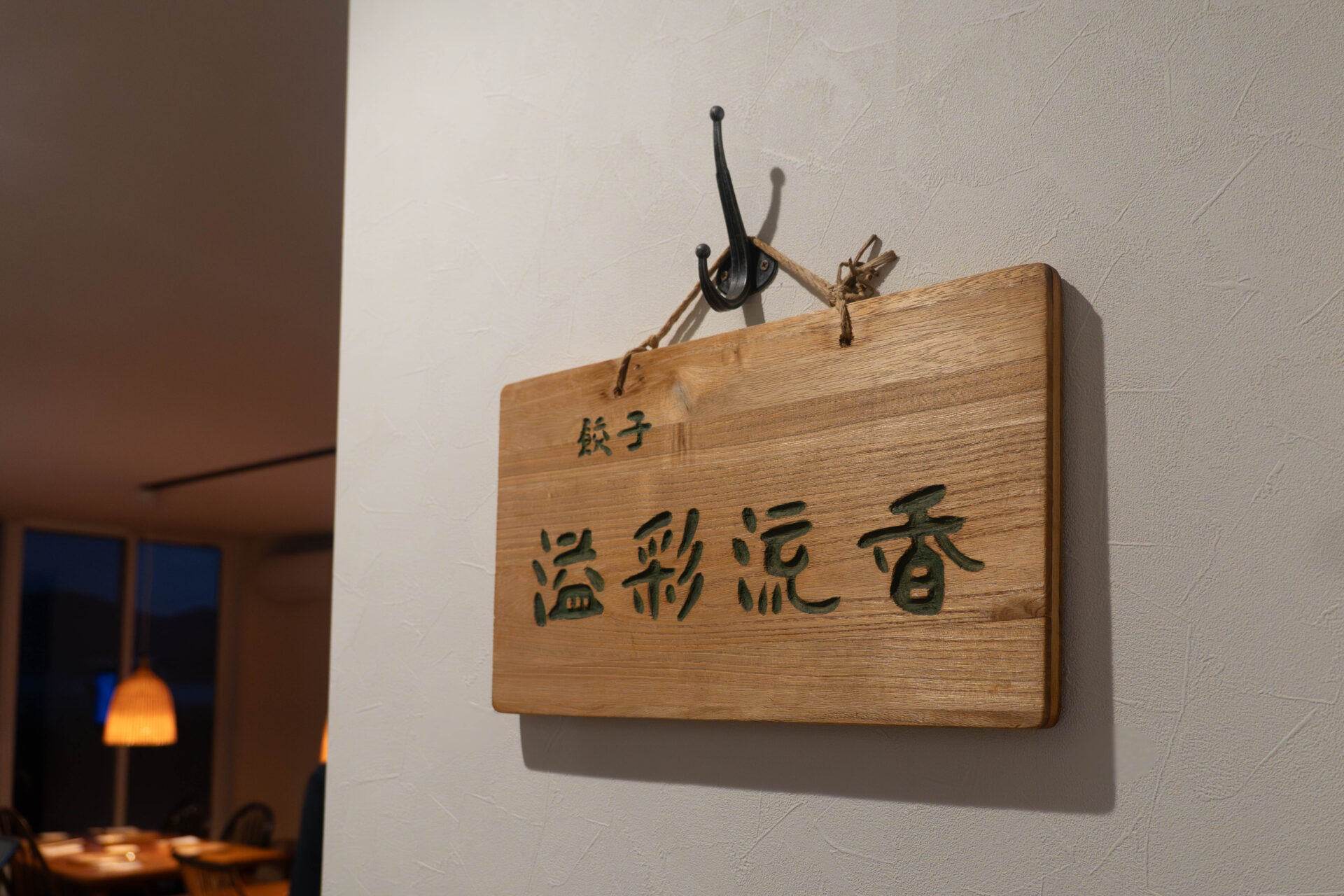
About Yicai Liuxiang (溢彩流香 / Isairyūshan)
Concept
Set on the seafront of Tsurumi in Bizen City, Okayama, “Yicai Liuxiang” is a restaurant that carefully expresses the bounty of the Seto Inland Sea’s mountains and coast through the craft of Chinese home cooking.
Once known in Takatsuki, Osaka, as the “Chinese home-cooking restaurant you couldn’t get a reservation at,” it relocated to a tranquil inlet on the Seto Inland Sea in 2023.
The building takes the form of a small auberge where guests can also stay overnight. It is designed as a place to savor food slowly while feeling the sound of waves and the shifting light. The style of hosting only one or a few small groups at a time reflects the wish to create “a space where people and food can quietly face one another.”
The ingredients used are ones with a visible producer behind them — local Bizen vegetables and grains, seafood landed each morning on the Seto Inland Sea, and herbs from the restaurant’s own garden. Details such as dumpling wrappers made with stone-ground wheat, and dumpling fillings made without garlic, reflect a commitment to drawing out the flavor of ingredients in a way that is “gentle and honest.”
Unrestricted by the conventional bounds of Chinese cuisine, Yicai Liuxiang’s appeal lies in the way the warmth of home cooking overlaps with an artisan’s precision. Not just the food, but the sea, the sky, and the passage of time itself become part of a single memorable experience — offering a form of “dining as a stay.”
The Chef: Lin-san
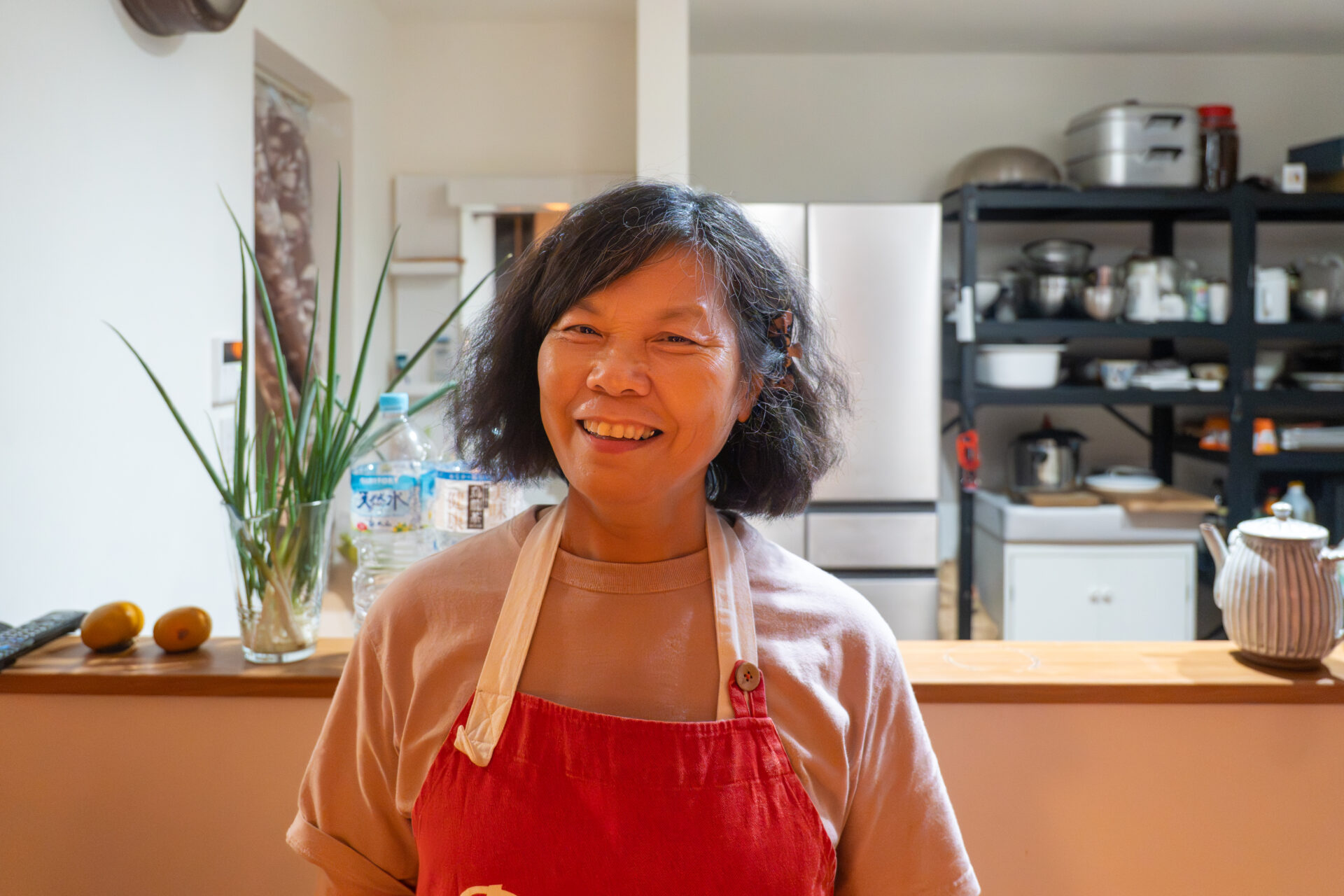
At the helm of Yicai Liuxiang is Ye Zhaoyang, a chef originally from Zhanjiang, Guangdong Province, China. At the restaurant, he is affectionately known as “Lin-san.”
In 2009, he opened “Yicai Liuxiang” as a small dumpling specialty shop in Takatsuki, Osaka. Drawing on the culinary sensibility nurtured in his own Chinese household, he has pursued a style of “Chinese cooking as an extension of home,” attuned to Japanese ingredients and everyday life.
Lin-san’s approach is to “let the ingredients’ own aroma do the work, without using garlic.” His signature “crystal dumplings” are known for their striking contrast between the umami of the filling and its texture, sealed inside a clear, delicate wrapper — a refinement that reaches the level of true craftsmanship while still being home cooking at heart.
From the preparation of ingredients, to the balance of the filling, to the kneading of the dough, every step is handled with a sure, unhesitating touch. As he himself puts it: “I treasure my mother’s flavors, but my cooking will never taste exactly like hers” — a reflection of how he has carried forward the memory of home while steadily building his own personal expression.
The move to Okayama grew out of a wish to “bring life and cooking together, amid nature.” Standing between mountain and sea, he weaves together dishes shaped by the local bounty, offering visitors the chance to simply enjoy “the time spent eating” itself.
In Chef Ye’s cooking, one senses the warmth of home, the precision of a craftsman, and a quiet philosophy rooted in this particular land.
Dining Prelude
Exterior and Entrance
Standing along the inlet of Tsurumi in Bizen City, “Yicai Liuxiang” is a restaurant nestled in a quiet setting, embraced by sea and mountain.
The building doubles as an auberge, and its exterior is understated and clean. White walls, calm wood textures, and the surrounding greenery come together in harmony — the warmth of a private home coexisting with the crisp bearing of a restaurant.


The approach to the entrance is gentle and unhurried; with each step, the noise of the city recedes further, while the sound of waves and the scent of the sea breeze grow gradually stronger. At the entryway, simple plantings and understated lighting await. The restaurant’s stance of “unadorned, yet welcoming” comes through clearly in this atmosphere.
At night, lights trace the outline of the building, giving it a warmth reminiscent of being invited into someone’s home. It feels less like a restaurant and more like “the entrance to a stay” — the moment you step out of the car, time already begins to flow more slowly.
Standing here, looking out over the Seto Inland Sea, it becomes easy to understand why the restaurant chose to move from Osaka to this spot. Here, it feels as though the scenery and the air themselves have been prepared as part of the course, alongside the food.

About the Dining Space
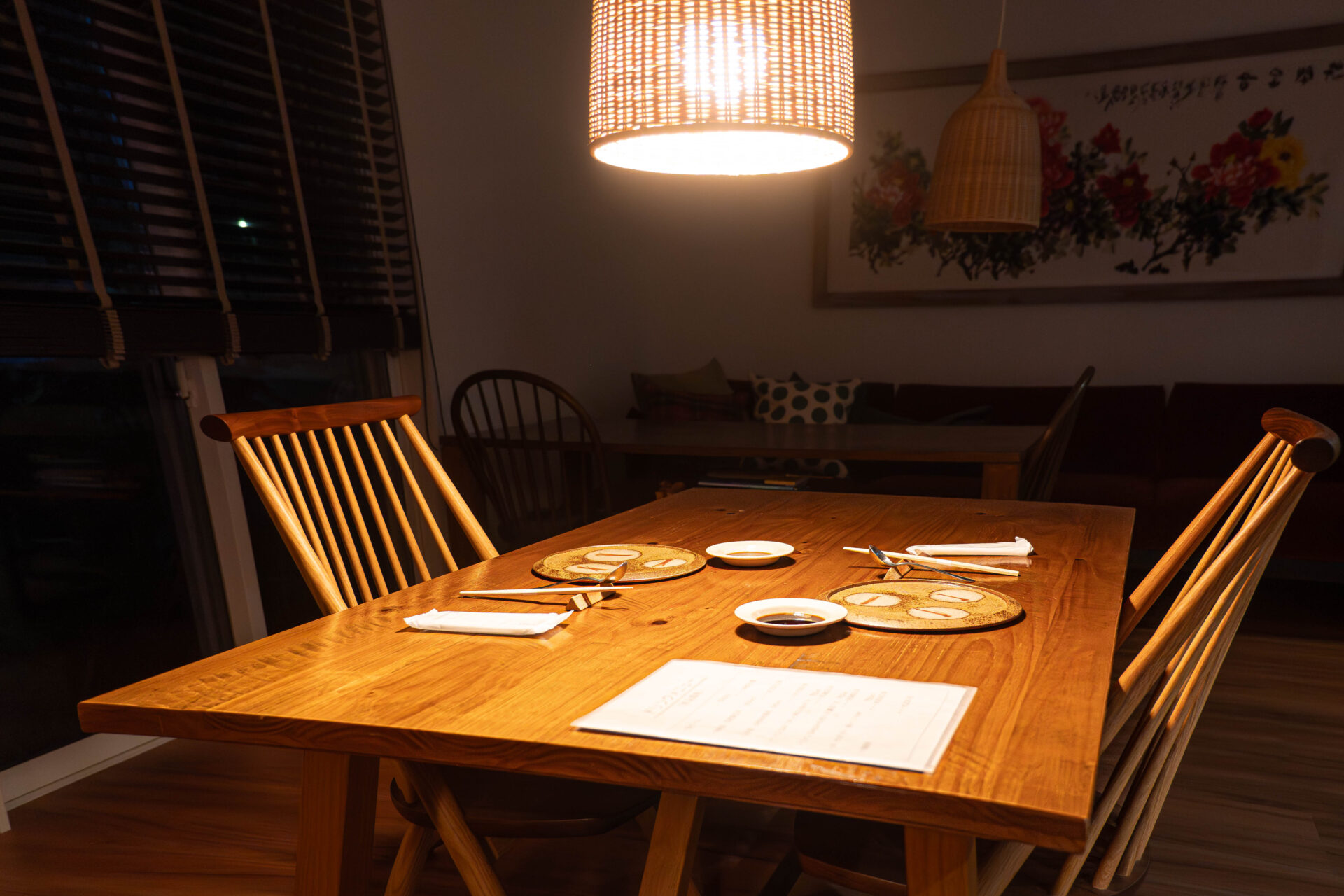
The dining room is arranged to overlook the inlet of Tsurumi in Bizen, set between mountain and sea. Gentle light from the Seto Inland Sea streams in through large windows, quietly conveying the passage of time.
Seating is limited, with the restaurant accepting only one or two parties per day. Tables are placed generously within a spacious layout, leaving enough room that neighboring guests are barely noticeable.
Furniture and flooring make the most of natural wood textures, paired with soft lighting tones. Decoration has been pared down to the essentials, so that the food and the view remain the true focus. Sitting by the window, the shimmer of the distant sea comes into view, along with the occasional call of a bird or the sound of the wind.
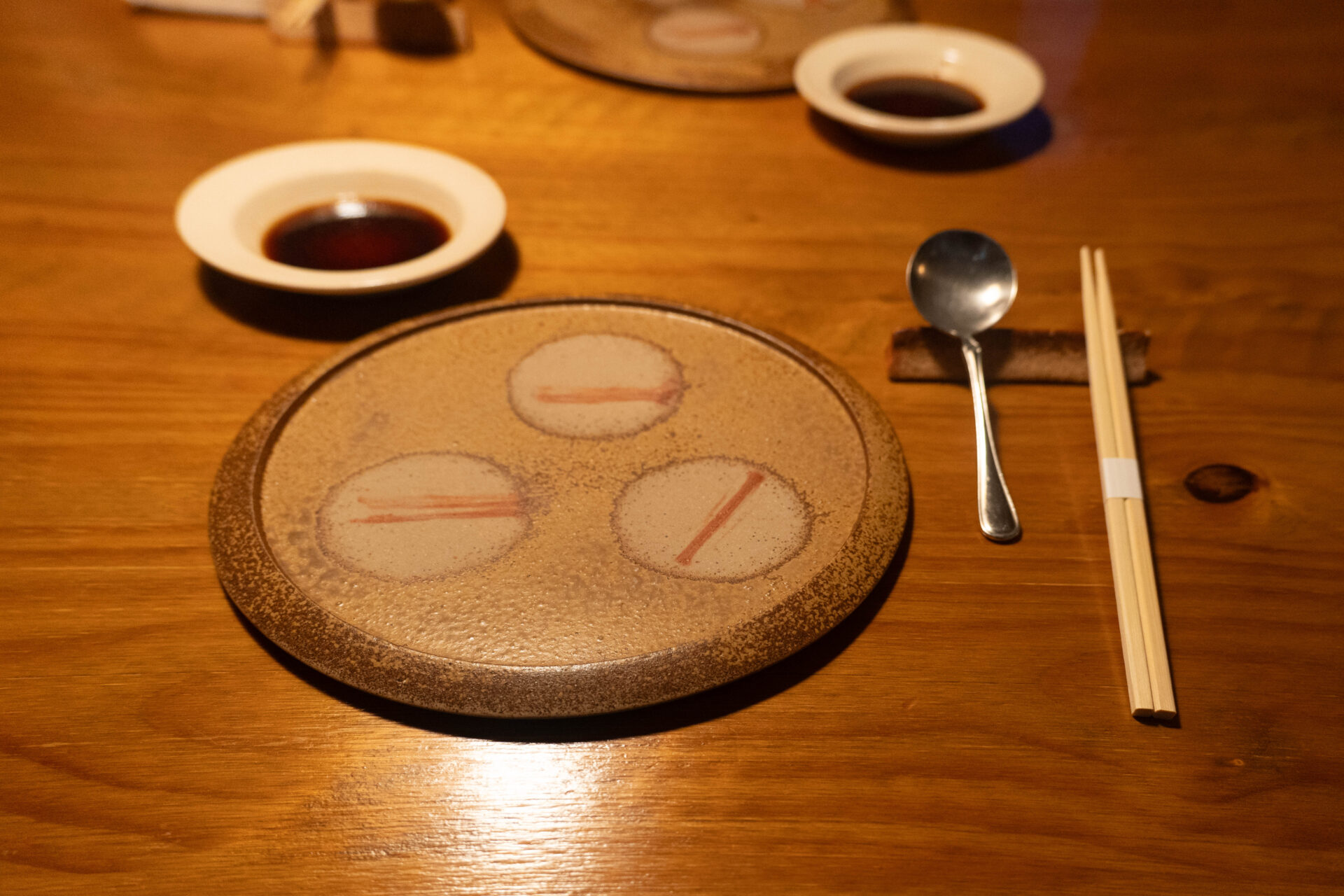
The tableware draws on local Bizen ware and pieces by individual artists; each time a dish is set down, the interplay of light and earthen texture comes alive. Ingredients, tableware, scenery — none of it flashy, yet together they form one quiet, coherent world.
As night falls and the lighting is dimmed, the boundary between sea and sky beyond the window gently dissolves. Against this backdrop, in a space where sound and light are both kept low, even the chef’s hand movements and the rising steam from the dishes feel like part of the meal itself.
Here, the experience feels less like “eating a meal” and more like “savoring time itself.” It remains an extension of everyday life, and yet clearly conveys something out of the ordinary. That was the kind of dining room it was.
Menu Presentation
The cuisine at “Yicai Liuxiang” is not built around a fixed menu, but rather an omakase-style course composed according to the ingredients and season of the day.
Vegetables and grains grown across the mountains and coast of the Seto Inland Sea and the village of Bizen. Cooking methods and seasoning are adjusted subtly according to the ingredients delivered that day. Even the same course, they say, differs slightly from one day to the next for this reason.
The structure follows a gentle progression — from appetizers to dim sum, to the main course, to rice dishes, and finally dessert. The balance of texture and aroma is calculated dish by dish, so that guests never feel fatigued by the end, the food settling naturally into the body.
The restaurant’s signature dumplings come in many forms — pan-fried, steamed, and boiled. Among them, the standout is the so-called “crystal dumpling”: a filling sealed within a translucent wrapper, glowing faintly as light passes through it. The combination of pork, shrimp, and vegetables changes with the seasons, and everything from the wrapper’s composition to the steaming time is fine-tuned by Lin-san himself.
Main courses include dishes such as braised Kuroge Wagyu beef and stir-fried wild eel with spices — rooted in Chinese technique, yet clearly shaped by the bounty of this land. Seasoning is kept restrained, allowing the natural aroma and umami of the ingredients themselves to come forward.
The meal closes with dishes such as dried-meat fried rice or crab and yellow chive fried rice — a dish that wraps up the course with gentle fragrance and the natural sweetness of rice. Dessert, too, changes with the season: sweets such as Shine Muscat daifuku or dried persimmon mochi carry a faint sense of nostalgia in their sweetness.
Overnight guests are also served breakfast, featuring dishes such as vegetables dressed with Chinese-influenced techniques, fish preserved in sake lees, stir-fried eggs with yellow chives, and congee or fried rice — a gentle blend of Japanese and Chinese sensibilities.
Rather than flamboyance, this is food meant to let guests savor the land and the passage of time. That quiet structure is, more than anything, what best expresses the essence of “Yicai Liuxiang.”
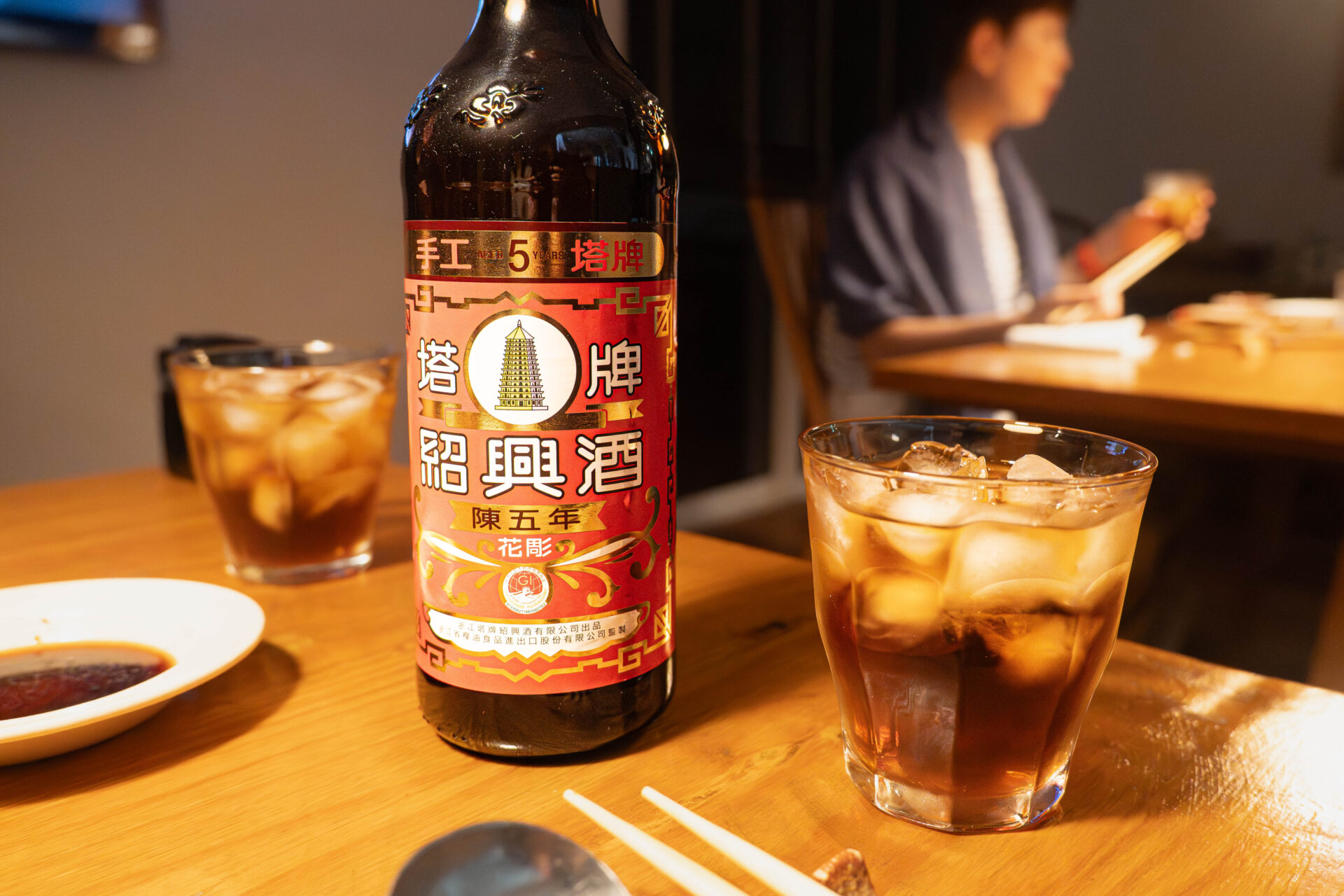
Starter Drink
The meal began with a five-year aged Shaoxing wine, “Tapai Chen Wunian Huadiao,” served with soda.
The mellow sweetness and depth of the Shaoxing wine combine with the light crispness of the soda for a clean, refreshing finish. Light enough as an aperitif, it made for just the right first pour to begin the day’s Chinese home-style meal.
The Dishes We Tasted
Appetizers
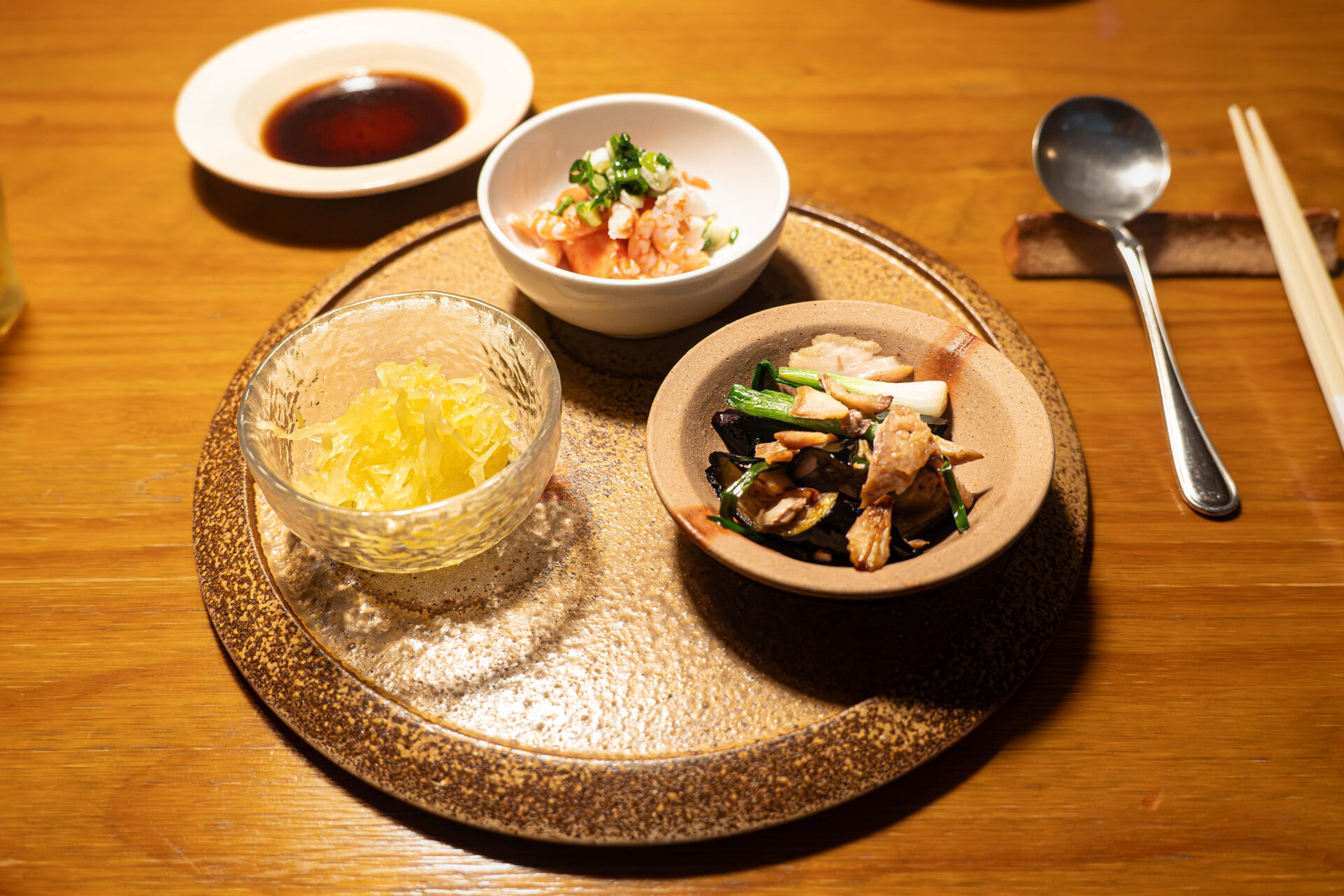
The meal opened with three small appetizers, each bowl quietly presenting the bounty of the Seto Inland Sea and the surrounding fields.
In a white dish, two kinds of shrimp caught in the Seto Inland Sea — small pattern shrimp, with red-legged shrimp tucked beneath them — brought lightly together with a Mekabu-style sauce. The cooking was restrained, letting the sweetness of the shrimp meet the sauce’s acidity; from the very first bite, the outline of the Seto Inland Sea itself seemed to unfold.
In a clear glass dish, spaghetti squash dressed with lemon and olive oil. Once boiled and pulled apart, the flesh unravels into thin, noodle-like strands. The acidity of the lemon and the fragrance of the oil combine to cleanse the palate.
The third dish paired eggplant from the garden with Atka mackerel, stir-fried with fish sauce. The softness of the eggplant met the smoky richness of the mackerel — Chinese in style, yet carrying a faint earthiness reminiscent of Japanese cooking too.
None of the presentations were flashy, and yet each dish held its ingredients’ character clearly in focus. More than a set of dishes, it felt like an appetizer that revealed the land’s own “flavor of beginnings.”
Pear and White Fungus Soup with Spare Ribs
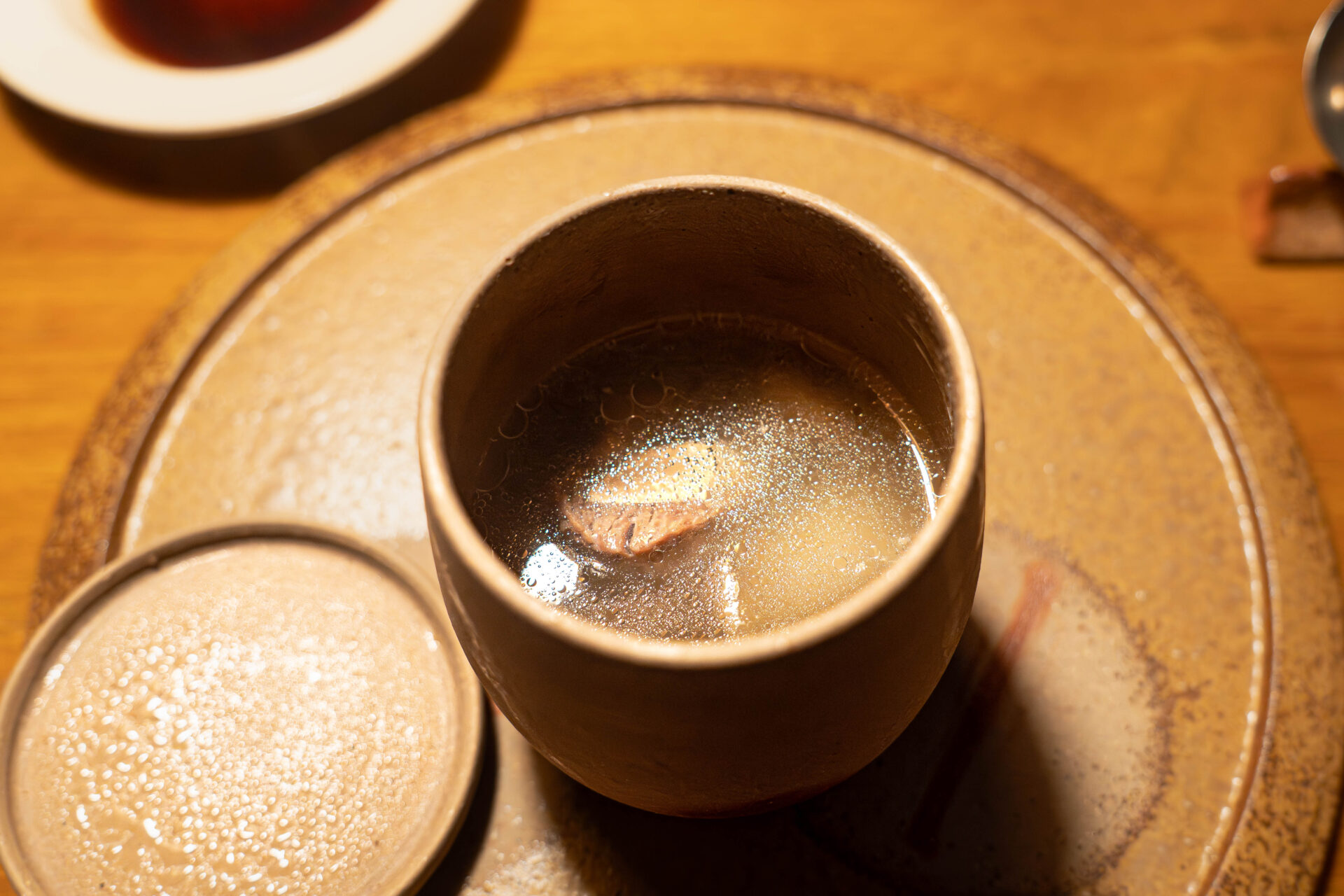
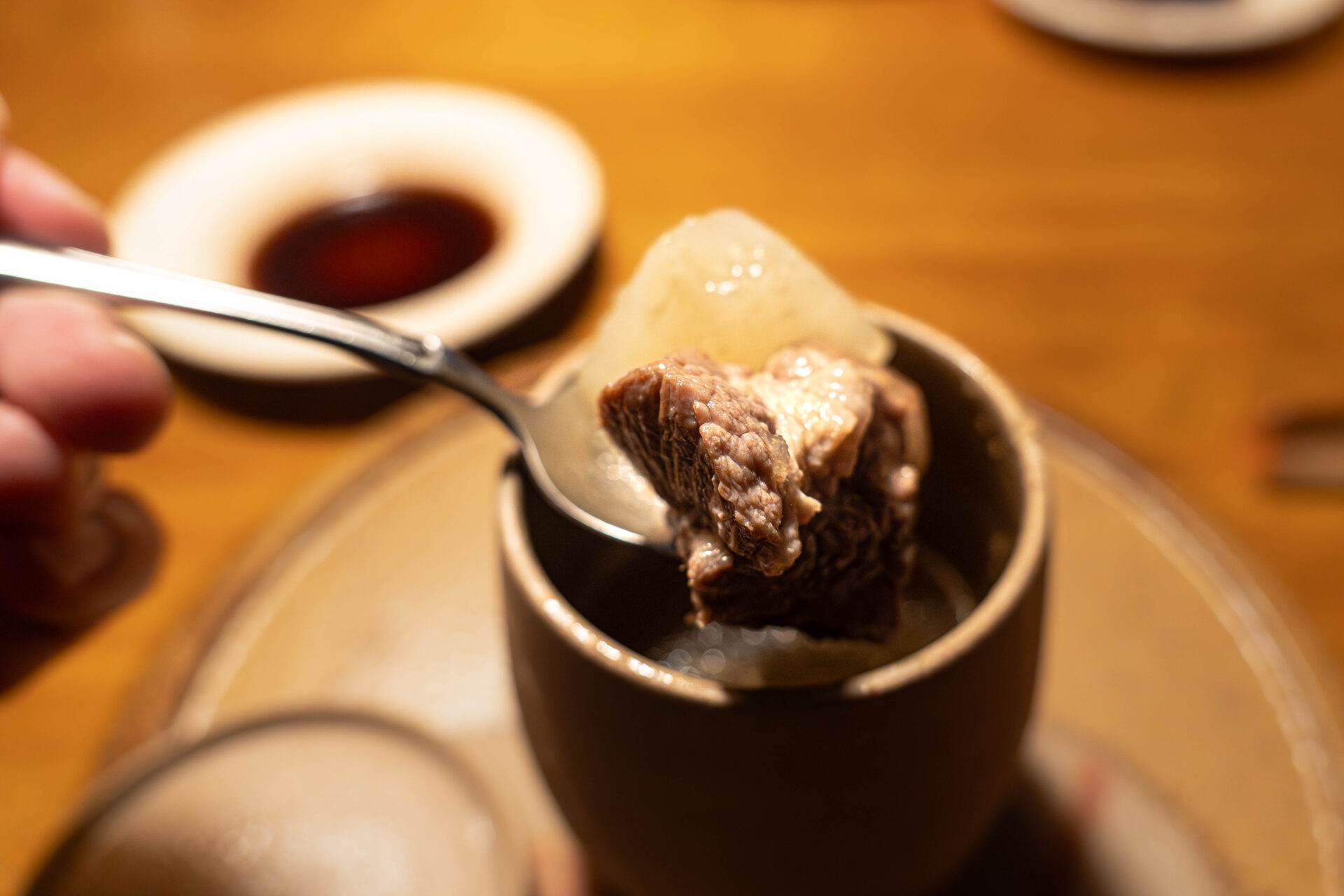
The second course arrived quietly in a covered bowl. Lifting the lid released a soft aroma, revealing spare ribs and white fungus (silver ear mushroom) suspended in a clear broth, with generously cut pieces of pear peeking through.
Based on a traditional soup beloved in the Guangdong region, the dish uses half a Shinko pear to bring out natural sweetness. Long simmering allows the white fungus to dissolve into the broth, giving the whole soup a silky, velvety texture.
The sweetness of the pear spreads gently, yet feels surprisingly natural in the context. The richness of the bone-in meat and the delicate fragrance of the fruit settle into a single harmony. This idea of a “sweetened soup” is said to be rooted in Guangdong home-cooking wisdom.
In China, ingredients such as sugarcane, water chestnut, and carrot are often added, with the soup itself — rather than the solid ingredients — being the main point of enjoyment. Here, that culture has been reconstructed using the ingredients of the Seto Inland Sea.
With every spoonful, a warmth seemed to seep to the very core of the body — a dish experienced more through sensation than through taste alone.
Two Kinds of Boiled Dumplings
Next came the dish that has become synonymous with this restaurant: dumplings. Two kinds of boiled dumplings were served side by side — one with a translucent wrapper, the other pure white.
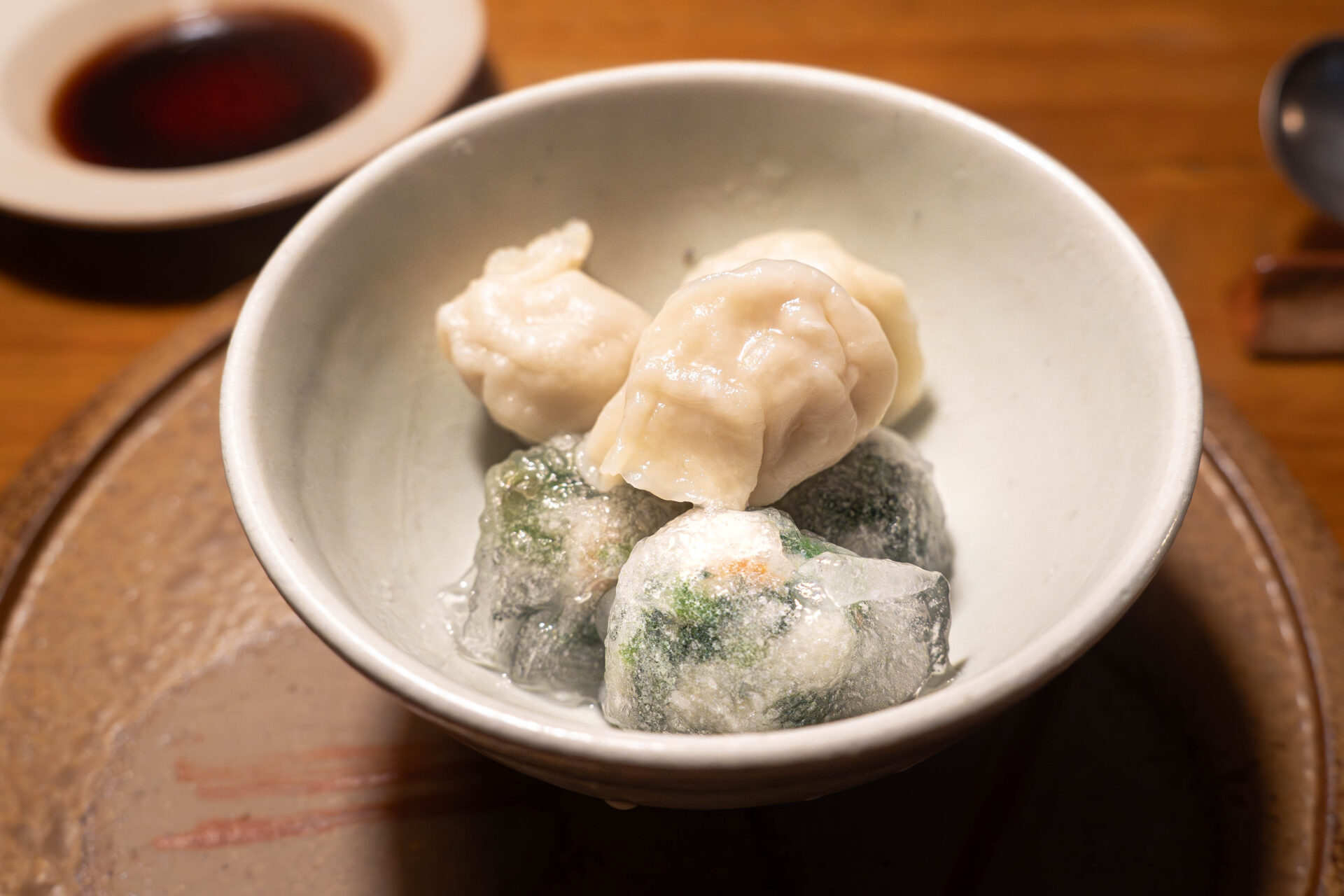
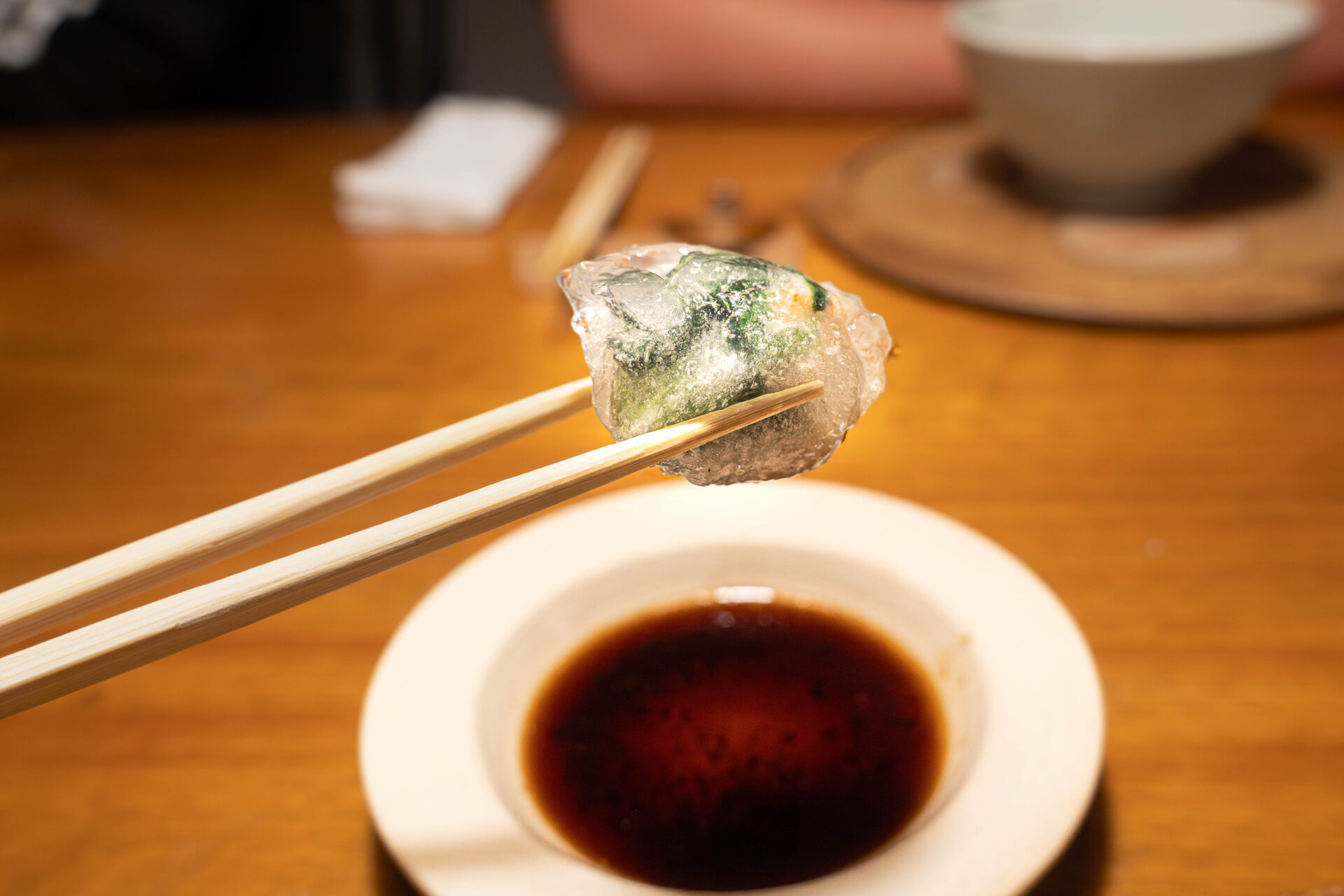
The translucent dumpling was filled with pork, shrimp, and spinach. Beneath the wrapper — so thin that light passes through it — the outline of the filling is faintly visible.
Taking a bite revealed a chewy texture, followed by the umami of pork and the fragrance of shrimp, with the spinach’s freshness lightening the overall flavor.
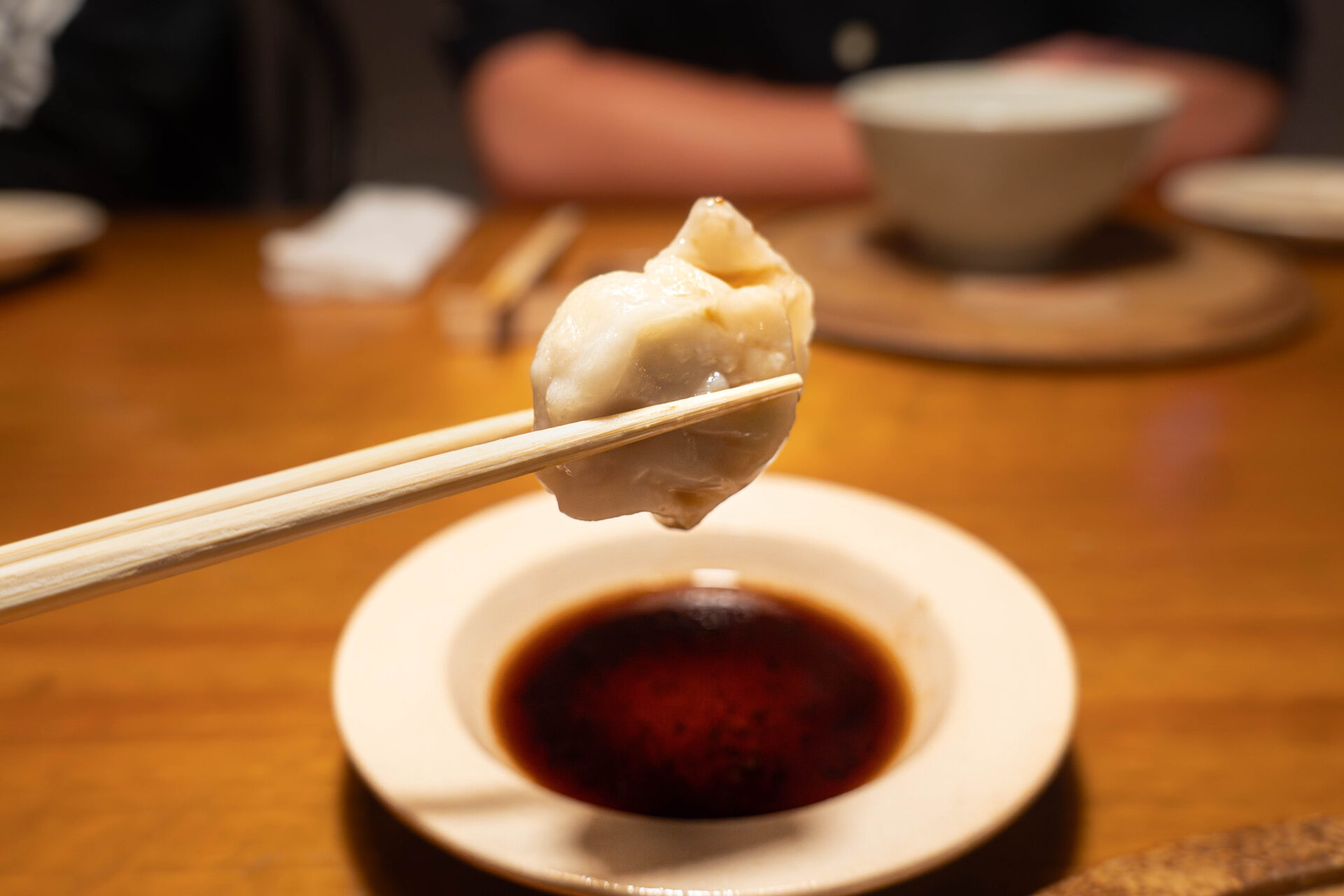
The pure white dumpling was filled with squid and lightly pickled napa cabbage, combined with a small amount of pork. Beneath a gentle sweetness, a faint tang from the cabbage’s fermentation comes through, followed by the lingering umami and saltiness of the squid.
The first bite is best enjoyed plain — even without dipping sauce, the balance between wrapper and filling feels complete, with umami deepening with every chew. Later on, adding a black vinegar–based dipping sauce sharpens the flavor and reveals a different side of the dish entirely.
Even the combination of ingredients and the precision of the folding felt meticulously calculated — a simple-seeming dish that carries, in fact, the very philosophy of this restaurant.
Crystal Dumplings
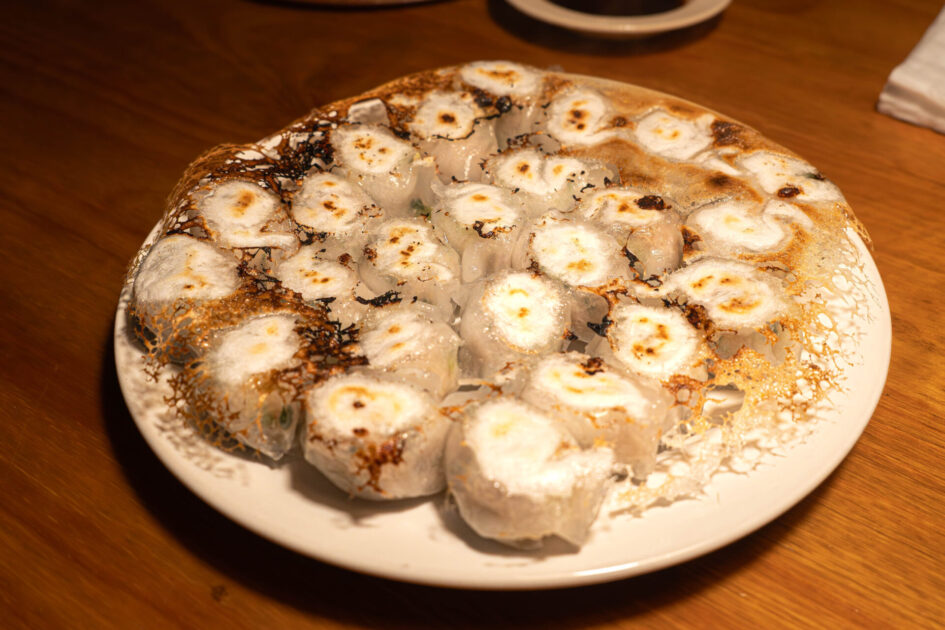
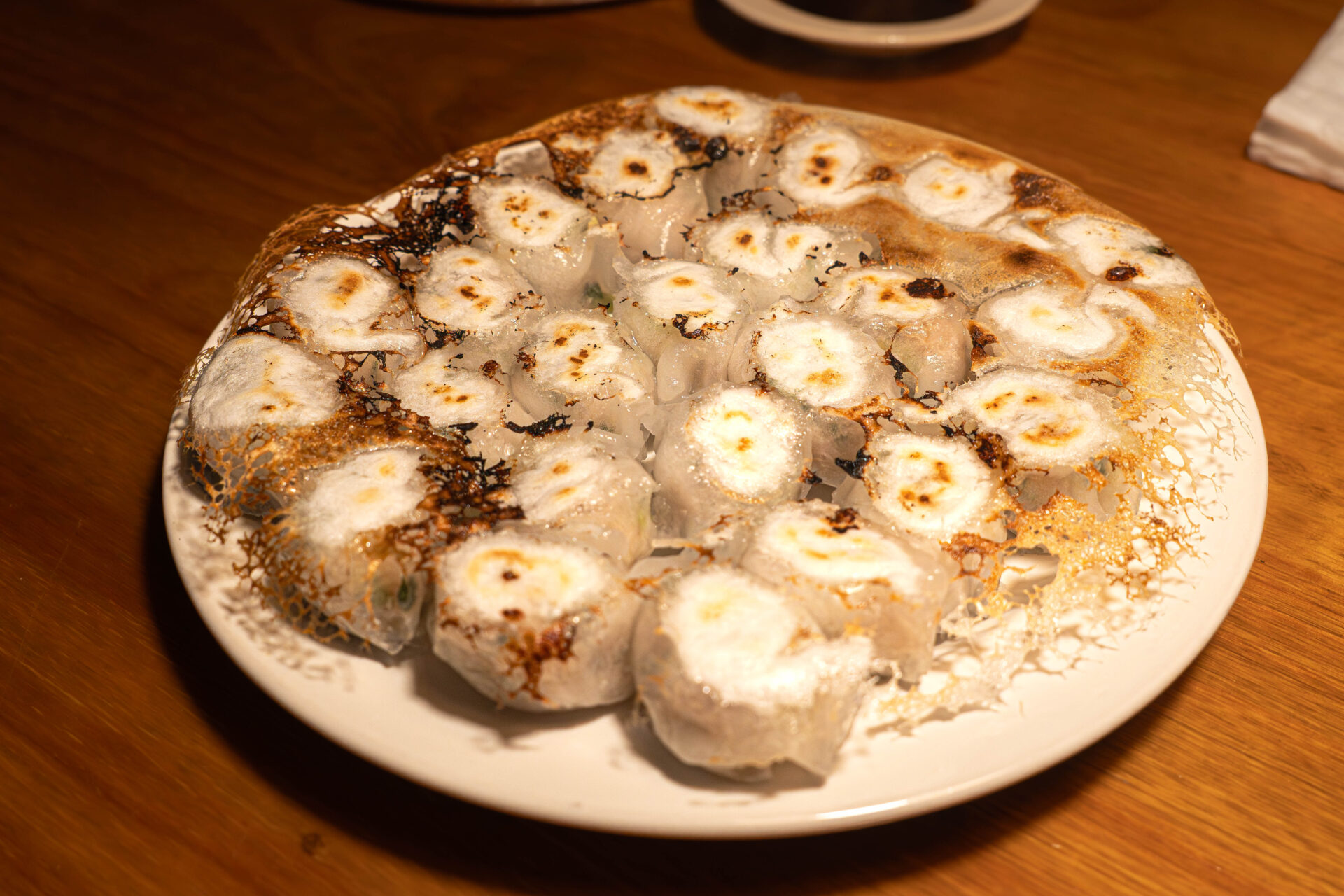
Arriving with the sizzling sound of its crisped underside, the next dish was the restaurant’s signature: “crystal dumplings.”
A wing of golden, crisped batter spread across the plate, beneath which the thin, translucent wrapper shimmered as it reflected the light. The special wrapper, made from a blend of stone-ground flour and starch, turns crisp on the outside and springy within once cooked.
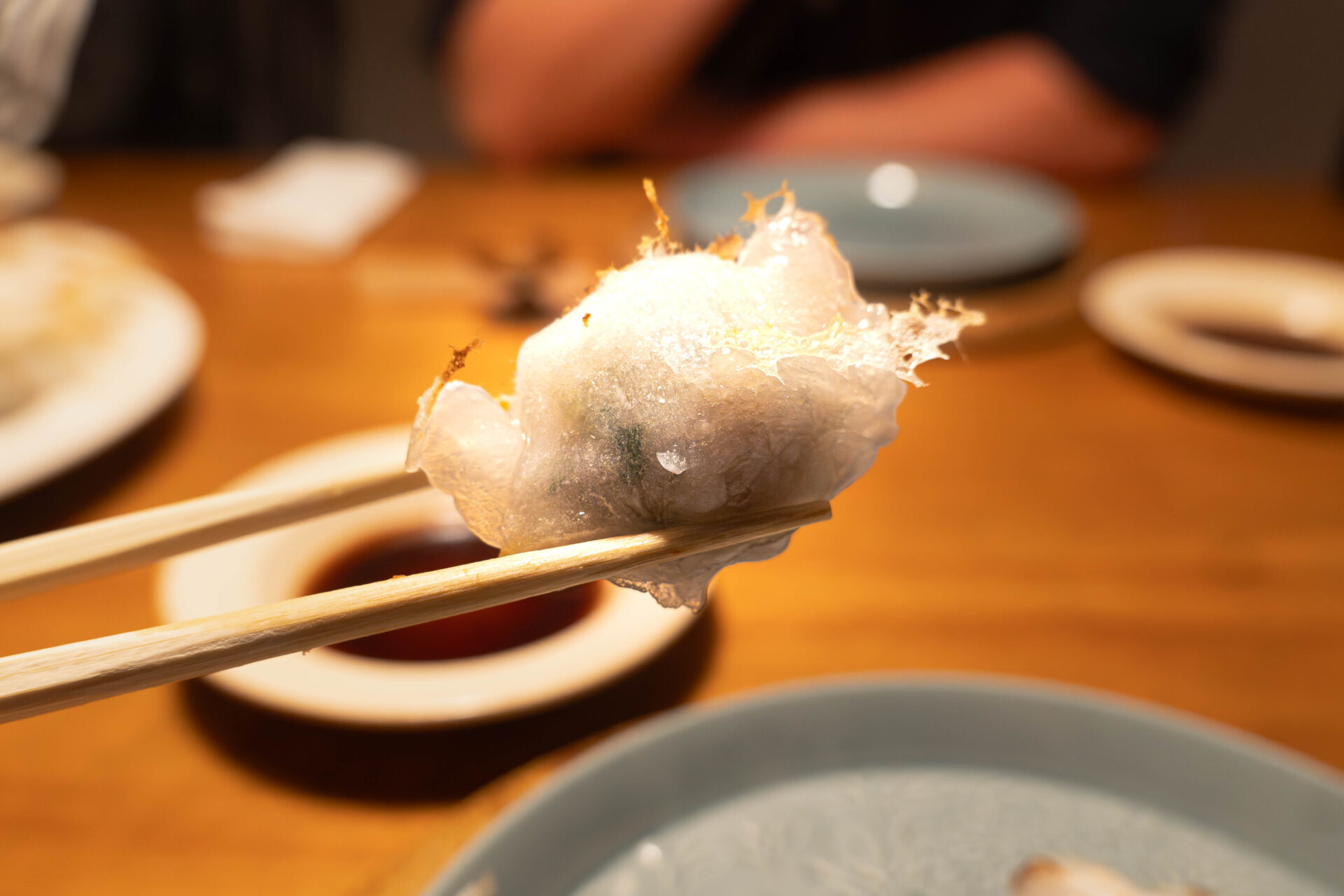
Lifting one with chopsticks, the filling was faintly visible through the wrapper. At the first bite, a crisp sound released a puff of steam, carrying with it the aroma of pork, vegetables, and shrimp. Made without garlic, the flavor rests entirely on the natural sweetness of the ingredients — yet there is no heaviness or oiliness to it at all.
The light, smoky fragrance of the crisped edge, the translucence of the wrapper, and the rich umami of the filling — three layers of texture unfolding together in the mouth. The flavor felt deeper eaten plain, without dipping sauce.
A sense that runs through every dish at this restaurant — that “the work of the hands becomes the flavor itself” — comes through most clearly of all in this crystal dumpling.
Glass Noodle and Daikon Spring Rolls
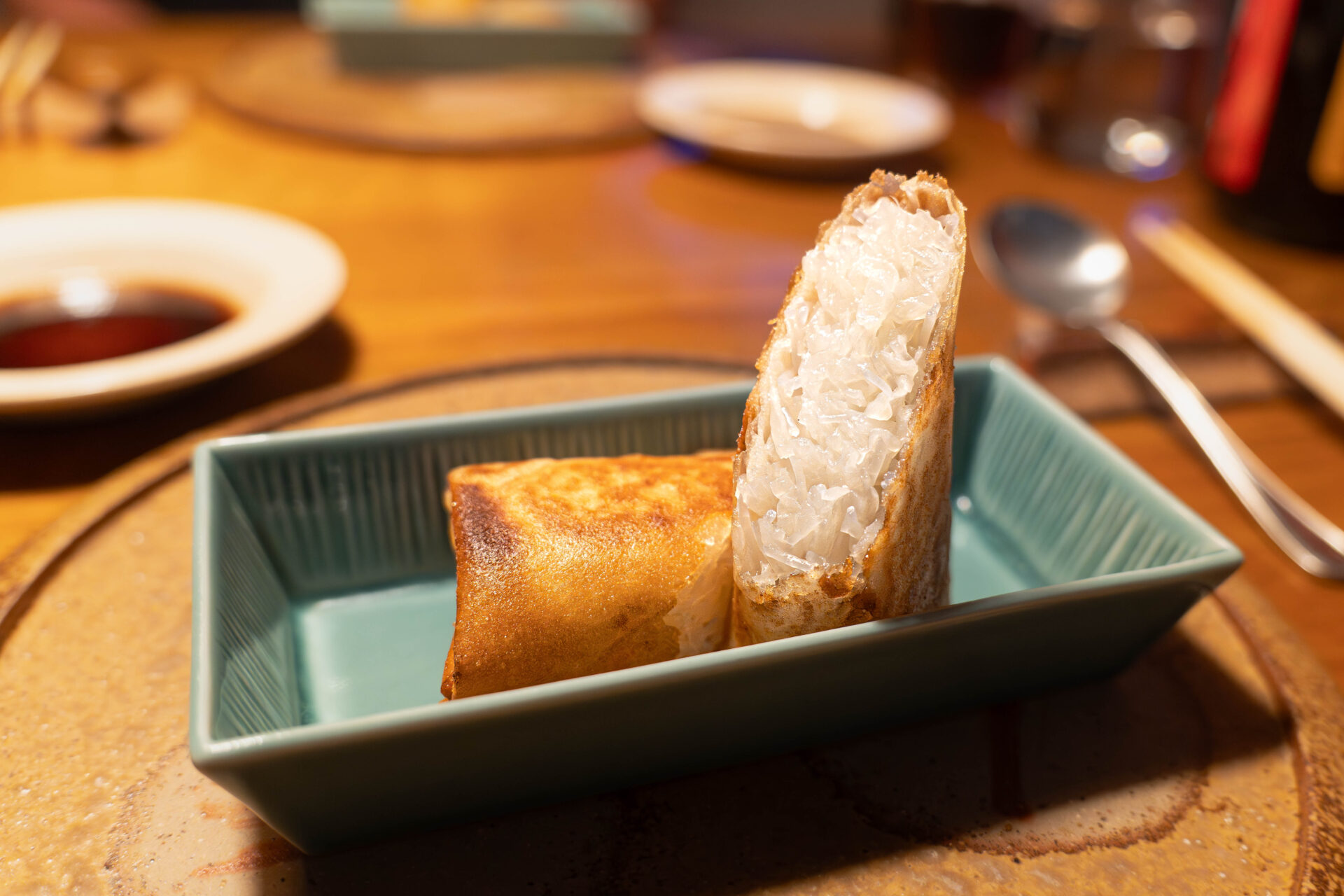
Next came golden, crisply fried spring rolls. Biting in released a crackling sound from the thin wrapper, revealing glass noodles and daikon radish peeking through inside.
The filling was kept simple, with just glass noodles and daikon. Cooked briefly over restrained heat, the daikon retained its natural sweetness and freshness. The chewiness of the noodles against the softness of the daikon created a rhythmic contrast, growing lighter with every bite.
The wrapper, it turns out, is a store-bought one — yet the precision of the heat and the beauty of the wrapping make that hard to notice. The homely familiarity of the dish and the precision of a craftsman rise up together, at once.
Beneath the fragrant, crisped surface lies a kind of paradox particular to this restaurant — “something special within the everyday.” Ordinary ingredients, quietly made to shine. That, it seemed, is the true strength behind Yicai Liuxiang’s cooking.
Stir-Fried Squid and Bell Pepper with Garlic Powder
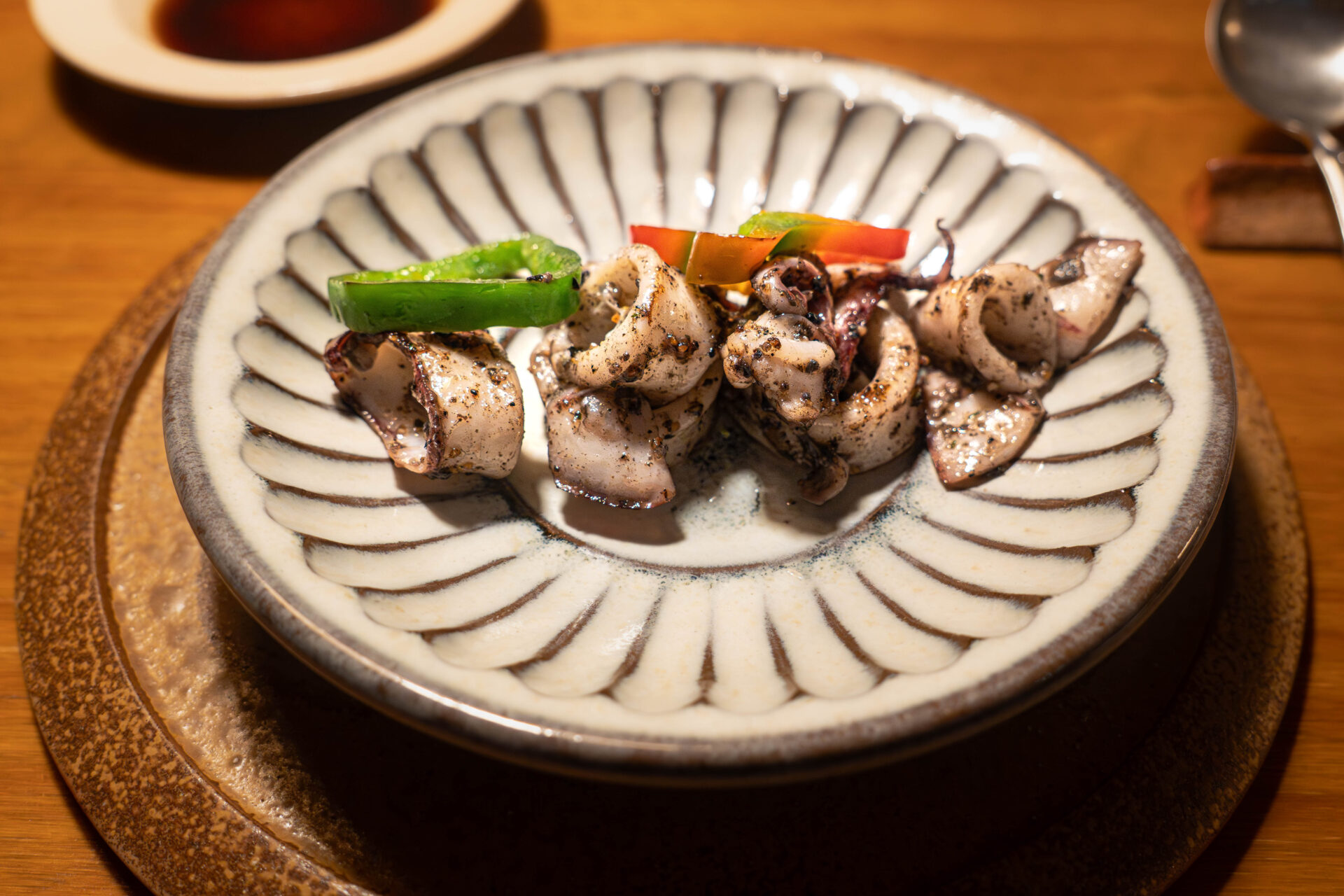
Next was a stir-fried squid dish. On the plate sat lightly seared squid rings alongside a restrained scattering of red and green bell pepper.
The squid had a translucent texture, remaining tender even after cooking, its sweetness deepening with each bite. This preparation incorporated squid ink, giving the dish a deeper umami and added depth of aroma.
Being in season for roe, small clusters of eggs offered a delicate, crumbling texture with each bite — a subtlety that further highlighted the tenderness of the squid.
The seasoning was kept extremely simple, with just a faint aroma of garlic powder wrapping around the natural umami of the ingredients. There was almost no bitterness, and even the innards had been transformed into pure umami — a striking detail.
Stripped of unnecessary flourish, the dish still showed real skill in its layering of heat and aroma. Seemingly homely at first glance, each bite revealed the hand of real experience — a quietly powerful dish.
Kuroge Wagyu Leg with Manchurian Wild Rice Stem and Long Green Beans, Qingjiao Rousi–Style
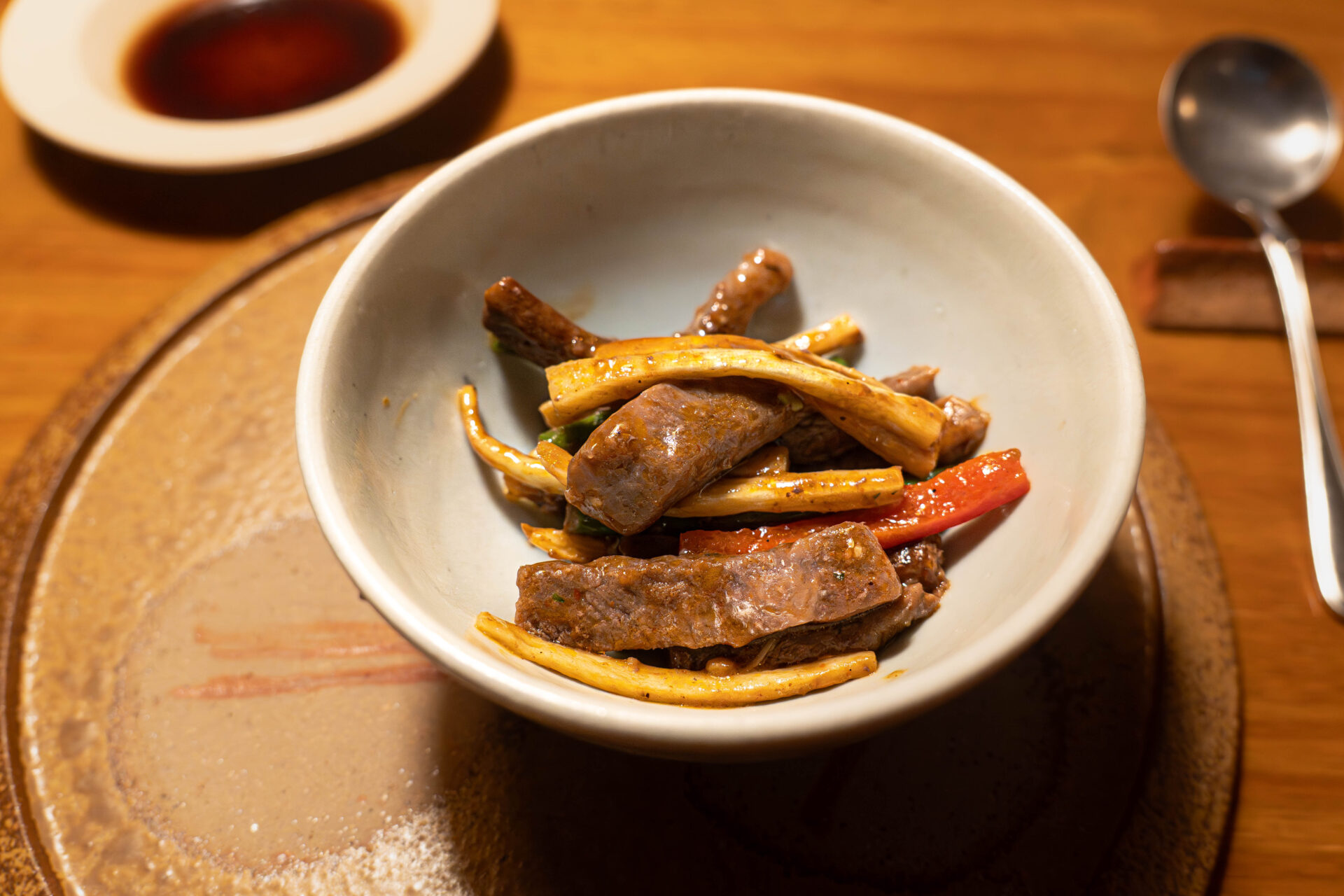
The main course was a version of qingjiao rousi (shredded pepper-and-meat stir-fry) made with Kuroge Wagyu leg meat. Unlike the typical dish, the beef was not thinly julienned but cut into generous pieces, each retaining the clear texture of the meat’s fibers.
Paired with Manchurian wild rice stem and long green beans, both cooked briefly to retain their crisp texture, allowing the umami of the wagyu and the aroma of savory soy sauce to settle into them.
In the moment when the gentle sweetness of the wild rice stem meets the bold richness of the wagyu’s lean meat, a new harmony emerges — beyond what one would expect from a typical qingjiao rousi. With each bite, what comes through is not the richness of oil, but the aroma of the ingredients themselves, unfolding naturally.
Excess moisture was cooked off with precision, the heat stopped at the exact moment before any char could set in — a light yet precisely controlled stir-fry, characteristic of this restaurant.
Nothing flashy or decorative sat on the plate. And yet the heat, the seasoning, and the lingering aroma were all perfectly composed. To elevate something as simple as “stir-frying meat” to this level felt, quietly, like something remarkable.
Grilled Eel Fried Rice
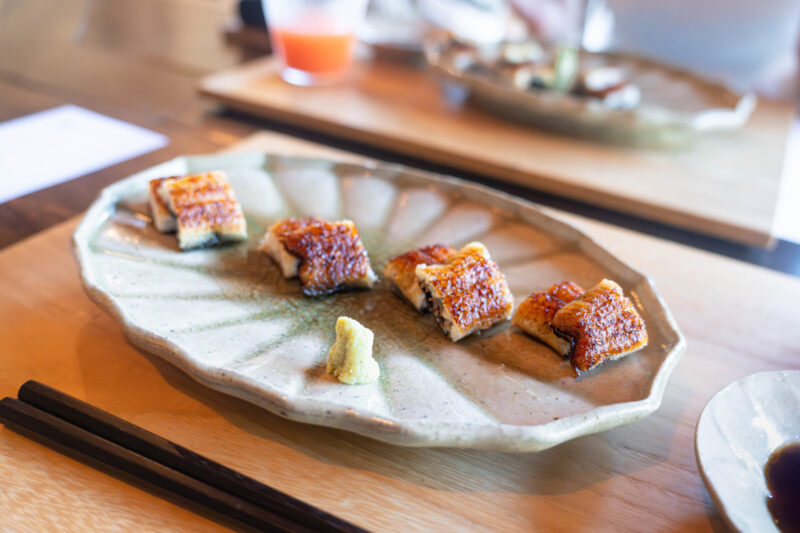
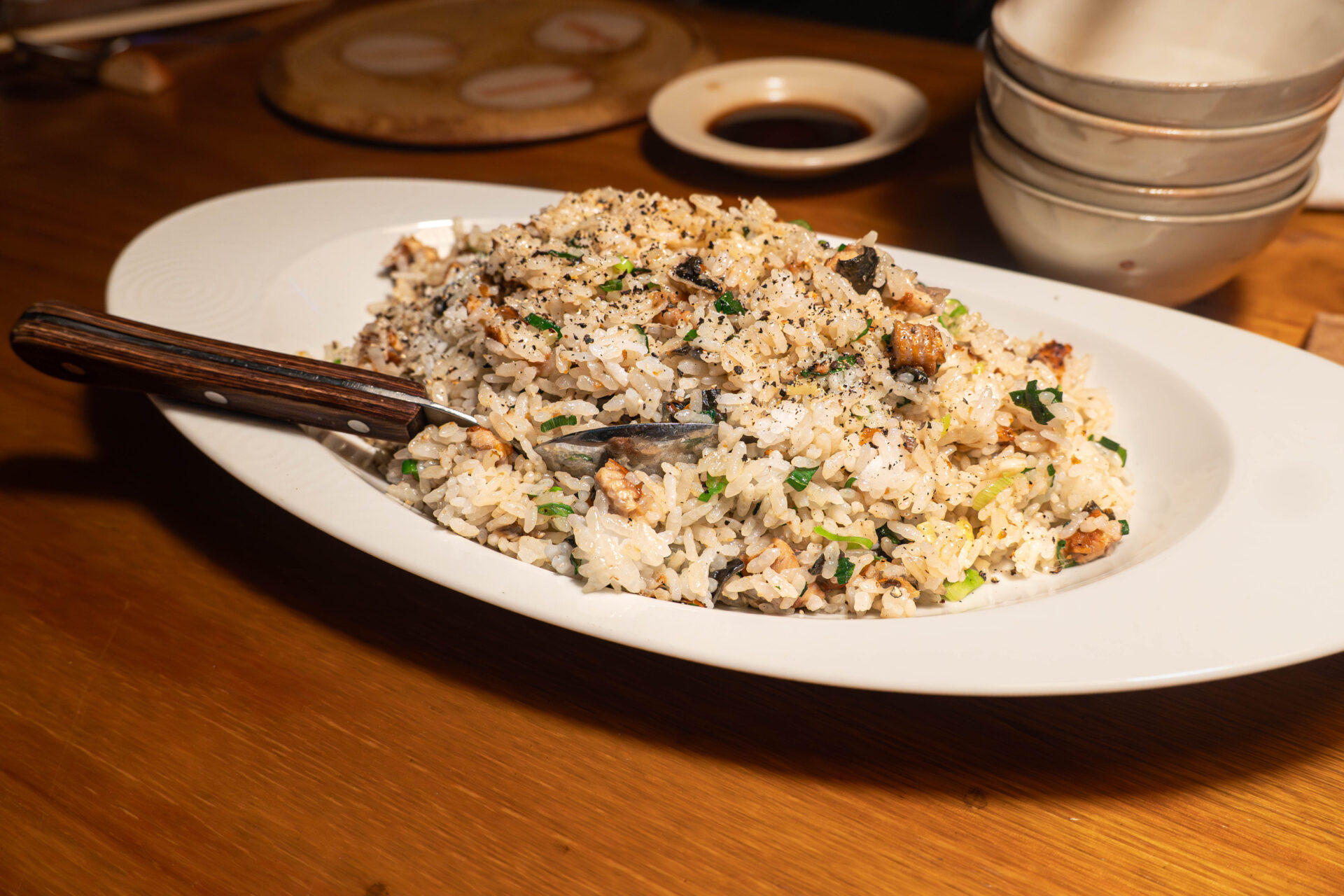
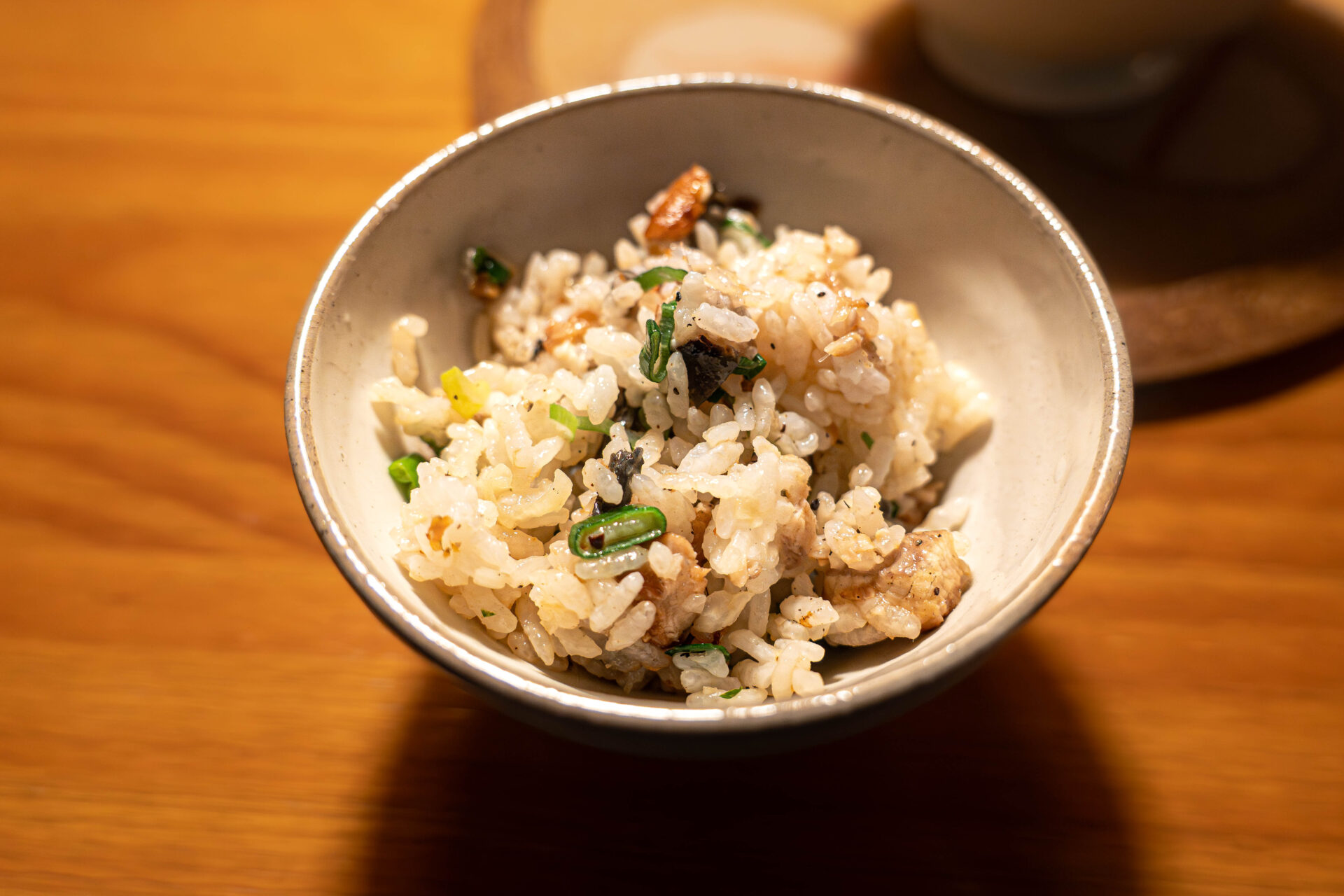
To close the meal, fried rice made with grilled eel. From the mound of rice heaped on the white plate, a fragrant, smoky aroma spread immediately.
Chopped pieces of eel were mixed throughout, with a light heat from doubanjiang and black pepper pulling the whole dish together. Each grain of rice was stir-fried until it separated cleanly, with no trace of oiliness — light and fluffy in the mouth.
The sweet-savory glaze of the grilled eel layered with the spice of the doubanjiang for a flavor that sat somewhere between Japanese and Chinese cooking. With each bite, the smoky richness of the eel melted together with the sweetness of the rice.
The lingering spiciness felt pleasant, leaving behind a satisfying aftertaste to close the meal. Not heavy, and yet fully satisfying. Within the flow of the whole course, it was a striking finish — one that kept “the joy of eating” going right to the very end.
Dessert & Finale
Muscat Mochi
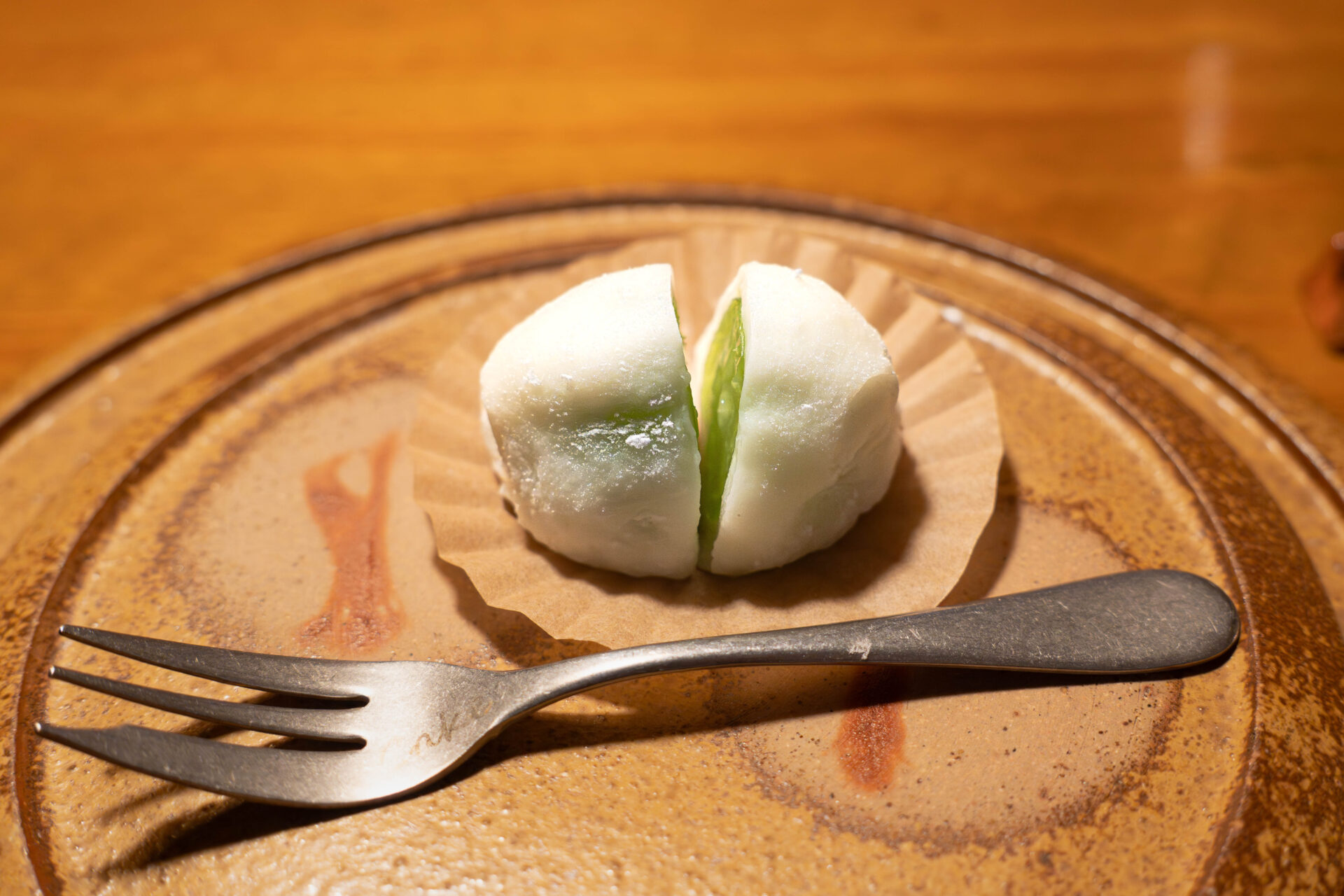
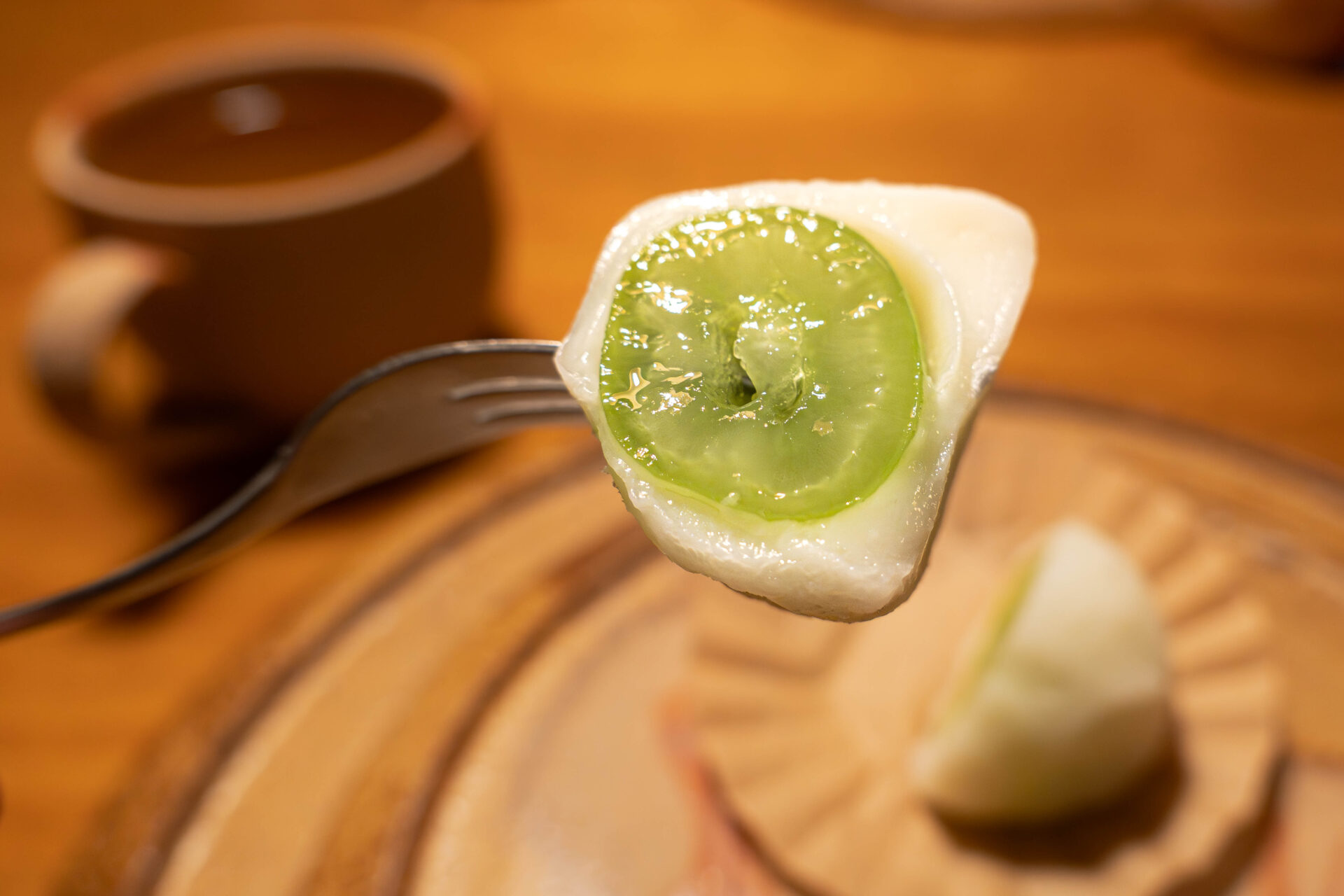
The dish following the meal was a simple sweet: a single Shine Muscat grape wrapped inside white gyuhi (soft mochi).
Cutting in with a fork, the soft, elastic mochi gave way to reveal a burst of juicy fruit. On the palate, the refreshing sweetness and acidity of the muscat grape unfolded, meeting the delicate sweetness of the gyuhi perfectly.
Amid the coolness lay a faint warmth, quietly closing out the lingering flavors of the meal. Understated, yet this single bite brought the whole flow of the meal together.
It became easy to understand why this is placed at the end of the course — a quiet sweetness indeed.
Summary & Impressions
Set within a single house in Tsurumi, Bizen, surrounded by sea and mountain, “Yicai Liuxiang” is a small auberge built around Chinese home cooking.
The stay itself feels like an extension of hospitality; at the table, the warmth of home cooking and the precision of a craftsman quietly coexist. The ingredients used are drawn mainly from the Seto Inland Sea and the restaurant’s own garden, and every dish, without any unnecessary flourish, let the natural character of its ingredients stand out clearly.
Among the dishes, what left the strongest impression was, unsurprisingly, the long-awaited “crystal dumpling.” The filling, wrapped in a translucent skin, catches the light and glows — its harmony of aroma and texture carrying years of accumulated skill. Rather than “surpassing” home cooking, it felt more like a “matured, everyday” flavor found just beyond home cooking’s frontier.
The lodging, too, carries the comfort of one’s own home. Unadorned and unpolished, it gently receives the visitor’s time. In the quiet after the meal, gazing out at the sea through the window, the special nature of this place became clear once more.
The food, the space, and the sense of distance between people — all of it felt natural, with nothing forced. And yet each and every piece of work was carried out with astonishing care, offering a realization: “How far can everyday cooking be elevated?”
Next time, I would love to visit for both the dumpling-making class and an overnight stay. Learning while eating — that time itself, I think, is this restaurant’s finest form of hospitality.
Reservations & Access Information
Address & Phone 3710 Tsurumi, Bizen City, Okayama Prefecture / Tel. 080-4017-6682 (calls accepted 9:00 AM–6:00 PM)
Hours & Closed Days Lunch from 12:00 PM / Dinner from 5:00 PM, closed irregularly. Fully reservation-based; walk-ins cannot be accommodated.
How to Reserve Reservations for the restaurant, lodging, and dumpling-making class are all made through the official reservation page (https://gzlohas.com/reserve/). Proceed to the reservation form for each plan (here) and follow the on-screen instructions.
The process runs as follows:
- Submit a reservation through the reservation form
- A “provisional reservation received” email will arrive
- Once the reservation is approved, a “reservation confirmed” email will arrive
- An invoice and payment instructions will follow by email; payment is made by credit card
Note: If you have spam-filtering or domain-restricted email settings, confirmation emails may not arrive properly. Please set your email to accept messages from “gzlohas@yahoo.co.jp,” as this domain is used for automatic reply emails.
- Restaurant-only dining is available for parties of 4 or more (up to 8 guests); when dining without lodging, the restaurant accepts a maximum of two parties per day. The omakase course is ¥8,000 (tax included). Reserve via the restaurant reservation page.
- Lodging is limited to one party per day (2–4 guests; please inquire for parties of 5 or more). Check-in is 3:00–7:00 PM, check-out at 10:00 AM. Several plans are available, including dinner-and-breakfast packages and room-only stays. Reserve via the lodging reservation page.
- The dumpling-making class is offered as an optional activity for overnight guests, available for booking between 11:00 AM and 2:00 PM (the class itself runs roughly 2–3 hours). This is arranged not through the reservation form but via the contact page.
Cancellation fees are 50% of the total charge from the confirmation date up to 30 days before the stay, and 100% from 7 days before through the day of the stay.
Access
By Car
- From the Osaka direction: Take the Sanyo Expressway southbound, then follow the Suita–Yamaguchi Route toward Okayama, exiting toward Bizen/Hinase. Follow signs toward Hinase onto the Okayama Blue Line; exit at Tsurumi IC, about 3 minutes from there.
- From the Okayama direction: Exit the Okayama Blue Line at Oku IC, about 15 minutes from there.
Parking for 3–4 cars is available in front of the restaurant.
By Train
- From the Osaka direction: Transfer to the Ako Line at Himeji Station or Banshu-Ako Station and get off at Hinase Station (about 1 hour from Himeji, about 30 minutes from Ako). From Hinase Station, it’s about a 15-minute taxi ride.
- From the Okayama direction: Transfer to the Ako Line at Okayama Station and get off at Hinase Station (about 1 hour). From Hinase Station, it’s about a 15-minute taxi ride.
As the restaurant sits in a coastal area that is difficult to reach without a car, guests relying on public transportation will find taking a taxi from Hinase Station the most practical option.
Reservations & Access Information
| Item | Details |
|---|---|
| Address | 3710 Tsurumi, Bizen City, Okayama Prefecture |
| Phone | 080-4017-6682 (calls accepted 9:00 AM–6:00 PM) |
| Hours | Lunch from 12:00 PM / Dinner from 5:00 PM |
| Closed Days | Irregular |
| Reservations | Fully reservation-based (no walk-ins) |
| Reservation Page | https://gzlohas.com/reserve/ |
| Reservation Form | Here |
| Restaurant Dining | 4 guests or more (max 8) / max 2 parties per day for dining only / omakase course ¥8,000 (tax incl.) / Reserve here |
| Lodging | One party per day only (2–4 guests, inquire for larger groups) / check-in 3:00–7:00 PM, check-out 10:00 AM / Reserve here |
| Dumpling Class | Bookable 11:00 AM–2:00 PM (approx. 2–3 hours) / arrange via contact page |
| Cancellation Fees | 50% of total from confirmation date to 30 days before / 100% from 7 days before through the day of |
| Parking | 3–4 spaces in front of the restaurant |
| By Car (from Osaka) | Sanyo Expressway southbound → Suita–Yamaguchi Route toward Okayama → exit toward Bizen/Hinase → Okayama Blue Line → exit at Tsurumi IC, approx. 3 min. |
| By Car (from Okayama) | Exit the Okayama Blue Line at Oku IC, approx. 15 min. |
| By Train (from Osaka) | Transfer to the Ako Line at Himeji or Banshu-Ako Station, get off at Hinase Station (approx. 1 hr from Himeji, 30 min from Ako) → approx. 15-min taxi ride |
| By Train (from Okayama) | Transfer to the Ako Line at Okayama Station, get off at Hinase Station (approx. 1 hr) → approx. 15-min taxi ride |
- TAGS
 Plan Your Journey
We’ll create a journey tailored to your interests.